Cold.
It isn't just a temperature in Ilulissat during the deep pitch of January; it is a physical weight that presses against your sternum, steals the moisture from your lungs, and turns the air outside a kitchen door into a wall of static electricity. For months, the sun does not clear the horizon. Instead, the sky bruises into a two-hour twilight of violet and slate before collapsing back into total darkness, leaving the town lit only by the sodium-orange glow of streetlights and the ghostly reflection of stars off towering icebergs locked in the Disko Bay.
Inside a tiny, fiercely warm prep kitchen overlooking that frozen harbor, a young chef—let’s call him Malik, a composite of the new generation of Greenlandic cooks reclaiming their culinary birthright—stares at a crate of air-freighted shallots that froze solid on the tarmac in Kangerlussuaq. He throws them in the trash.
For decades, the standard operating procedure for "high-end" hospitality in the Arctic was simple, expensive, and entirely disconnected from the land. If a hotel in Nuuk or Ilulissat wanted to impress a wealthy European or American traveler, it flew in French butter, Spanish olive oil, Belgian chocolate, and greenhouse herbs from Denmark. You paid a fortune for a plate of food that had traveled three thousand miles, tasted vaguely of airplane cargo holds, and pretended the eight hundred thousand square miles of ice, tundra, and freezing ocean outside the window didn't exist.
That era is dying. Quietly, stubbornly, and against almost comical logistical odds, Greenland is staging a culinary revolution. It is a movement that refuses to treat the Arctic as an empty, barren pantry, turning instead toward whale skin, fermented seal, crowberries, snow crab, and the centuries-old social ritual of kaffemik to build a fine-dining identity that cannot be replicated anywhere else on Earth.
The Tyranny of the Supply Chain
To understand why plating a twelve-course tasting menu in Greenland borders on madness, you have to understand the map. Greenland has roughly fifty-six thousand residents scattered across coastal towns separated by impassable ice sheets and fjords. There are no highways connecting the settlements. Everything moves by boat, helicopter, or small twin-propeller aircraft.
When winter sea ice locks up the harbors in the north—sometimes from November through May—the supply ships stop. Fresh produce becomes a rumor. A single head of imported cauliflower can cost the equivalent of twelve dollars, assuming it survives the journey without turning to black mush in an unheated cargo hold.
Consider what happens next when a chef decides to abandon the cargo plane entirely.
If you reject imported luxury ingredients, you are suddenly at the mercy of the weather, the tides, and the local hunters. In Nuuk, restaurants like Sarfalik or the globally celebrated Koks—which famously relocated from the Faroe Islands to the remote settlement of Ilimanaq for two summer seasons, accessible only by a forty-five-minute boat ride dodging icebergs—had to rewrite the basic rules of restaurant management. You cannot call a broadline food distributor on a Tuesday afternoon and order forty pounds of prime tenderloin for Friday night service.
Instead, the kitchen runs on what the sea gives up that morning. A local fisherman pulls up to the wooden dock in a fiberglass skiff, his hands chapped raw, carrying buckets of lumpfish roe, halibut pulled from four hundred meters down, or sea urchins harvested from frigid coastal rocks. If a winter storm blows in off the Labrador Sea, the boats stay tied up, the hunters stay home, and the evening’s menu changes three hours before the first guest walks through the door.
This is not farm-to-table dining as practiced in California or Copenhagen, where "foraging" often means walking through a manicured forest ten minutes from a paved road. In Greenland, foraging happens during a violent, six-week summer explosion of life. When the midnight sun finally melts the snow off the granite hills, the tundra erupts. Chefs and their teams spend weeks hunched over the moss, racing the first September frost to pick buckets of wild angelica, Labrador tea, crowberries, and cloudberries. They dry, pickle, ferment, and vacuum-seal every ounce of green and purple they can find, building a flavor bank designed to carry the dining room through eight months of snow.
The Ghosts of Noma and the Trap of Mimicry
If you have followed global food culture over the past twenty years, you already know the shadow looming over every Nordic kitchen: New Nordic Cuisine. Born in Copenhagen in the early 2000s, the movement turned moss, ants, fermented berries, and hyper-local seafood into the ultimate status symbol of modern gastronomy.
For a long time, Greenland was treated by outsiders as little more than a dramatic backdrop for that philosophy—an exotic pantry to be raided for glacier ice and rare herbs. Even well-meaning culinary tourism often fell into a subtle trap, framing Greenlandic ingredients as "primitive" or "extreme" curiosities to be tamed by European fine-dining techniques.
To the people who actually grew up eating mattak (whale skin and blubber) or dried capelin on their grandmother’s porch, watching a foreign chef charge four hundred dollars for a micro-portion of the same food served on a smooth basalt stone carried a complicated emotional charge. Pride mingled with a quiet sting of recognition. For generations under Danish colonial influence, traditional Greenlandic foods—kalaalimernit—were often pushed to the margins of "polite" society, viewed as rustic survival rations rather than culture.
Imagine growing up embarrassed to bring dried whale meat to school because the imported Danish liver pâté on rye bread was considered modern and civilized, only to watch Michelin inspectors fly in from Paris twenty years later to praise the exact flavors your family never stopped eating.
That tension is the beating heart of Greenland’s modern food scene. The new wave of Greenlandic chefs isn't trying to turn Nuuk into Copenhagen-on-ice. They are using classical techniques—emulsions, precise curing, controlled fermentation—not to disguise their heritage, but to translate it.
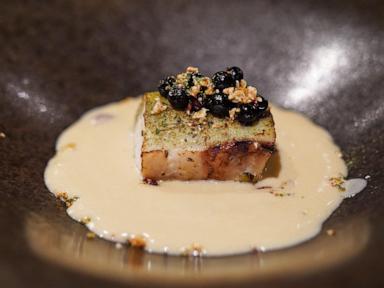
Take muskox, an Ice Age relic with a coat like a wool rug and meat so lean and mineral-rich it tastes like concentrated tundra. Overcook it by thirty seconds and it turns into shoe leather. Treated with reverence—perhaps dry-aged in salt-crusted rooms, seared over birchwood embers, and paired with a sharp reduction of tart crowberries and spruce tips—it rivals any wagyu beef on the planet. Or take mattak, traditionally eaten raw in thick cubes with salt. In a modern tasting menu, it might be sliced paper-thin, cured gently, and draped over warm, smoked halibut, letting the rich marine fat melt slowly on the tongue rather than demanding ten minutes of vigorous chewing from an uninitiated diner.
The Warmth of the Kaffemik
Yet if you strip away the tweezers, the tasting menus, and the dramatic fjord views, you still miss the soul of Greenlandic hospitality. You cannot understand how Greenland eats until you have been invited to a kaffemik.
On paper, a kaffemik sounds simple: an open-house gathering held to celebrate a birthday, a wedding, a child’s first day of school, a confirmation, or simply the return of the sun in January. The host opens their front door, puts out pots of strong black coffee, lays out an absurd spread of homemade cakes, pastries, dried fish, and boiled seal, and waits.
There are no formal invitations, no seating charts, and no lingering for six hours at the same table. Guests arrive in waves. You take off your boots in the entryway—leaving a mountain of Sorels and sealskin kamiks by the door—shake hands, eat a slice of layer cake, drink a cup of coffee, catch up on village news, and then get up to leave so the next wave of neighbors can sit down.
I once watched an entire coastal town cycle through a living room no bigger than a suburban garage over the course of a Sunday afternoon. Grandmothers in beaded national dress sat shoulder-to-shoulder with fishermen in flannel shirts and teenagers checking their phones. Nobody was performing. Nobody was rushing to take a photo for social media. The food wasn't plated for aesthetics; it was piled high on mismatched plates because abundance, in a place where winter can kill you, is the purest expression of love.
This is the secret weapon of Greenland’s fine dining push. In Paris, Tokyo, or New York, luxury restaurants often rely on hushed reverence—white tablecloths, whispered service, an invisible wall between the server and the served. In Greenland, that kind of stiffness feels ridiculous. When a blizzard is rattling the triple-pane windows at sixty knots, pretense freezes to death immediately.
The best dining rooms in Nuuk and Ilulissat feel less like temples of gastronomy and more like elevated kaffemiks. The chef walks out from behind the pass to explain how his uncle shot the reindeer you’re eating three valleys over. The server tells you which fjord the snow crab came from because she grew up swimming in its icy shallows every July. Hospitality isn't a trained service script; it is an instinct born from living in small communities where your survival literally depends on how well you treat your neighbors.
Tourism’s Double-Edged Knife
Still, we have to be honest about what happens when the outside world discovers a quiet revolution.
With new international airports opening in Nuuk and Ilulissat—allowing wide-body jets to fly directly from Europe and North America without transferring through old military bases—Greenland is bracing for a surge in tourism unlike anything in its history. For decades, high barriers to entry kept visitor numbers low and protected the country from the worst excesses of mass travel. Those barriers are coming down fast.
Here lies the real danger. Fine dining requires volume, consistency, and capital to survive. When cruise ships dump thousands of passengers onto small docks for six hours at a time, local restaurants face an overwhelming financial temptation to abandon difficult, seasonal local ingredients in favor of frozen burgers, imported pasta, and generic "Arctic" souvenirs.
At the same time, over-harvesting is a real threat. Greenland’s ecosystem is fragile, governed by strict quotas on whales, seals, muskox, and halibut to ensure Indigenous communities can feed themselves first. A restaurant cannot simply demand double the supply of narwhal skin because a travel magazine put Nuuk on a "Where to Go Next" list. True sustainability in the Arctic isn't a marketing buzzword printed on recycled menu paper; it is a hard biological ceiling.
The chefs leading this movement know they are walking a razor’s edge. They want the world to taste their home, to validate the brilliance of a culinary tradition forged in ice and darkness. Yet they also know that if their food becomes purely a luxury commodity for wealthy foreigners—priced completely out of reach for the hunters and fishermen who supply the kitchen—then the revolution has failed.
The Last Bite Before the Dark
Step back outside that kitchen in Ilulissat at midnight.
The wind has dropped. The silence over the bay is so complete you can hear the icebergs groaning two miles away as the tide shifts beneath them, a low, metallic rumble that vibrates through the soles of your boots. Overhead, a faint green ribbon of the aurora borealis begins to unspool across the black sky, reflection shimmering faintly on the slush-choked water below.
Inside, the last guests have buttoned their parkas and stepped out into the sub-zero air, their cheeks flushed from wild crowberry liqueur and the fierce heat of the dining room. In the kitchen, the young chef wipes down the stainless-steel counter, packs away three leftover portions of cured halibut for tomorrow’s staff meal, and turns off the overhead hood.
Outside, the Arctic remains vast, indifferent, and unforgiving. Inside, on a warm ceramic plate, a culture that spent centuries learning how to survive the dark has finally invited the world to taste the light.