Listen closely to the morning air in any modern suburb, and you will hear a very specific kind of silence. It is not the silence of peace. It is the silence of a stretched rubber band, pulled taut over years of quiet subtraction.
In a hypothetical classroom in the autumn of 2016, a teacher named Elena sets down a cardboard box of outdated textbooks. The binding on page 412 is cracked. The map of Europe still features countries that dissolved a quarter-century before her students were born. She looks out at twenty-eight faces—bright, curious, entirely dependent on this room being a sanctuary of possibility—and she knows there is no budget for replacements. Not this year. Probably not next year either.
This is what happens when public institutions are quietly remodeled by the gospel of the ledger.
For decades, across the nations belonging to the Organisation for Economic Co-operation and Development, a specific economic experiment took root. The premise sounded sophisticated in boardrooms and policy papers. Treat education like an enterprise. Trim the fat. Introduce market efficiencies. Let private capital rescue sluggish public bureaucracies. Cut the spending where it feels soft, and let performance metrics justify the scalpel.
The spreadsheets looked brilliant. The balance sheets balanced. But human systems do not behave like corporate portfolios. When you squeeze a sponge, water comes out. When you squeeze a school system, something infinitely more precious leaks away: trust, equity, and the time to look a struggling child in the eye.
To understand how we arrived at this juncture, we have to look past the macro-level policy briefs and examine the daily texture of decline.
Consider what happens when austerity becomes a permanent administrative climate. It does not arrive with a dramatic crash. It arrives in installments. First, the art teacher splits time between three different campuses, arriving in a blur and leaving before the paint has dried. Then, the school psychologist—the one person who notices when a fourteen-year-old stops speaking—is reduced from a full-time fixture to a once-a-week visitor. Next come the building repairs deferred until winter rain turns a corner of the library into a bucket-and-mop zone.
These are not line items. These are messages. They whisper to children, teachers, and communities about how much their collective future is worth.
Proponents of privatization argued that competition would cure these ills. The theory suggested that if public schools had to fight for students against private alternatives, efficiency would naturally skyrocket. Vouchers would empower parents. Choice would drive excellence.
Instead, a different reality unfolded. Rather than lifting all boats, market-driven reforms frequently drained the harbor. When funding follows the student into private or semi-private models, the traditional public school—the community anchor that must accept every child, regardless of special needs, behavioral challenges, or socioeconomic background—is left with fewer resources to handle increasingly complex demands.
Think of it like a public transit network. If you siphon off the profitable routes for private operators, leaving the public provider to maintain the empty tracks in remote neighborhoods, the system does not become more efficient. It collapses under the weight of its own mandate.
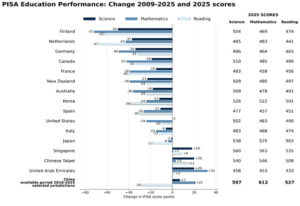
Data compiled across OECD economies over the past twenty years reveals a stark pattern. Systems that prioritized deep spending cuts and decentralized oversight without adequate safety nets saw widening gaps between affluent districts and underfunded enclaves. Achievement gaps widened. Teacher burnout spiked, transforming a respected profession into a revolving door of exhausted novices.
Why did this happen? Because education is not a transactional commodity. You cannot buy an education the way you buy a smartphone. Learning is an intimate, cumulative act of human mentorship. It requires small group sizes so a stuttering reader can find their voice. It requires stable infrastructure so a child’s mind does not have to fight the distraction of a freezing room or a leaking roof.
When we apply corporate metrics to classrooms, we misdiagnose the entire engine of social mobility.
I remember sitting across from a veteran administrator who had spent thirty-four years in public education. He pointed to a stack of compliance reports towering over his desk.
"We spend half our energy proving we are accountable," he told me, rubbing his temples. "And the other half trying to figure out how to teach thirty-two kids algebra in a room built for twenty. The accountants won the argument, but the kids lost the classroom."
That is the hidden cost of the austerity mindset. It mistakes cost-cutting for thrift and accountability for surveillance. It measures what is easy to count—test scores, administrative overhead ratios—while ignoring what truly matters: whether a child leaves school believing their mind has value and their future is unwritten.
The turnaround will not come from another round of optimization metrics or top-down restructuring. It begins with a fundamental re-examination of our values. We have to decide whether public education is a public utility—like clean water and emergency services—or an optional consumer good subject to the whims of market forces.
When a society decides that every child deserves a fully resourced, deeply human learning environment, the math changes. The budget stops being a document of scarcity and becomes a statement of collective ambition.
Elena is still teaching, though she has changed districts twice. In her current classroom, the paint on the walls is fresh, and the textbooks are up to date. But she still keeps a small box of supplies on her own desk, bought with her own money, for the kids who arrive with nothing.
The system has not been entirely fixed. The invisible tug-of-war between the ledger and the classroom continues every single day in city councils and legislative halls across the globe. But every time a community stands up to protect its local school, every time a taxpayer realizes that cheap education is the most expensive thing a society can buy, the rubber band snaps back just a little bit closer to sanity.
The bell rings. The hallway fills with the chaotic, beautiful noise of human potential refusing to be quieted by a spreadsheet.