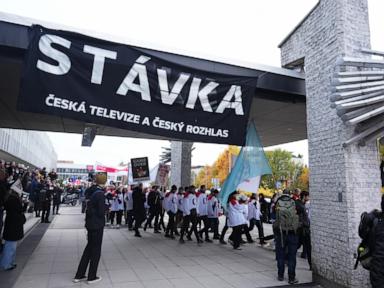
The red light above Studio 1 in Prague’s Kavčí Hory broadcast center usually means one thing. Silence. For decades, that glowing rectangle has signaled to sound engineers, camera operators, and anchors that the outside world must stop at the heavy acoustic doors while the news goes out to millions of Czech households.
Today, the silence inside the hallways feels entirely different. If you found value in this article, you might want to check out: this related article.
It is not the focused quiet of a live broadcast preparing to roll. It is the heavy, uncertain stillness of a newsroom walking out on the job. When Czech public media workers—journalists, technicians, and editors across Czech Television and Czech Radio—decided to strike over a government plan to overhaul their funding, the headlines treated it like a bureaucratic budget dispute. Dry paragraphs listed percentages, parliamentary committee dates, and administrative restructuring proposals.
Numbers make terrible stories. They numb us. Yet behind the sterile language of fiscal reform lies a fight over a single, terrifyingly simple question. Who owns the truth when the government holds the checkbook? For another perspective on this event, refer to the latest coverage from Al Jazeera.
The Anatomy of a Paycheck and a Promise
To understand why a camera operator in Brno or an investigative reporter in Prague would risk their livelihood by stepping away from their post, you have to look at how public broadcasting works when it actually works.
For years, the Czech Republic relied on a license fee model. Every household with a television or a radio paid a modest, direct monthly fee—roughly the price of a couple of cups of coffee—straight to Czech Television and Czech Radio. It was never glamorous. People grumbled about the bill, just as citizens do in the United Kingdom with the BBC or in Germany with ARD and ZDF.
That direct line between the citizen's wallet and the newsroom floor served a specific architectural purpose. Think of it like a firewall in an old apartment building. You do not notice the thick brick wall separating your living room from your neighbor's kitchen until a grease fire breaks out next door. The license fee was that brick wall. Because the money came directly from households rather than the annual state budget, a prime minister angered by an investigative report could not simply pick up a pen in October and slash the newsroom's funding for January.
The government’s overhaul plan proposes tearing down that brick wall and replacing it with a glass door. By abolishing the direct household license fee and folding public media financing directly into the state budget—or tying it to strict government-controlled allocations—ministers argue they are modernizing an outdated system and easing financial pressure on families during tough economic times.
On paper, it sounds almost generous. Who argues against saving households a monthly bill?
Inside the Control Room
Consider a hypothetical scenario that plays out in newsrooms across Central Europe whenever direct funding vanishes. Let us call our producer Marek. He has worked the night desk at a public broadcaster for fifteen years, drinking bitter espresso out of paper cups while vetting municipal corruption tips.
Under the old system, when a leaked document lands on Marek’s desk implicating a sitting cabinet minister in a rigged infrastructure tender, Marek has one question to ask his editor-in-chief. Is the evidence airtight? If the answer is yes, the story runs at seven o'clock. The minister fumes, calls the station's director, and demands an apology. The director points to the charter and the independent fee structure, shrugs, and goes back to work.
Now change the ledger. Imagine that same document lands on Marek’s desk six months after the funding overhaul takes effect. Suddenly, the station's annual budget is a line item negotiated in the very ministry whose leader is named in the leaked file. Nobody needs to send a censor into the control room. No official needs to issue a formal ban. The pressure becomes atmospheric. A quiet word in a corridor about "fiscal responsibility" next quarter. A sudden delay in approving funds for new studio equipment. Slowly, almost imperceptibly, Marek begins to ask a second question before running a story. How much will this cost us in November?
Self-censorship does not arrive with boots and sirens. It arrives wearing a lanyard, carrying a spreadsheet, and asking everyone to be reasonable.
Ghosts of the Velvet Past
If you have ever stood in Wenceslas Square in November, feeling the damp autumn chill seep through your coat while looking up at the facade of the National Museum, you know that Czech history is written in broadcasts.
In 1968, when Warsaw Pact tanks rolled into Prague to crush the Prague Spring, Czechoslovak Radio kept broadcasting even as soldiers surrounded the building on Vinohradská Street. Announcers read the news while gunfire echoed in the stairwells, signing off only when the transmitters were physically cut. Twenty-one years later, during the Velvet Revolution of 1989, the turning point came when television workers defied Communist Party minders and broadcast live footage of student demonstrations, shattering the state's monopoly on reality in a single evening.
Memories like these do not fade easily in a country that spent four decades learning how state-controlled media bends language until words lose their meaning. When Czech journalists walk out on strike today, they are not merely defending collective bargaining agreements or pension contributions. They are reacting to an institutional muscle memory that recognizes the early symptoms of political capture.
We have seen this exact movie play out just across the borders. In Hungary, public media was systematically absorbed into a centralized state apparatus over the last decade, transforming once-independent outlets into mouthpieces that rarely air a critical syllable against the ruling party. In Slovakia, recent legislative overhauls replaced public broadcaster leadership and altered funding mechanisms, sparking mass protests and warnings from European press freedom watchdogs.
The pattern is remarkably consistent. First, politicians question the financial efficiency of the public broadcaster. Second, they propose "streamlining" the funding to protect taxpayers. Third, the financial tether is tied directly to the Ministry of Finance. Within two election cycles, the watchdog has been traded for a lapdog.
The Cost of Noise
Of course, it is easy to romanticize public media from the outside, and pretending the current system is flawless would be dishonest. Czech Television and Czech Radio have faced legitimate criticism over the years. Viewers outside Prague sometimes feel their regional struggles receive less airtime than parliamentary squabbles in the capital. Younger audiences, glued to phones and algorithmic feeds, often ask why they should fund traditional broadcasts they rarely watch. Maintaining vast buildings, orchestras, and regional bureaus costs real money, and public institutions can grow sluggish when shielded from market pressures.
Those doubts are valid. Every taxpayer has the right to ask whether their money buys genuine value or bloated bureaucracy.
Yet look at what fills the vacuum when public media weakens. Private television networks and commercial websites answer to advertisers and billionaires—many of whom own sprawling chemical, agricultural, or energy conglomerates with deep ties to government contracts. In the Czech media landscape, oligarchic ownership of major newspapers is already a documented reality, not a conspiracy theory. When private owners hold political ambitions, editorial lines bend toward corporate survival.
Public media remains the only room in the house where the furniture is not owned by a billionaire or a political party. It is messy, occasionally stubborn, and forever arguing with itself. That friction is the whole point.
When the Signal Drops
A strike in a broadcast studio looks strange to the outside observer. There are no assembly lines grinding to a halt, no heaps of uncollected garbage piling up on street corners, no grounded flights stranding travelers at Václav Havel Airport. Instead, screens flicker to pre-recorded documentaries. Radio frequencies play uninterrupted loops of classical music—Dvořák and Smetana filling the dead air where morning political interviews usually live.
To a casual listener driving to work through the morning fog along the Vltava River, a sudden hour of uninterrupted symphonies might even feel like a pleasant surprise. Peaceful. Quiet.
Listen closer to that silence.
Every democracy relies on an invisible infrastructure of friction—courts that say no to presidents, auditors who question ministries, and reporters who ask uncomfortable questions on live television at prime time. You rarely notice how much weight those pillars carry until the day someone decides they are too expensive to maintain.
Back at Kavčí Hory, the camera operators stand outside in the crisp air, holding hand-painted placards beside their coffee thermoses while the red light above Studio 1 stays dark. Inside, the empty anchor desk sits under cold studio lamps, waiting to see whether the voices that return to the airwaves will still belong to the people watching at home.