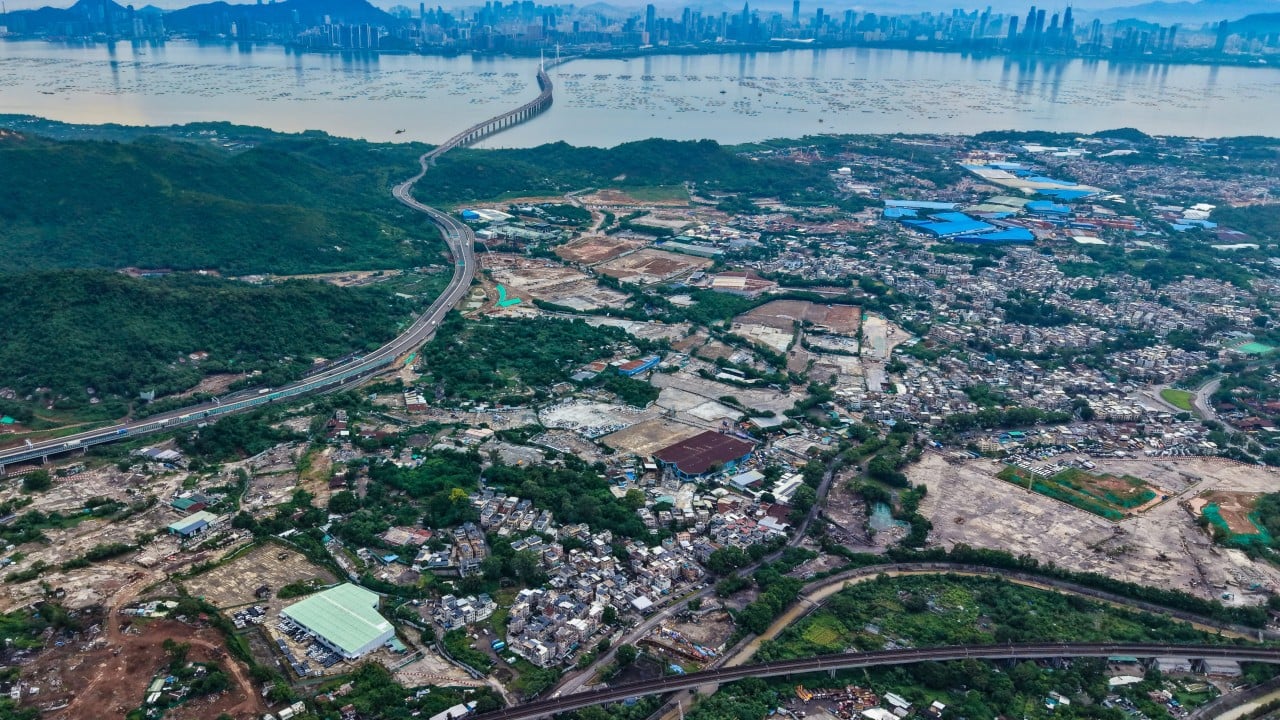
The rain in Lok Ma Chau smells like wet concrete and diesel exhaust, a heavy, metallic scent that clings to your collar before you even step off the train.
Stand near the edge of the Shenzhen River on a Tuesday morning, and you can watch two different versions of the future staring at each other across a narrow strip of muddy water. To the north, glass towers pierce the low-hanging clouds like silver needles, humming with venture capital, drone laboratories, and the relentless kinetic energy of mainland China’s tech engine. To the south, stretching across hectares of fishponds, scrubland, and corrugated-iron warehouses in Hong Kong’s New Territories, sits a quiet expanse of mud.
For decades, this borderland was an afterthought—a buffer zone you sped through on your way to somewhere else. Today, that mud is the site of one of the most audacious academic bets in modern history.
Hong Kong is trying to build university towns from scratch. Not just a stray lecture hall or a satellite annex, but sprawling, self-contained ecosystems of higher education designed to pull the world’s brightest minds onto a contested, rapidly evolving frontier. And according to recent dispatches from the city’s education leadership, overseas institutions are not only paying attention—they are eager to buy in, and oddly willing to lift up the local universities already fighting for oxygen in the harbor below.
It sounds like a press release. On paper, it reads like standard bureaucratic optimism: land allocations, cross-border research synergies, talent pipelines, and international partnerships.
Strip away the policy jargon, however, and you find a high-stakes human drama playing out in lecture halls from Oxford to Kowloon. You find professors wondering if their life’s work will survive demographic collapse, nineteen-year-old students trying to calculate where their degrees will actually hold value in ten years, and Western university presidents quietly weighing prestige against political risk.
The Empty Desk Problem
To understand why foreign universities are suddenly looking at fishponds near the Shenzhen border, you first have to understand what happens when a city runs out of young people.
Walk through the older campuses in Hong Kong—places perched on steep green hillsides overlooking Victoria Harbour—and you will feel a subtle, creeping anxiety beneath the academic bustle. Hong Kong has one of the lowest birth rates on the planet. The math is brutal and unforgiving. Every year, the pool of local eighteen-year-olds shrinks. A university system built for a booming twentieth-century metropolis cannot survive on domestic enrollment alone, no matter how high its global rankings climb.
At the exact same moment, the traditional Western model of higher education is buckling under its own weight.
Consider a hypothetical character—let us call her Dr. Eleanor Vance, a senior administrator at a mid-sized, research-heavy university in the United Kingdom. For twenty years, Eleanor’s institution balanced its books on a simple, reliable formula: charge domestic students capped tuition, then make up the massive financial shortfall by recruiting thousands of full-fee-paying undergraduates from East Asia.
That pipeline is fracturing. Visa restrictions in London, Ottawa, and Canberra have tightened like a vise. Political rhetoric in Washington has turned international research labs into minefields of suspicion. Families in Shanghai, Chengdu, and Kuala Lumpur are looking at the cost of sending a child to Boston or Manchester—often exceeding eighty thousand dollars a year once rent and flights are tallied—and asking a terrifying question.
Is it worth it anymore?
Eleanor sits in a wood-paneled boardroom in England, staring at a spreadsheet bleeding red ink, while three thousand miles away, a Hong Kong policy planner stares at an empty map of the Northern Metropolis.
They need each other. Desperately.
The Anatomy of a University Town
When officials talk about the Northern Metropolis University Town—spanning zones like Hung Shui Kiu, Ngau Tam Mei, and the New Territories North—they are proposing something fundamentally different from the cramped, vertical campuses that define urban Hong Kong.
In central Hong Kong, real estate is measured in square feet and priced in blood. A chemistry lab sits stacked on top of a humanities library, which sits above a subway station. There is no room to breathe, no space for massive robotics testing grounds, and nowhere to house ten thousand graduate researchers without bankrupting them.
The Northern Metropolis changes the geometry entirely. By carving out over eighty hectares of land specifically for post-secondary education, the city is offering something practically extinct in Asia’s financial capitals: space.
Think of a traditional city campus like an espresso shot—concentrated, intense, and over in three sips. A university town is a slow-drip pour-over. It requires dormitories where students argue about philosophy at two in the morning over cheap noodles. It needs wet labs connected directly to manufacturing prototypes across the river in Shenzhen. It demands coffee shops, bookstores, clinics, and parks where a visiting Nobel laureate from Zurich might accidentally bump into a twenty-two-year-old coder from Kowloon.
Overseas institutions see this blueprint and recognize an extraordinary arbitrage opportunity. If a prestigious European or North American university sets up a joint institute or a specialized campus in Hong Kong’s northern belt, it gains immediate physical proximity to the Greater Bay Area—a market of over eighty-six million people and an industrial supply chain that can turn a university blueprint into a physical prototype in forty-eight hours.
Yet they get to do it inside Hong Kong’s distinct legal and academic framework. English remains the primary language of instruction. Common law governs contracts and intellectual property. Academic grants flow through transparent, internationally recognized peer-review mechanisms. For a Western dean looking to expand into Asia without surrendering institutional autonomy, Hong Kong offers a familiar harbor right next to the storm of mainland innovation.
Why Competitors Are Suddenly Helping Each Other
Here is the detail that makes seasoned observers raise an eyebrow: the willingness of incoming overseas giants to collaborate with—and actively assist—Hong Kong’s local institutions.
In the cutthroat world of global higher education, universities rarely act out of charity. They poach each other’s star faculty. They hoard endowment money. They obsess over moving up two spots in the annual QS World University Rankings like hedge fund managers watching a ticker tape.
So why would a top-tier foreign university walk into Hong Kong and offer to share labs, co-supervise doctoral candidates, and help elevate local peers?
Survival. And leverage.
Imagine you are an overseas university president landing at Chek Lap Kok airport. You have world-class theoretical researchers in astrophysics or biomedical engineering, and a brand name that opens doors globally. What you do not have is local fluency. You do not know how to navigate Hong Kong’s Town Planning Board, how to recruit top talent from secondary schools across Southeast Asia, or how to bridge the subtle cultural chasms between Western grant-writing and regional industrial needs.
Hong Kong’s local universities—institutions like the University of Hong Kong, the Chinese University of Hong Kong, and the Hong Kong University of Science and Technology—already punch wildly above their weight class. Five of the city’s publicly funded universities routinely sit inside the global top one hundred. They possess deep regional roots, established alumni networks across the Belt and Road economies, and battle-tested administrative teams.
When an overseas institution teams up with a local peer, it isn't an act of altruism. It is a mutual defense pact.
Let us return to our hypothetical British administrator, Dr. Vance, and pair her with a fictional counterpart in Hong Kong—Professor Kenji Chan, head of a materials science department in Sha Tin. Kenji has brilliant doctoral students and state-of-the-art equipment, but his department struggles to attract postdocs from Europe and North America who hesitate to relocate to Asia without a familiar institutional anchor. Eleanor has the European academic pipeline and the historic brand, but she lacks the funding and physical lab space to scale her university’s clean-energy research.
Together, inside a shared facility in the Northern Metropolis, they solve each other’s fatal flaws. Eleanor’s postdocs arrive in Hong Kong under a joint fellowship that carries her university’s crest on their CV. Kenji’s local students gain seamless access to European research networks and dual-degree credentials. When they apply for massive international climate grants, their combined roster makes them virtually impossible to reject.
Nobody loses face. Everybody gets funded.
The Invisible Stakes
I remember walking through an older industrial district in Kwun Tong a few years ago, watching an old printing press get dismantled piece by piece to make way for a co-working space. The foreman stood by the freight elevator, smoking a cigarette, watching thirty years of mechanical muscle get hauled away in a rusted van. He wasn't angry. He just looked hollowed out, acutely aware that the city had moved on to a currency he didn't know how to spend.
Cities survive by constantly shedding their skin, and the process is never painless.
For forty years, Hong Kong’s lifeblood was frictionless finance and logistics—moving containers from ships to trucks, and moving capital from London to Shanghai. That era hasn't vanished, but its monopoly on the city’s future is gone. The global economy is fracturing into regional blocs. Supply chains are shortening. Capital is scrutinized by national security committees before it ever crosses a border.
In a fragmented world, ideas are the last contraband that still slips easily through customs.
By betting its northern border on university towns, Hong Kong is attempting to pivot from a financial warehouse into an intellectual refinery. The government has already raised the non-local student quota at publicly funded universities from twenty percent to forty percent. It is pouring billions into research clusters focusing on artificial intelligence, life sciences, and microelectronics.
If it works, the city secures a relevance that no tariff or geopolitical sanction can easily erase. You cannot sanction a generation of scientists who trained together in the same labs, published papers together, and built companies together. Those human networks outlast political cycles.
The Doubts Nobody Says Out Loud
Still, standing on that muddy riverbank in Lok Ma Chau, it is impossible to ignore the risks. To pretend this transition is guaranteed would be dishonest.
Building a university town is not like building a shopping mall. You can pour concrete in eighteen months, hang luxury brand logos on the facade, and open the doors to tourists on a Friday morning. Academic culture takes decades to ferment. You cannot mandate serendipity by zoning law.
There are real, lingering questions that keep university trustees awake at night.
First, there is the question of academic freedom and perception. Even when Hong Kong’s laws explicitly protect institutional autonomy and research integrity, perception in Western faculty lounges moves slowly—and often unfairly. Convincing a tenured professor in Boston or Berlin to uproot their family and move to the New Territories requires more than a generous housing allowance. It requires trust that the rules of engagement will remain stable ten years from now.
Second, there is the sheer logistics of infrastructure. Right now, much of the Northern Metropolis exists primarily in architectural renderings and land-resumption notices. Roads have to be paved. Rail links like the Northern Link have to be tunneled through granite. Dormitories, international schools for faculty children, and hospitals have to rise out of former farmland simultaneously. If the universities arrive before the neighborhoods do, professors will find themselves commuting ninety minutes each way from Kowloon, turning a visionary academic community into a sterile commuter campus.
Finally, there is the brutal competition from regional neighbors. Singapore has spent two decades courting foreign universities with aggressive subsidies and clinical efficiency. Shenzhen, right across that narrow river, is building its own massive university complexes at a speed that makes Hong Kong’s public consultation process look glacial.
The Bridge Over the Mud
Yet, history suggests you should never bet against Hong Kong’s capacity for reinvention when its back is against the wall.
This is a city built on a barren rock with no natural resources, no freshwater rivers of its own, and no arable land to speak of. Every single era of its prosperity was improvised out of necessity. When the 1951 trade embargo choked off its entrepôt economy, refugees turned tenements into textile factories overnight. When manufacturing moved north in the 1980s, the city reinvented itself as Asia’s premier financial clearinghouse in less than a decade.
Now, the raw material is human curiosity.
Picture that same riverbank in Lok Ma Chau ten years from today. The diesel smell of the border trucks has been replaced by the hum of electric shuttles gliding between research institutes. Inside a glass-walled atrium overlooking restored wetlands, a twenty-year-old undergraduate from Jakarta is debugging a neural network alongside a visiting lecturer from Zurich and a doctoral fellow who grew up ten minutes away in Yuen Long.
They aren't thinking about land-resumption budgets, non-local enrollment quotas, or geopolitical headwinds. They are arguing over why the algorithm failed on the third test run, scribbling equations on a whiteboard smeared with black marker, completely unaware that they are standing on ground that used to be nothing at all.