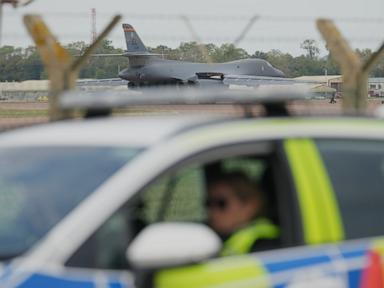
Rain falls differently on a British tarmac at four in the morning. It doesn't wash things clean; it just makes the concrete look like wet slate and turns the sodium vapor lights into bruised, blurry halos.
Imagine, for a second, standing behind the reinforced glass of an observation room at a joint military installation in the English countryside. This is a hypothetical vantage point, of course, built from years of watching how intelligence failures actually unfold in the real world rather than how they are scripted in thriller novels. In the movies, traitors wear trench coats and pass microfilms under park benches. In reality, they wear pressed uniforms, carry high-level security clearances, and complain about the coffee in the mess hall just like everyone else.
When word broke that UK counter-terrorism police had arrested a senior US soldier on suspicion of offenses under the National Security Act—specifically involving alleged links to Russia—the headlines landed with the dull, predictable thud of modern geopolitics. Another arrest. Another allegation of espionage. Another brief flash of outrage before the news cycle moved on to the next crisis.
Stop.
Read that headline again, and strip away the bureaucratic anesthetic. A senior American service member, stationed on British soil under the umbrella of the oldest and most intimate intelligence-sharing alliance in the modern world, was taken into custody by London’s specialized counter-terrorism command because investigators suspected he was working for Moscow.
That is not just a news item. That is a tremor beneath the foundation of Western defense.
The Architecture of Assumed Trust
To understand why an arrest like this sends cold chills down the spines of defense officials in both Washington and London, you have to understand the invisible currency that keeps NATO functioning. It isn't hardware. It isn't budgets. It is assumed trust.
Think of the US-UK defense relationship like a shared nervous system. For decades, American troops stationed at bases like RAF Lakenheath, RAF Mildenhall, or Croughton haven't been treated as foreign guests; they have been woven directly into the local security fabric. They share comms, they share threat assessments, and they share the quiet, unspoken certainty that the person sitting across the briefing table is fighting on the same side.
When you spend enough time around military intelligence, you learn that security clearances are essentially institutionalized faith. A background check can tell you if a twenty-two-year-old recruit has unpaid parking tickets or a secret gambling habit. It cannot tell you what happens to that same person twenty years later when rank brings isolation, when personal grievances fester in the dark, or when a foreign intelligence service figures out exactly which emotional lever to pull.
By the time a soldier reaches senior rank, the perimeter fences aren't designed to keep them out. They are the perimeter.
Consider the mechanics of how modern espionage actually works. We still cling to the Cold War mythology of ideological converts—men like Kim Philby or Aldrich Ames, driven by grand political delusions or staggering sums of cash. Today, the recruitment playbook is far quieter, infinitely more patient, and brutally psychological. Intelligence officers operating out of Russian agencies—whether the
They start by listening.
The Anatomy of a Slow Compromise
Let’s trace a hypothetical scenario—a composite drawn from documented counter-intelligence cases over the past decade—to see how a senior service member ends up in the back of a Metropolitan Police van.
Picture a career soldier approaching the twilight of his service. He has spent two decades moving from base to base, missing birthdays, watching younger officers get promoted past him, and feeling the slow, creeping irrelevance that haunts people who have given their entire adult lives to a massive institution. He isn't a villain. He is tired, maybe quietly bitter, and deeply convinced that his expertise goes unrecognized.
Enter a conversation. Maybe it happens online, in a niche military history forum or an encrypted messaging channel where veterans vent about defense policy. Maybe it happens at a conference in a European capital, over a late drink at a hotel bar. The person asking questions doesn't have a thick accent or a sinister demeanor. They are flattering. They treat the soldier like an equal, a strategist whose insights actually matter.
First, they ask for unclassified opinions. What do you think of the current readiness posture in Eastern Europe? Easy enough. Every senior NCO or officer has an opinion.
Next, there is a small consulting fee for a "private geopolitical risk firm." A few hundred pounds. Nothing that triggers a bank alarm, just enough to fix a transmission or pay off a credit card bill.
Then comes the subtle shift. The questions get sharper. We’re trying to verify troop rotation schedules out of the UK for an insurance client—does this timeline look accurate to you? Now, the soldier isn't offering opinions; he is confirming operational details. And the moment he crosses that line, the trap shuts. He can't report the contact without admitting he already took money and shared restricted information. The foreign handler doesn't even need to threaten him; the soldier’s own fear of losing his pension, his rank, and his freedom does all the heavy lifting.
This is the reality behind cases prosecuted under Britain’s updated
Why London Made the Arrest
One detail in the official reports stood out to anyone paying close attention: the arrest was carried out by UK counter-terrorism police, specifically the Metropolitan Police’s Counter Terrorism Command, known as SO15.
Why British police, and not solely American military investigators?
Jurisdiction on foreign bases is a delicate, fiercely negotiated dance governed by the
When British counter-terrorism officers step in to execute an arrest under the National Security Act, it signals something specific: the alleged threat wasn't confined to internal American discipline. It touched British national security directly.
Think about what a senior US soldier stationed in the UK actually sees. They aren't just looking at American assets. They have visibility into British airspace coordination, joint naval tracking in the North Atlantic, and the logistical pipelines feeding equipment into continental Europe—including support networks for Ukraine.
If Moscow gains a set of eyes inside a UK-based American command, they aren't just peeking at Pentagon files. They are looking straight into the nerve center of European defense. Every radar gap, every transport bottleneck, every vulnerability in critical undersea cable protection becomes visible to an adversary actively probing NATO’s edges.
And for the British intelligence community—
The Invisible Casualties
I have sat across from counter-intelligence investigators after a breach has been contained, and the mood in the room is never triumphant. There are no high-fives. There is mostly a heavy, suffocating exhaustion.
Why? Because catching a suspected spy doesn't fix the damage; it only begins the agonizing process of measuring it.
Imagine being the commander of that unit the morning after the arrest. You have to walk into a briefing room full of men and women who trusted the person now sitting in a London police cell. You have to look at every operation planned over the last two years, every secure communication line used, every allied partner who shared sensitive data with your team, and ask a terrifying question: How much of this does Moscow already know?
That is the real cost of espionage. It isn't just the stolen secrets. It is the poison injected into the bloodstream of an alliance.
Suddenly, British liaison officers hesitate before sending an unredacted intelligence brief to their American counterparts. Commanders double-check who is on the distribution list for routine movement orders. People start looking sideways at colleagues they have known for years, wondering who else might be carrying a secret debt, a hidden resentment, or a second phone.
Russia’s intelligence services understand this dynamic intimately. Even when an operation is blown—even when their alleged asset ends up in handcuffs—they still extract a strategic dividend from the paranoia left behind. In a partnership built entirely on seamless cooperation, friction is a victory for the adversary.
The Shifting Battlefield
We tend to think of war in terms of geography—trenches in the Donbas, naval patrols in the Black Sea, fighter jets scrambling over the Baltic. We draw lines on maps and measure front lines in kilometers.
That map is obsolete.
The real front line runs straight through quiet English market towns, nondescript office buildings in suburban Maryland, and the encrypted digital spaces in between. It is fought not with artillery, but with patience, psychological leverage, and the quiet exploitation of human frailty.
When a senior US soldier is led out of a facility by British counter-terrorism officers, it forces us to confront an uncomfortable truth we would rather ignore. Billions of dollars in stealth technology, satellite surveillance, and cyber defenses can all be neutralized by a single compromised human being with a valid badge and a reason to look the other way.
The investigation will grind forward behind closed doors. Lawyers will argue over extradition, diplomatic immunity, and the classification of evidence. Eventually, a heavily redacted summary will make its way into a courtroom, scrubbed of the details that matter most.
Out on the tarmac, the rain will keep falling, washing over the painted lines that separate one nation's territory from another—lines that look solid from the air, yet vanish completely the moment you step across them in the dark.