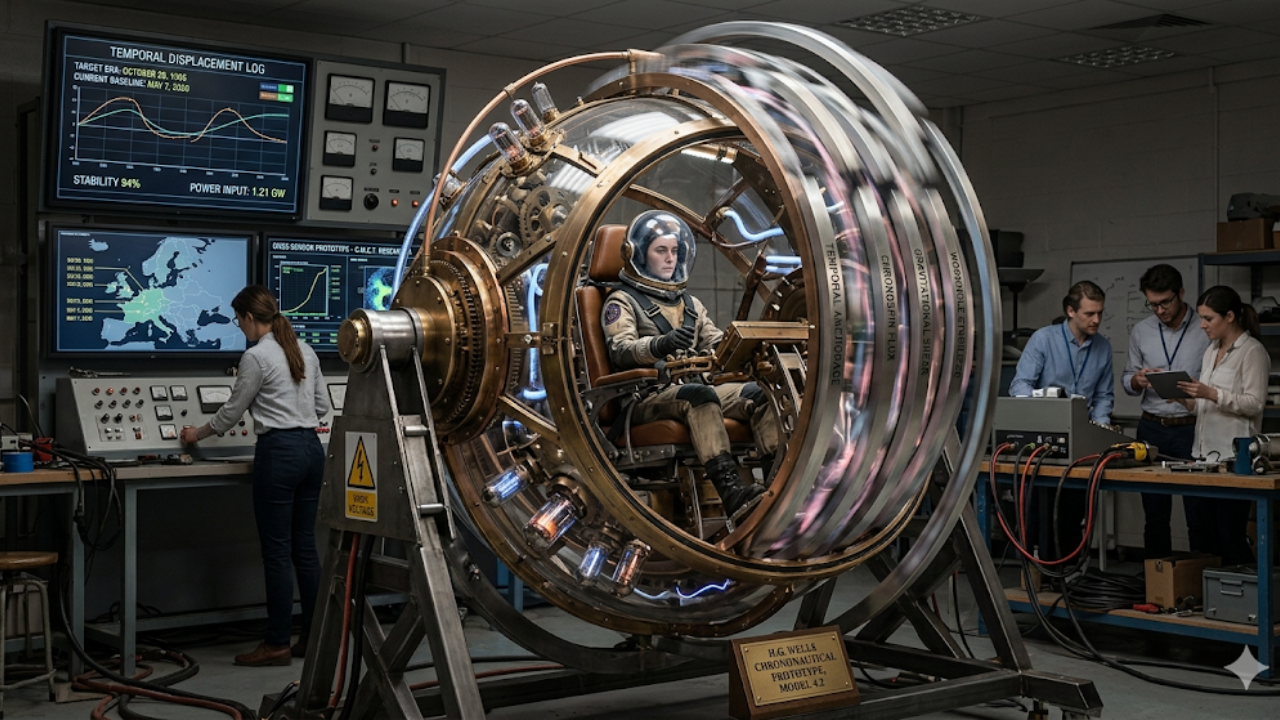
The physical impossibility of sending information into the past is not merely a limitation of engineering but a fundamental constraint of the No-Communication Theorem in quantum mechanics. While popular discourse often conflates "quantum entanglement" with "faster-than-light communication," the actual mechanism involves a rigid barrier: the requirement for a classical sub-channel. Recent explorations into quantum temporal dynamics focus on whether non-linear evolution or specific entanglement topologies could bypass this barrier, effectively allowing a "message" to influence its own history.
This analysis deconstructs the mechanics of retrocausal proposals, identifies the structural bottlenecks in temporal information transfer, and quantifies the probability of success in closed timelike curves (CTCs).
The Structural Mechanics of Quantum Entanglement
To understand the constraints of temporal messaging, one must first isolate the variables of entanglement. When two particles are entangled, their states are linked such that measuring one determines the state of the other, regardless of distance. However, the outcome of the first measurement is inherently probabilistic.
- The Entropy Constraint: Because the sender cannot force a specific outcome on their local measurement, they cannot encode a specific bit (0 or 1) into the distant particle.
- The Measurement Problem: The receiver sees a random distribution of states until they receive a classical message—limited by the speed of light—explaining the measurement basis used.
Retrocausal signaling attempts to exploit this by suggesting that if the measurement in the future can be linked to a state in the past, the "random" outcome might be influenced by a future decision. This requires a violation of the Standard Quantum Formalism, specifically the assumption that state vectors evolve only forward in time.
The Closed Timelike Curve (CTC) Framework
General relativity allows for the theoretical existence of Closed Timelike Curves—paths through spacetime that return to their starting point. In a quantum context, CTCs introduce a logic gate where the output of a computation is fed back as the input.
The Deutsch Logic Model
Physicist David Deutsch proposed a self-consistency condition for quantum particles entering a CTC. In this model, the particle must exist in a state that is a "fixed point" of the transformation it undergoes.
- Self-Consistency Requirement: $ \rho_{f} = \text{Tr}{2} [ U (\rho{f} \otimes \rho_{in}) U^{\dagger} ] $
- Operational Result: The system forces a state that avoids logical paradoxes (like the Grandfather Paradox).
- The Information Bottleneck: While this allows for "computational" advantages—such as solving NP-complete problems in polynomial time—it does not allow for the transmission of arbitrary, high-entropy data. The universe essentially "filters" the message to ensure it is logically compatible with the already-occurred past.
The Post-Selection Alternative
An alternative to the Deutsch model is the P-CTC (Post-selected Closed Timelike Curve). This framework uses quantum teleportation and post-selection to simulate a return to the past. In a P-CTC, only the measurement outcomes that are consistent with the desired past state are kept.
The probability of success in a P-CTC scales inversely with the complexity of the message. If a sender attempts to send a complex instruction (a large string of bits) to the past, the post-selection "success" rate approaches zero, effectively neutralizing the signal through sheer statistical improbability.
Three Pillars of Temporal Signaling Failure
The failure of back-in-time messaging is not due to a single flaw but a convergence of three distinct physical pillars.
1. Linearity of the Schrödinger Equation
Quantum mechanics is linear. Linearity ensures that the evolution of a state is predictable and forward-moving. For retrocausality to function, the evolution would need to be non-linear, allowing for feedback loops. Every experiment conducted to date confirms the linearity of quantum mechanics to within a fraction of $ 10^{-20} $. Any "signal" from the future would represent a non-linear perturbation that has never been observed in a laboratory setting.
2. The Decoherence Barrier
Quantum states are fragile. For a message to travel "backwards" via entanglement or CTCs, the system must remain coherent—isolated from the environment.
- Interaction Decay: As soon as a quantum system interacts with a single photon or molecule, the entanglement "leaks" into the environment.
- Macro-Scale impossibility: To send a human-readable message, you would need trillions of entangled qubits. Maintaining the coherence of such a system across even a nanosecond of temporal displacement requires a vacuum and temperature control far beyond current Type I civilization capabilities.
3. The Consistency Constraint (Novikov Principle)
Even if the quantum mechanics allowed for a signal, the Novikov Self-Consistency Principle dictates that the probability of any event that creates a paradox is zero. In a strategic sense, this means any "message" sent back to change the past would already be a part of the history that led to the message being sent. The information is not "changing" the past; it is a fixed variable in a static four-dimensional block universe.
Quantifying the "Information Gain" from the Future
If we assume for a moment that a P-CTC could be stabilized, we must evaluate the utility of the information. In standard computation, a bit of information reduces uncertainty by half. In a quantum retrocausal system, the information gain is restricted by the Holevo Bound.
The Holevo Bound states that $ n $ qubits can carry no more than $ n $ bits of classical information. Because the "past" version of the receiver has no way to know which qubits are part of a future signal without a classical key, the effective bit-rate of a retrocausal channel remains zero until the moment the future actually happens.
This creates a Causality Loophole: The information is only "received" at the same moment it could have been sent via light-speed communication anyway. The "temporal" aspect becomes a mathematical redundancy rather than a functional advantage.
The Cost Function of Retrocausal Experimentation
The energy requirements for creating a localized region of spacetime curvature sufficient to test these theories are astronomical.
- Negative Energy Density: Creating a CTC requires "Exotic Matter" with negative energy density to stabilize a wormhole or a Tipler Cylinder.
- Planck Scale Requirements: To manipulate quantum states at a level where temporal displacement is measurable, one must probe scales near the Planck length ($ 1.6 \times 10^{-35} $ meters).
- Computational Overhead: Simulating a 50-qubit P-CTC requires more classical memory than currently exists in the world's most advanced data centers.
The "cost" of sending a single bit of information into the past—assuming it were possible—would exceed the total energy output of a G-type star over its entire lifespan. This suggests that even if the physics allowed it, the thermodynamics would forbid it.
Logical Mismatch in the "Backwards" Narrative
Most analyses fail to distinguish between correlation and signaling. In the "Quantum Eraser" experiment, a measurement made today seems to determine whether a particle behaved as a wave or a particle yesterday.
The structural reality is different:
- The data from "yesterday" is a scrambled mess of points.
- The measurement from "today" provides the key to sort that mess into two distinct patterns (wave and particle).
- Without the key from "today," the data from "yesterday" is useless noise.
The "signal" didn't go back in time; the interpretation of the data was simply delayed until the necessary information was available. This is a crucial distinction that negates the "messaging" potential of the experiment.
Strategic Outlook for Quantum Information Systems
The pursuit of back-in-time messaging is a dead-end for communication technology, but it serves as a high-stress testing ground for Quantum Error Correction (QEC) and Unitary Evolution.
Current R&D should pivot away from "temporal signaling" and toward Retrocausal Modeling for Predictive Analytics. By using the mathematical frameworks of P-CTCs, engineers can develop algorithms that "post-select" for successful outcomes in complex simulations, effectively "simulating" a successful future to find the necessary starting conditions in the present. This is not time travel; it is a sophisticated form of Bayesian inference accelerated by quantum logic.
The bottleneck of the next decade will not be "traveling to the past," but managing the massive decoherence that prevents us from maintaining a single, stable quantum state for more than a few seconds. Strategic investment must prioritize high-fidelity qubit gate operations and thermal isolation. The "past" is inaccessible because it is a state of lower entropy that has already been integrated into the current high-entropy environment; to reverse a message is to reverse the Second Law of Thermodynamics, a feat that requires more than just quantum entanglement. It requires a total restructuring of the cosmic causal chain.
Focus on developing Quantum Key Distribution (QKD) networks that are immune to future decryption through "temporal" logic. This ensures that even if a future adversary develops a Deutsch-model computer, the information remains structurally inaccessible due to the fundamental randomness of the initial state preparation.