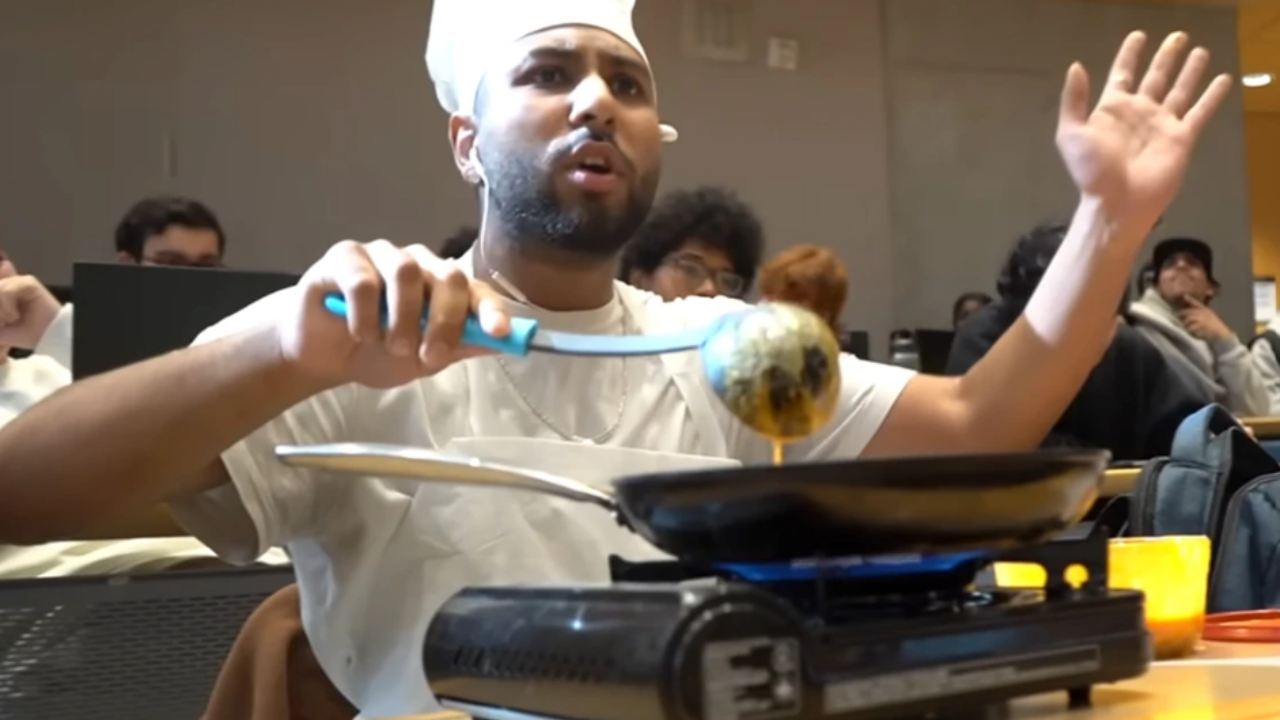
The scent of turmeric and cumin is supposed to evoke comfort. It belongs in a warm kitchen, shared among friends at the end of a grueling week of midterm exams. It does not belong dripping from the ceiling of a university library, soaking through the pages of a textbook, or burning the eyes of a terrified student who was just trying to pass corporate finance.
But in the attention economy, nothing is sacred. Not even lunch.
We have crossed an invisible line in our digital culture, shifting from the era of the harmless candid-camera gag to a hyper-aggressive form of content creation that treats unsuspecting bystanders as disposable props. When an internet personality decides that a crowded campus building is their personal soundstage, the real world pays the bill. This is the story of what happens when the thirst for views collides with the boundaries of a civilized society, and why a university in Ontario finally decided to push back with the full weight of the law.
The Micro-Second Decoupling of Empathy
Consider the anatomy of a modern internet prank.
A creator walks into a public space. They are wired for sound. They have a hidden camera operator tracking their movements from twenty feet away, framing the shot, adjusting the exposure. To the creator, the environment is entirely abstract. The students sitting at the desks aren't people with histories, anxieties, or deadlines. They are background extras. They are potential thumbnails.
Then comes the flash of action. In this case, a bucket of curry, lifted and thrown.
In that singular moment, a profound psychological decoupling occurs. To the person holding the bucket, the liquid is just a visual effect. It is a catalyst for a reaction that will translate into algorithmic engagement, likes, shares, and ad revenue. But to the person sitting at the desk, the reality is entirely different.
Imagine sitting in a quiet zone, your mind entirely consumed by the stress of an upcoming exam. Suddenly, an unknown individual rushes at you and douses you in a thick, staining, hot substance. For a terrifying split second, your brain does not register "prank." It registers an assault. It registers a threat. The adrenaline spikes. The fight-or-flight response kicks in with brutal efficiency.
The physical aftermath is messy enough. Clothes are ruined, laptops are potentially destroyed, and the communal space is rendered unusable. But the psychological stain lingers much longer than the smell of spices in the carpet. It is the sudden, violent erasure of public safety. It is the realization that you can be targeted for humiliation at any moment, simply because you happened to be sitting in the wrong chair when someone needed to feed the algorithm.
The Institutional Breaking Point
For years, universities and public institutions have treated rowdy internet creators with a sort of exhausted tolerance. Administrators would issue stern warnings. Campus security would escort the offenders off the property. Perhaps a trespassing notice would be filed away in a drawer.
It didn't work. In fact, getting kicked out by security often became the climax of the video, a badge of honor to prove how "edgy" the content was.
But Ontario Tech University drew a line in the sand. By launching a formal lawsuit against the YouTuber alleged to be behind the stunt, the institution shifted the battlefield from the comments section to the courtroom. This isn't just about a broken code of conduct; it is an assertion of property rights, civil liability, and the duty of care an educational institution owes to its student body.
When a university sues a creator, the financial math of the influencer lifestyle changes instantly.
A video might generate a few thousand dollars in sponsorship money or platform payouts. But a civil lawsuit carries the weight of thousands of dollars in restoration costs, legal fees, and potential punitive damages. The university's legal strategy sends a clear, chilling message to anyone with a smartphone and a bad idea: you cannot externalize the cost of your production onto our community. If you break our peace to build your brand, we will dismantle that brand dollar by dollar.
The Illusion of the Victimless Gag
The defenders of these stunts always rely on a predictable defense mechanism. They claim the audience is too sensitive. They tell the victims to take a joke. They argue that because no bones were broken, no real harm was done.
This argument is hollow. It ignores the hidden infrastructure of a student's life.
Many of the individuals attending commuter campuses or balancing heavy course loads are working part-time jobs to survive. A ruined laptop isn't just an inconvenience; it is a catastrophic financial setback that can derail an entire semester. A stained winter coat represents hours of minimum-wage labor to replace. The creators who perpetrate these acts rarely stop to consider the economic precarity of the people they choose to victimize. They operate from a position of immense privilege, assuming that their eventual apology video or a casual offer of cash will wipe the slate clean.
It doesn't. The trauma of public humiliation doesn't vanish when the camera stops rolling. The victims do not get a share of the ad revenue. They are left to clean the curry out of their hair while the creator edits the footage in a comfortable apartment, waiting for the view count to climb.
The Algorithm is an Insatiable Beast
To understand how we reached this point, we have to look at the systems that incentivize this behavior.
Platforms do not reward nuance. They do not reward quiet contemplation or respectful boundaries. The digital economy runs on shock. It demands escalation. What shocked an audience last year is considered boring today. A creator who started their career doing harmless word-play gags eventually finds themselves trapped on a treadmill of escalating extremity. They must go further, get louder, and become more disruptive just to maintain their baseline viewership.
This escalation path has a logical, dangerous conclusion. We have seen creators stage fake robberies, simulate terror threats, and place bystanders in genuine physical peril, all for the sake of retention metrics. The curry throwing at Ontario Tech is not an isolated incident of poor judgment. It is the predictable symptom of a systemic disease.
When we watch these videos, even out of morbid curiosity or disgust, we are feeding the beast. We are validating the metric that tells the creator the risk was worth it.
The legal action taken in Ontario is a necessary counterweight to this systemic pressure. It creates a real-world friction that the digital world lacks. It forces a pause. It compels the creator to look past the screen and confront the reality of a judge, a witness stand, and a judgment debt that cannot be deleted with a click.
The library at Ontario Tech University will eventually smell normal again. The carpets will be scrubbed, the desks wiped down, and the students will return to their books. But the cultural conversation sparked by a flying bucket of food is far from over.
We are finally forcing a reckoning with the digital voyeurism that treats human dignity as cheap content. The next time a creator weighs the potential views of a public disruption against the cost of a lawsuit, they might just decide to leave the bucket behind. The applause of a million strangers feels incredibly distant when you are sitting alone in a courtroom, listening to the itemized bill of the damage you left in your wake.