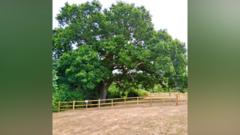
The physical survival of a centenarian canopy asset depends on strict adherence to environmental mechanics rather than sentimental conservation. When urban development or infrastructural encroachment threatens a mature specimen, standard protective reactions typically default to superficial cordons. True structural preservation demands a granular understanding of root architecture, soil physics, and physiological stress limits.
The mechanics of failure in specimen trees rarely stem from direct structural timber collapse. Instead, decline originates beneath the ground surface through two primary mechanisms: mechanical root severing and macro-aggregate soil compaction. Preserving a legacy specimen requires an engineering mindset focused on load distribution, hydraulic integrity, and biochemical stability.
The Biomechanical Boundary Mechanics
The root system of a mature oak operates as a decentralized hydraulic and structural anchor. Unlike the vertical taproots of juvenile specimens, mature trees rely on a horizontal plate of structural roots radiating outward within the top twelve to thirty-six inches of soil. This horizontal matrix dictates the dimensions of the Critical Root Zone.
Standard protective fencing frequently fails because planners conflate the visible canopy perimeter with the actual root zone. The biological boundary extends well beyond the outermost foliage.
- The Structural Root Plate: The immediate zone surrounding the trunk responsible for physical stabilization. Any mechanical excavation within this perimeter destabilizes the center of gravity and severs primary load-bearing roots.
- The Absorptive Matrix: The broader network of fine feeder roots responsible for water and nutrient acquisition, typically concentrated within and beyond the dripline. Compaction in this zone halts gas exchange.
When heavy machinery operates over unmanaged soil, wheel loads transmit compressive forces downward. This destroys soil macropores, the air-filled channels essential for root respiration. Without macropores, oxygen levels drop below the threshold required for root cell division and ion uptake.
Intervention Protocols for Sub-Surface Mitigation
Mitigating construction or environmental impact demands active engineering controls rather than passive restrictions. Standard trenching destroys root tips and introduces pathogen vectors.
Hydraulic Excavation and Air-Spading
When utility installation or grade adjustments must occur near a protected specimen, conventional backhoes are unacceptable. High-velocity pneumatic excavation tools, such as air-spades, utilize compressed air to displace soil without cutting structural roots. This exposes the root architecture intact, allowing arborists to cleanly sever minor roots with sterilized hand tools or route utilities underneath the root plate via directional boring.
Load Distribution Surfaces
Heavy equipment transit introduces localized pressure spikes that compact soil horizons permanently. To prevent structural failure of the soil matrix, site operators must install engineered bridging systems.
- Geotextile Interfaces: High-tensile woven geotextile fabrics placed directly on the soil grade distribute point loads horizontally.
- Aggregate Cushions: A minimum six-inch layer of coarse, organic wood mulch or crushed rock layered over timber mats absorbs and disperses heavy equipment weight.
- Rigid Matting: Temporary interlocking composite or heavy timber mats prevent track-slip shear forces from tearing surface feeder roots.
Pathological Vulnerabilities and Environmental Stressors
A stressed tree exhibits altered biochemical signaling that attracts secondary pests and fungal pathogens. Mechanical damage to the cambium layer creates an open wound, removing the tree's primary defense against wood-boring insects and decay fungi.
The Mechanics of Oak Wilt and Root Rot
Species within the red oak family face acute susceptibility to vascular pathogens like Ceratocystis fagacearum (Oak Wilt). Spores transmit via sap-feeding beetles drawn to fresh pruning wounds or mechanical bark abrasions.
- Timing Constraints: Pruning or structural modification must occur exclusively during dormant windows when vector insect populations are inactive.
- Wound Sealing Physics: Traditional bituminous wound paints often trap moisture and fungal spores against the cambium. Modern protocols dictate clean cuts flush to the branch collar without chemical sealants, relying on the tree's natural compartmentalization of decay in trees (CODIT) process.
Hydrological Shock Management
Altering surface grade changes water runoff patterns. Adding soil layers as shallow as three inches over the root zone smothers fine feeder roots by cutting off oxygen exchange. Conversely, removing soil strips away organic horizons and exposes roots to rapid desiccation.
Supplemental irrigation must follow a strict volumetric schedule. Frequent, shallow watering encourages superficial root development, leaving the tree vulnerable to drought. Deep, infrequent saturation cycles force roots to follow receding moisture profiles downward, stabilizing the anchor system.
Resource Allocation and Long-Term Viability
Protecting an irreplaceable botanical asset requires continuous quantitative monitoring rather than a singular defensive event. Arborists utilize resistographs and sonic tomography to map internal decay without invasive drilling, calculating residual wall thickness to determine mechanical safety factors.
When urban density increases around a landmark specimen, the urban heat island effect and altered wind tunnels impose abnormal mechanical drag coefficients. Cable bracing systems and dynamic support lines redistribute wind load across multiple scaffold branches, reducing peak torque at primary branch unions.
Implement continuous soil oxygen sensors within the root protection zone to detect compaction-induced hypoxia before canopy chlorosis or twig dieback manifests. Pair these sensors with automated sub-surface radial aeration treatments to maintain macropore gas exchange permanently.