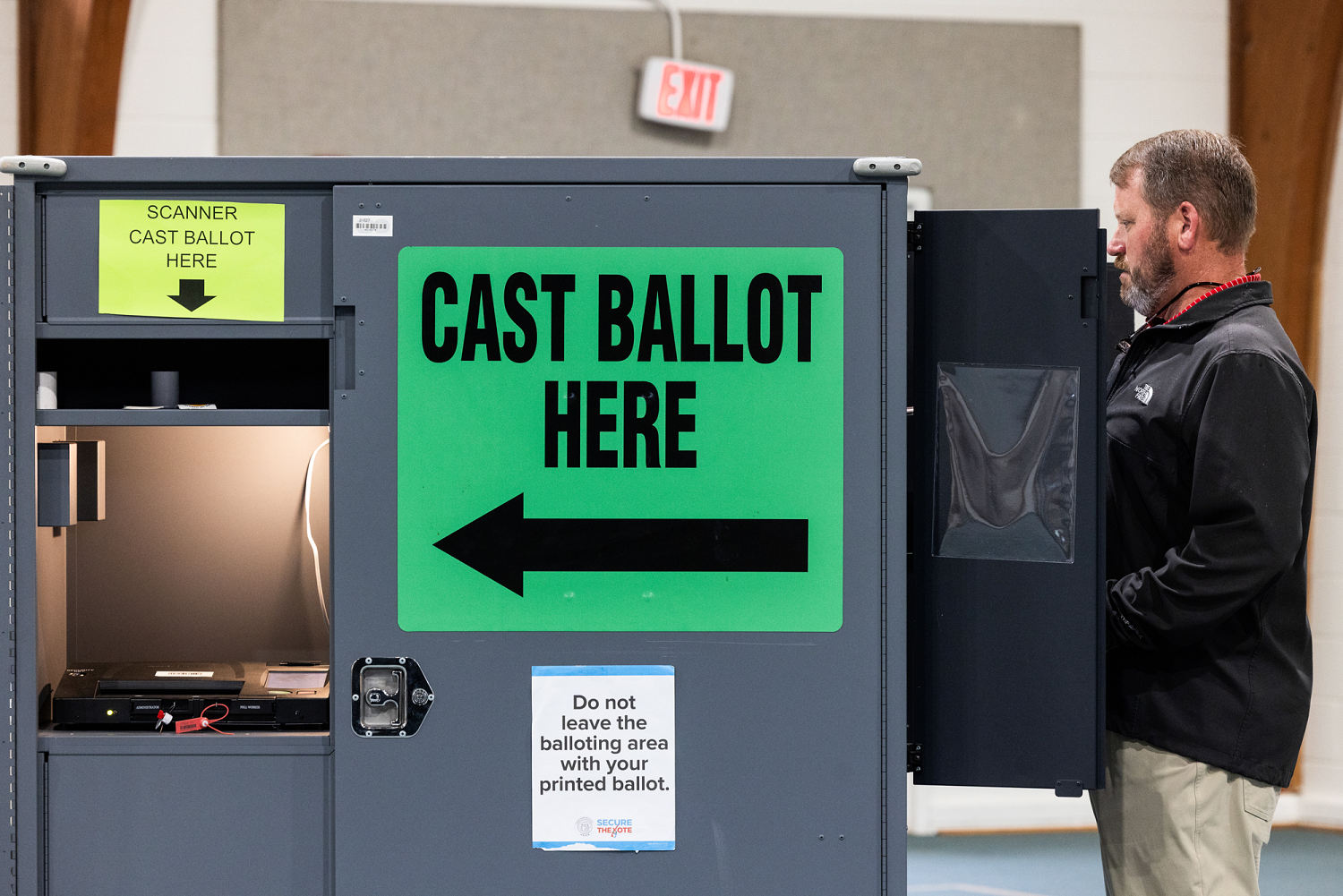
If you walk into a quiet precinct in rural Georgia on election night, the most important sound you will hear is not a human voice. It is a soft, rhythmic mechanical click. It is the sound of a Dominion voting machine spitting out a heavy sheet of paper.
For the voter, that paper feels like a receipt of their citizenship. They look at it, they see the names they selected printed clearly in black ink, and they feel a brief sense of accomplishment before sliding it into the scanner.
But there is a second layer to that paper. It is a small, blocky square of black-and-white static printed at the top of the page. A QR code.
To the human eye, it is entirely unreadable. To the digital scanner, it is the only part of the page that actually matters. When the scanner pulls the paper in, it does not read the English letters spelling out a candidate's name. It reads the pixels in the code. And therein lies a quiet, simmering crisis of trust that has spent the last two years pushing Georgia to the absolute brink of an election meltdown.
We are told that democracy rests on laws, on constitutions, and on grand ideals. The reality is much more fragile. Democracy rests on the collective belief that when you mark a choice, that choice is counted exactly as you intended.
When that belief fractures, everything else starts to splinter.
Consider the impossible position of a local county election director. Let us call her Sarah, a composite of the dedicated public servants who run these offices across Georgia’s 150-plus counties. For months, Sarah has been staring at a looming calendar date with a knot in her stomach: July 1.
Two years ago, under immense pressure from a vocal contingent of conservative activists who argued that a citizen should be able to read every part of their own ballot, the Georgia General Assembly passed a law. The law was clear: by July 1, QR codes were banned. The state had to switch to a system where the tabulating machines read human-readable text instead of digital codes.
It sounded like a straightforward victory for transparency. But the state government never actually sent Sarah the money to buy new machines. They never picked an alternative system.
The Secretary of State’s office pointed its finger at the legislature, noting that rewriting the software and updating the machinery across the entire state would cost an estimated 66 million dollars. The legislature pointed its finger right back. Meanwhile, the clock kept ticking.
Imagine trying to completely overhaul the technological infrastructure of a massive, heavily scrutinized voting system with just days left on the clock, right as the November midterm elections are looming over the horizon. Sarah was facing a logistical nightmare. If the deadline arrived and the old machines became illegal under state law, but no new machines existed to replace them, her county would be forced to count every single ballot by hand.
Chaos was not just a possibility. It was a statistical certainty.
Recognizing that the state was about to drive directly off a cliff, Governor Brian Kemp called lawmakers back to Atlanta for an emergency special legislative session. The Capitol building filled with the familiar, tense energy of a political rescue mission. Protesters marched outside in the sticky June heat, signaling that the ghost of the 2020 election still haunts the hallways of Georgia power.
Inside, the air-conditioned chambers became a theater of frantic negotiation. The clock was running out on the QR code deadline, and the state needed a release valve.
They found it in a compromise called Senate Bill 3EX.
Sponsored by Senator Max Burns, a Republican from Sylvania, the bill does something that local election officials view as a temporary lifesaver, but what critics view as a massive retreat. It kicks the can down the road. The looming July 1 deadline is gone, replaced with a new target: January 1, 2028.
For the next year and a half, Georgians will continue to use the exact same QR-code-dependent machines they have used since 2020. The digital squares win a temporary lease on life.
But political survival requires giving something to everyone. To appease the factions who deeply distrust the digital processing of votes, lawmakers attached a high-stakes condition to the delay. Under the new law, if a top-of-the-ticket statewide race—such as the governor or lieutenant governor—finishes with a margin of 0.5 percent or less, the state will mandate and fund a full, manual hand recount.
The human hand will step in to audit the machine.
To the bill's supporters, this is a bridge toward restoring faith. It provides a human safety net beneath a digital high wire. But to others, it is a recipe for deep anxiety.
The friction between the two political parties during the special session revealed just how deep the structural wounds remain. Democrats watched the creation of a new special legislative committee—tasked with designing the standards for the next 2028 voting system—and realized they were being locked out. An amendment to ensure minority party representation on the panel failed on a strictly partisan vote.
Trust is a mirror. Once it is cracked, you cannot fix it simply by changing the angle at which you hold it.
Critics of the manual recount provision argue that hand tallies are notoriously slow, expensive, and subject to human error. If a machine count and a hand count disagree by even a handful of votes in a highly charged political atmosphere, which one does the public believe? The pen or the pixel?
As the special session closed and lawmakers packed their bags to return home, the immediate crisis was averted. The local election directors breathed a sigh of relief. They can run their upcoming elections without the terrifying specter of immediate logistical collapse.
But the fundamental question has not been answered; it has merely been rescheduled.
Georgia has chosen to live in a state of suspended animation until the 2028 presidential cycle. We remain caught in the uncanny valley between the speed of the digital age and the visceral need for human certainty. Until we find a way to reconcile the two, every election will feel less like a celebration of a functioning republic and more like a high-wire act performed over a canyon of doubt.
On a chilly evening two winters from now, an elderly voter will step up to a booth, mark a ballot, and watch a machine code print out on a piece of paper. They will look at those strange black squares, wondering if the machine truly knows their mind, completely unaware of the millions of dollars, the sleepless nights, and the fierce political warfare waged just to keep that tiny, unreadable box on the page.