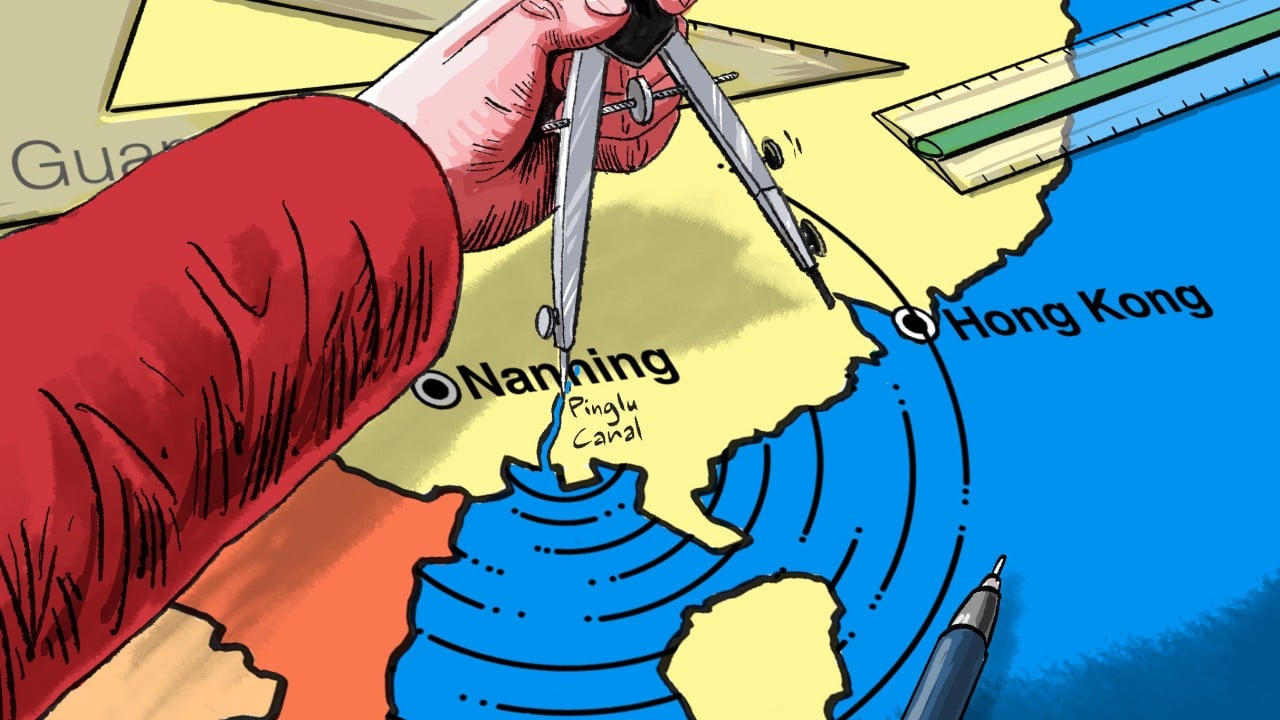
The regional maritime consensus has officially lost its mind. For the past year, logistics analysts and trade commentators have beaten the same drum: China’s 135-billion-yuan Pinglu Canal is a monumental shift that will redraw the shipping maps of Southeast Asia and breathe new life into Hong Kong’s declining port.
It is a comforting narrative. It is also entirely wrong.
The prevailing theory suggests that by connecting the river systems of Guangxi to the Gulf of Tonkin, a massive influx of inland cargo will bypass traditional routes, streamline western China's access to the sea, and somehow hand Hong Kong a golden ticket to reclaim its transshipment glory. This is a fundamental misunderstanding of modern maritime logistics, container economics, and geography. The Pinglu Canal will not save Hong Kong. In fact, if you look at the raw mechanics of regional supply chains, it might actually accelerate the city's marginalization.
The False Premise of the Inland Short-Cut
The core argument for the Pinglu Canal relies on a simplistic equation: shorter distance equals lower cost.
By carving a 134-kilometer channel from the Xijiang River system to Qinzhou port, the project cuts the journey from inland western provinces to the sea by roughly 560 kilometers compared to going through Guangzhou or Hong Kong. Mainstream commentators look at that number and assume the economic argument is settled.
They ignore the brutal reality of inland waterway economics versus open ocean freight.
The Pinglu Canal is designed to accommodate 5,000-tonne vessels. Consider the basic math of capacity. A 5,000-tonne river barge carries roughly 200 to 300 Twenty-Foot Equivalent Units (TEUs). By contrast, the ultra-large container vessels (ULCVs) that dominate global trade lanes routinely carry over 20,000 TEUs.
When you move goods along an inland waterway, you are dealing with a cascade of friction points:
- Lock Transits: The canal requires three massive, multi-stage lock complexes to manage the 65-meter water level drop. Waiting times at locks introduce volatility into shipping schedules.
- Draft Restrictions: River barges are highly sensitive to seasonal water level fluctuations. A drought or a dry season drops the allowable draft, slashing the cargo capacity per trip and wrecking the margins.
- Double Handling: Cargo coming down the canal cannot just sail across the Pacific. It must be unloaded at the Beibu Gulf ports (like Qinzhou) and reloaded onto ocean-going vessels.
Every time a container is touched by a crane, the logistics bill spikes. The illusion of a shorter geographic route vanishes when asset utilization and handling fees enter the equation.
Why the Beibu Gulf Hub is Hong Kong’s Competitor, Not Its Feeder
The most naive claim in circulation is that the Pinglu Canal will act as a feeder funnel for Hong Kong's port. The idea is that Guangxi will aggregate cargo via the canal, put it on coastal vessels, and send it straight to Hong Kong for international export.
I have spent years analyzing port utilization and supply chain networks. Hubs do not exist to feed rival hubs unless forced by severe infrastructure bottlenecks.
The Beibu Gulf port cluster—specifically Qinzhou—is not building out massive automated container terminals just to hand the lucrative ocean-leg freight over to Hong Kong. They are positioning themselves as a direct gateway to the Association of Southeast Asian Nations (ASEAN).
Qinzhou has spent the last five years aggressively expanding its direct-to-destination ocean routes. It already offers direct liner services to major hubs in Vietnam, Singapore, Indonesia, and Malaysia. The regional authorities are building an integrated logistical ecosystem called the New International Land-Sea Trade Corridor. The explicit goal of this corridor is to make western China self-sufficient in its logistics layout.
Why would an exporter in Chongqing or Nanning pay to barge goods down the Pinglu Canal to Qinzhou, only to pay again to ship those goods to Hong Kong, wait for transshipment, and then head to Europe or North America? They wouldn't. They will ship directly from Qinzhou.
Every container that flows down the Pinglu Canal is a container that the Beibu Gulf ports want to keep on their own berths for the high-margin long-haul routes. Hong Kong isn't the beneficiary of this new pipeline; Hong Kong is the target from which volume is being diverted.
The Terminal Handling Cost Crisis
To understand why Hong Kong cannot capture this traffic, we have to look at the structural cost disease plaguing Hong Kong’s port operations.
Hong Kong is routinely cited as one of the most expensive ports in the world for terminal handling charges (THCs). Data from maritime research agencies consistently shows that clearing a container through Hong Kong can cost double or even triple the rate of neighboring ports in Shenzhen or Guangzhou. Now compare that to the ultra-subsidized, highly competitive rates offered by the state-backed port operators in the Beibu Gulf.
| Port / Region | Average THC per TEU (Relative Estimate) | Primary Competitive Advantage |
|---|---|---|
| Hong Kong | Very High | Free port status, established financial legal framework |
| Shenzhen (Yantian/Shekou) | Moderate | Direct manufacturing hinterland proximity |
| Qinzhou (Beibu Gulf) | Low | Heavy state backing, integrated rail-to-sea infrastructure |
Let’s run a thought experiment. Imagine a manufacturing company producing industrial components in Liuzhou. They have two options to reach markets in Europe:
Option A: Use the traditional rail or river route to Guangzhou/Shenzhen, or transship via barge to Hong Kong. The terminal fees are steep, but the shipping schedules are frequent.
Option B: Use the new Pinglu Canal directly to Qinzhou, taking advantage of local government incentives, lower port tariffs, and immediate loading onto an ASEAN-bound or direct international vessel.
In an era where global manufacturing margins are razor-thin, logistics managers do not choose options based on historical sentiment or prestige. They choose the path of lowest total landed cost. Hong Kong's free port status and lack of customs duties—traditionally its greatest shields—matter very little for transshipment cargo that never leaves the bonded zone anyway.
The Shift to ASEAN is Already Bypassing Hong Kong
The pro-Hong Kong argument frequently highlights the booming trade between China and ASEAN as the ultimate justification for optimism. The logic goes: ASEAN is now China’s largest trading partner, Hong Kong is the premier super-connector, therefore Hong Kong wins.
This ignores where the geographic center of gravity is moving.
The Pinglu Canal connects western China directly to the Gulf of Tonkin, placing it at the doorstep of Vietnam and the rest of the ASEAN bloc. This infrastructure is explicitly designed to bypass the need to sail around the southern coast of China.
Furthermore, the nature of China-ASEAN trade has changed. It is no longer just about shipping finished goods. It is an intricate, intra-industry supply chain where semi-finished components move back and forth across borders for assembly. This requires tight, just-in-time logistics windows.
Geographically, Qinzhou and the Beibu Gulf ports are days closer to Haiphong or Ho Chi Minh City than Hong Kong is. The canal tightens the physical knot between the factories of southwestern China and the industrial zones of Southeast Asia. Hong Kong is physically left out of this loop. It sits too far east to serve as an efficient node for a localized, cross-border industrial ecosystem between Guangxi and northern Vietnam.
Admission of the Real Risk: The Downside of My Argument
A fair critique of my perspective would point out that Hong Kong still possesses an unparalleled density of international shipping routes. A port can have low fees, but if a ship only departs once a week, cargo will sit on the dock, eating up capital. Hong Kong's liner connectivity is still among the highest in the world, offering multiple departures a day to every major global market.
If the Beibu Gulf ports fail to attract the global shipping alliances—the Ocean Alliance, 2M, and THE Alliance—then the Pinglu Canal will indeed become a feeder network, and those containers might eventually have to find their way to deep-water hubs like Hong Kong or Shenzhen to get across the ocean.
But relying on your competitor's failure is a terrible corporate strategy. The global alliances go where the volume is. By building the Pinglu Canal, China is actively moving the volume to the west. The shipping lines will follow the freight, not the other way around. Qinzhou’s automated terminals are already expanding their berths to handle the largest vessels in existence. The connectivity gap is closing rapidly.
Stop Asking How the Canal Helps Hong Kong
The maritime industry needs to stop asking the wrong question. The question isn't "How can Hong Kong capitalize on the Pinglu Canal?" The real question is "How does Hong Kong survive the systemic diversion of inland Chinese cargo away from the Pearl River Delta?"
The Pearl River Delta’s dominance was built on the fact that all water-borne trade from the interior of China had to flow eastward down the Pearl River toward Guangzhou, Shenzhen, and Hong Kong. It was a geographic monopoly.
The Pinglu Canal breaks that monopoly by creating a western exit valve. It is an intentional decoupling of western China’s logistics from the eastern ports.
If Hong Kong wants to maintain its relevance in global logistics, it must abandon the fantasy that infrastructure projects in the far west of the country will miraculously bail it out. The city needs to stop treating its port as a volume game. It cannot compete on TEU counts against heavily subsidized, fully automated mainland mega-ports that sit closer to the new trade corridors.
Instead of fighting for raw container throughput that it will inevitably lose, the city must pivot entirely toward high-value maritime services—ship financing, maritime law, dispute resolution, and marine insurance. That is where the defensible moats are.
The physical containers are moving west, and they are not coming back. Anyone looking at the map of the Pinglu Canal and seeing a savior for Hong Kong’s docks is looking at a mirage.