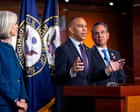
The headline circulating across news feeds got a massive detail wrong, and it tells you everything about how fast political news breaks—and breaks down—in Washington. Hakeem Jeffries isn't on the brink of Senate history. He's on the brink of House history, having just secured the Democratic nomination to become the first Black Speaker of the House of Representatives.
That initial typo in a live blog headline spread like wildfire across syndication feeds, confusing casual readers who thought the Brooklyn congressman had somehow jumped chambers overnight. Strip away the viral headline error, though, and the actual story unfolding on Capitol Hill is way more interesting. House Democrats just swept the 2026 midterm elections, capturing at least 258 seats in their largest victory since 1992. Yet behind closed doors on November 18, 2026, Jeffries walked away with 251 out of 262 votes cast—meaning 11 Democrats withheld their support even with no challenger on the ballot. In other news, read about: The Jurisdiction of Force in Sovereign Cross-Border Custody Disputes.
His response to that internal friction was blunt. He told his caucus to "fight Maga, not each other".
If you've watched Capitol Hill leadership fights over the last decade, you know that winning a massive majority doesn't buy you peace. It actually buys you headaches. When a party wins 258 seats, everybody wants a piece of the agenda, and nobody feels obligated to fall in line just to survive. NBC News has provided coverage on this fascinating topic in great detail.
Why Hakeem Jeffries Is Making House History Not Senate History
Let's clear up the civics confusion first. Hakeem Jeffries represents New York's 8th Congressional District in the House of Representatives, a seat he's held since 2013. He has never served in the U.S. Senate. When he shattered the first major racial barrier in congressional leadership back in late 2022, succeeding Nancy Pelosi as House Minority Leader, he became the first African American to lead a party in either chamber of Congress.
Now, following the November 2026 midterms, the math has flipped. Because Democrats won control of the lower chamber, Jeffries isn't just leading a party anymore. Assuming he holds the floor vote when the 120th Congress convenes on January 3, 2027, he will wield the Speaker's gavel—making him the first Black Speaker of the House in American history and placing him second in the presidential line of succession behind the Vice President.
The Senate has its own leadership drama playing out right now, which partly explains how wires got crossed in the media. Over in the upper chamber, Senate Democrats are gearing up for a December 1 leadership vote where Maryland Senator Chris Van Hollen has been picking up momentum in the race to lead the Senate caucus, alongside longtime leader Chuck Schumer. Two chambers, two leadership votes, one massive midterm wave.
The Historic Trio Taking Over House Leadership
Jeffries isn't walking onto the House floor alone in January 2027. The entire top tier of House Democratic leadership represents a generational and demographic overhaul of the chamber:
- Hakeem Jeffries (New York) as Speaker-designate, set to become the first Black Speaker.
- Katherine Clark (Massachusetts) as Majority Leader-elect, poised to become the first woman to hold the number-two House majority spot.
- Pete Aguilar (California) as Majority Whip-elect, set to become the first Latino lawmaker to serve as House Majority Whip.
All three ran unopposed inside the caucus. On paper, that looks like total unity. Inside the room, it was a bit messier.
What Those 11 Protest Votes Really Mean
Getting 251 out of 262 votes sounds like a landslide in normal life. In House leadership politics, where the floor vote requires an absolute majority of all members voting by name, 11 missing votes is a warning shot across the bow.
Why did 11 Democrats balk at endorsing Jeffries during the closed-door secret ballot? It wasn't because they had a rival candidate ready to go. Even progressive standard-bearer Alexandria Ocasio-Cortez pointed out at the Capitol that there was only one candidate in the race, adding that members were far more concerned with what that leadership actually promises to deliver.
The pushback came from deep frustration among the party's progressive flank and an energized base demanding a sharper break from establishment politics. Protesters had even heckled Jeffries during a Democratic conference in Denver just a week prior to the vote. Progressive lawmakers and voters raised pointed questions about several flashpoints:
- Donor influence and foreign policy: Grassroots activists have repeatedly pressed House leadership over campaign finance rules, calls to overturn Citizens United, and U.S. military entanglement abroad, specifically the ongoing conflict with Iran.
- Past outreach to Trump allies: Several Democrats had openly criticized Jeffries earlier in the year over a quiet August 2026 meeting with Donald Trump's envoy Jared Kushner.
- Aggression on oversight: Left-leaning members want guarantees that leadership won't pull punches when investigating the Trump administration or debating major structural reforms like Supreme Court expansion and congressional stock trading bans.
I've watched incoming House Speakers manage similar margins before, and here's the truth most pundits miss: a secret-ballot protest vote in November is a pressure valve. Members vent behind closed doors so they can extract committee assignments, floor votes on pet bills, or rules changes before the public roll call in January. With at least 258 seats in the incoming majority, Jeffries has a massive cushion compared to the razor-thin majorities that paralyzed Republican Speakers over the past four years. He can afford to lose a handful of votes in January and still win the gavel easily, though nobody wants an embarrassing multi-ballot spectacle on day one.
Inside the Fight Maga Strategy for 2027
When Jeffries told his colleagues to "fight Maga, not each other," he wasn't just tossing out a catchy soundbite for the cameras. He was trying to lock down a unified messaging discipline before the 120th Congress even starts.
Right now, House Democrats are pulled in two distinct directions—and both wings have loud advocates in the caucus. Centrists like New York Representative Tom Suozzi have argued publicly that House Democrats should spend 75% of their time on cost-of-living and affordability issues, leaving 25% for accountability. Meanwhile, other lawmakers and progressive voters want full-throttle investigations into executive branch misconduct and the MAGA movement.
Jeffries is trying to fuse both tracks into a single operating doctrine he calls "affordability and accountability".
The First 100 Hours and 100 Days Playbook
Based on Jeffries's public statements following the election, his leadership team has already mapped out aggressive early targets once they take the gavel in January 2027:
- Ending the Iran conflict: Jeffries stated that the new Democratic majority must move aggressively to end what he termed a "reckless and costly war of choice in Iran" not just in the first 100 days, but within the first 100 hours.
- Reversing economic and healthcare cuts: House Democrats plan to push legislation repealing Trump's tariffs, restoring Affordable Care Act tax credits, reversing cuts to Medicaid and SNAP, and raising the federal minimum wage.
- Subpoenas and executive oversight: Jeffries has explicitly vowed that the incoming majority will investigate corruption and abuses of power within the Trump administration. The White House has already fired back, warning that congressional probes into the administration could amount to "blatant criminality".
- Ethics and structural bills: Under pressure from the caucus, leadership is backing a ban on congressional stock trading, a ban on partisan and mid-decade gerrymandering, and passage of the John Lewis Voting Rights Act. Even within their own ranks, Jeffries, Clark, and Aguilar immediately backed House rules reforms to protect staffers from misconduct following an ethics report that forced California Representative Jimmy Gomez to announce his resignation.
Of course, passing bills in the House is one thing. Getting them past a divided government and onto Donald Trump's desk is another story entirely.
The Reality Check on Divided Government
Let's be honest about what a House majority actually accomplishes during the final two years of a president's term. Most of the ambitious progressive legislation on the Democratic wish list—like a constitutional amendment overturning Citizens United or sweeping Supreme Court reform—won't become law while Trump holds the veto pen.
Experienced legislative strategists know that in divided government, the House majority's real power comes down to three levers:
- The power of the purse: Every government funding bill and debt ceiling hike has to pass through Jeffries's House. That gives Democrats massive leverage to claw back funding—such as billions allocated to ICE—or force policy riders into must-pass spending packages.
- The subpoena cannon: House committees can compel testimony, demand documents, and hold televised hearings that dominate news cycles and put administration officials on defense.
- Messaging bills: Forcing vulnerable Republicans in swing districts to go on the record voting against lower healthcare costs, minimum wage hikes, or ethics bans sets the battlefield for the 2028 presidential race.
Jeffries also signaled he's willing to cross the political aisle on targeted domestic issues where compromise is possible, leaning on a track record that includes co-sponsoring the bipartisan First Step Act and the Music Modernization Act back in 2018. That pragmatic streak is exactly what endears him to swing-district frontliners—and exactly what makes purists on the left nervous.
How to Track What Happens Next on Capitol Hill
If you want to cut through the noise and see whether Jeffries actually keeps his caucus united over the coming weeks, ignore the cable news chatter and watch four concrete milestones:
- Watch the Senate Democratic leadership vote on December 1: Pay attention to how Senate Democrats resolve their own leadership race. Tight coordination between Jeffries in the House and whoever leads Senate Democrats will determine whether Congress can present a unified front against the White House.
- Track committee gavel assignments in December: Watch who Jeffries taps to chair the House Judiciary, Oversight, Ways and Means, and Appropriations committees. Giving key gavel spots or subcommittee roles to progressive members will tell you immediately whether those 11 holdouts got their concessions.
- Monitor the January 3, 2027 Speaker floor vote: Unlike the November secret ballot, the January 3 vote is public and recorded. If Jeffries gets all 258-plus Democrats on the first ballot, his "fight Maga, not each other" message worked. If even a handful vote "present" or cast protest votes on the floor, expect a rocky two years.
- Read the text of H.R. 1 in early January: The very first bill number reserved by a new Speaker always reveals their true top priority. Look closely at whether H.R. 1 focuses on economic affordability, voting rights, or ending the war in Iran—because that single bill will define the 120th Congress.