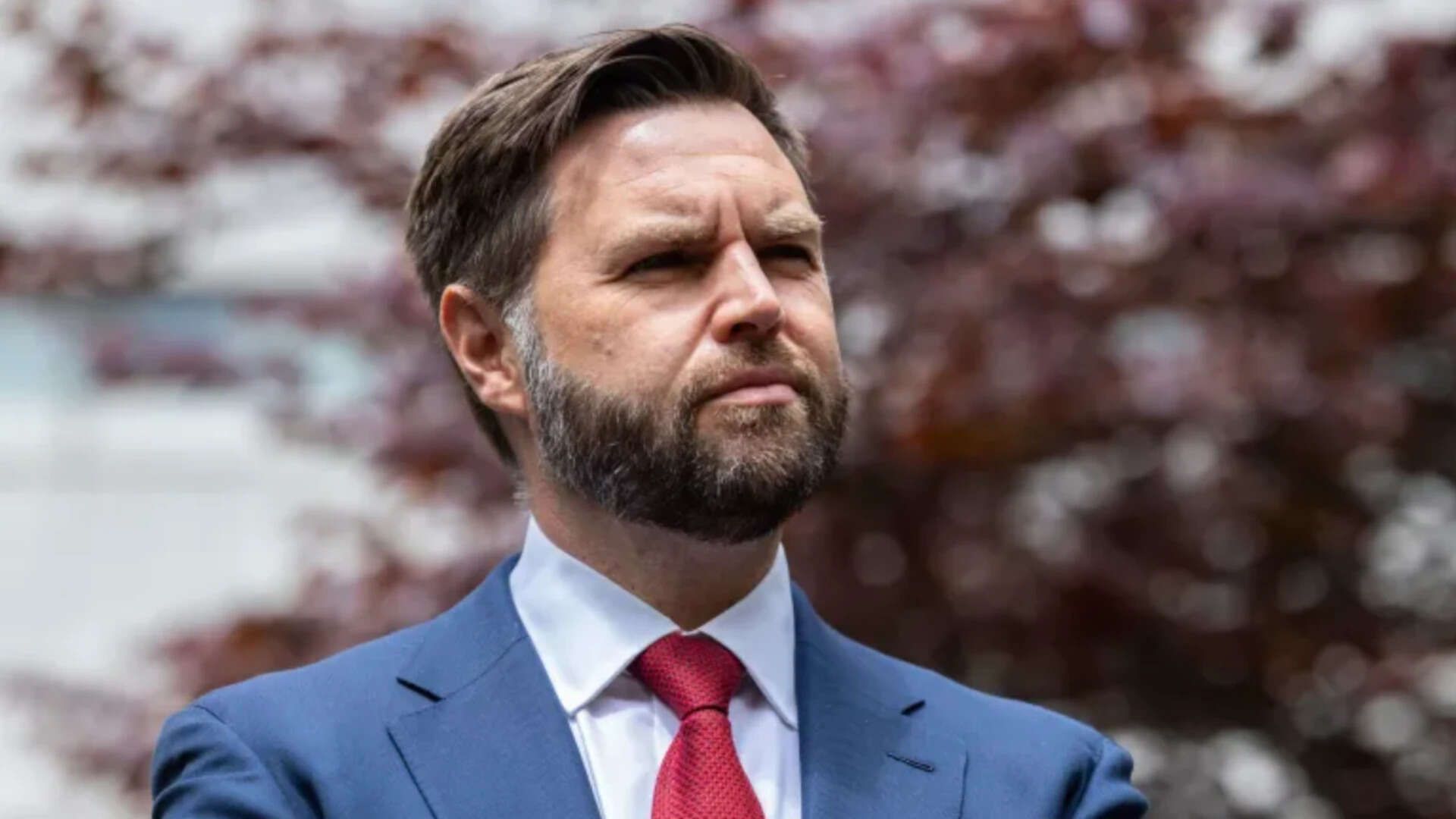
The television lights are unforgiving. They catch every bead of sweat, every micro-expression, every fleeting shadow of doubt. When a politician stands before a microphone, they are not just delivering policy; they are performing an identity. For JD Vance, that identity has become increasingly anchored in a very specific, traditionalist strain of Roman Catholicism. It is a faith of incense, ancient hierarchy, and uncompromising dogmatism.
But politics has a messy habit of colliding with the breakfast table.
When Vance articulated a worldview linking his Catholic faith to a fierce opposition to "low-wage foreigners," he wasn't just throwing red meat to a populist base. He was attempting to theological-outfit an economic argument. The blowback, however, did not just come from the predictable corners of economic liberalism. It struck a nerve that ran straight through his own living room. The internet erupted with a sharp, uncomfortable question that cut through the political theater: What about your wife?
Usha Vance is the daughter of Indian immigrants. She is a practicing Hindu.
To watch this public collision is to witness the central tension of modern American populism. It is the friction between an idealized, culturally homogeneous past and the complex, pluralistic reality of the people actually trying to build it.
The Theology of the Border
To understand the firestorm, you have to look beneath the soundbites. Vance did not merely say he wanted fewer immigrants. He argued that his religious conversion demanded it.
Catholic social teaching is a vast, centuries-old body of thought. It is not easily weaponized by either the American Left or Right. On one hand, the Church has long defended the rights of migrants, urging nations to welcome the stranger. On the other hand, traditionalist thinkers point to encyclicals like Pope Leo XIII’s Rerum Novarum, written in 1891, which criticized the unfettered capitalism that treats human beings as mere cogs in an industrial machine.
This is the intellectual sandbox Vance is playing in. His argument is that importing a continuous stream of cheap labor suppresses the wages of domestic workers, destroys the dignity of labor, and enriches a corporate elite that cares nothing for community cohesion. In this view, restricting immigration is not an act of malice; it is an act of mercy toward the domestic working class.
It is a coherent intellectual posture. But it breaks down the moment it leaves the seminar room and enters the arena of human relationships.
Consider a hypothetical worker named Thomas. Thomas lives in an Ohio valley town where the factories closed decades ago. He sees his community fracturing. He hears Vance talking about dignity, about protecting local jobs from global forces, and it feels like a lifeline. To Thomas, the theology makes sense because the economic pain is real.
But then Thomas looks at the stage. He sees the politician who champions this fiercely protective, culturally specific vision standing next to a woman whose very existence is a testament to the globalized, multicultural world the politician decries.
The cognitive dissonance is deafening.
The Intersecting Rivers
The public reaction was swift, visceral, and deeply personal. Critics picked up the phrase "low-wage foreigners" and flung it back at Vance, pointing to his wife’s heritage. The subtext of the online fury was clear: How do you reconcile a political philosophy that views foreign labor as a corrosive threat with a marriage built on a partnership with the child of foreign professionals?
This is where the political narrative becomes a human story.
Usha Vance is an elite corporate litigator, a graduate of Yale Law School and Cambridge. She does not fit the description of a "low-wage foreigner." But in the blunt-force world of political rhetoric, nuances are pulverized. To many watching the drama unfold, the attack on foreign workers felt like an attack on the global community from which Vance's own family emerged.
The irony is thick enough to choke on.
Imagine the dinners. On one side of the table sits a man who converted to Catholicism in 2019, seeking a rigorous, unyielding moral framework to anchor a life that began in the chaos of the Rust Belt. On the other side sits a woman whose family traditions stretch back millennia to the banks of the Ganges, rooted in a philosophy that views truth not as a singular, exclusive fortress, but as a diamond with many facets.
They have built a life together. They have children. They have managed to find harmony in the quiet spaces away from the cameras. Yet, the political movement Vance seeks to lead is one that increasingly views such synthesis not as a strength, but as a compromise.
The real problem lies elsewhere, far beneath the superficial accusations of hypocrisy. It rests in the impossibility of the populist promise. You cannot easily preach a gospel of cultural retrenchment while living a life of modern, cosmopolitan integration. The voters notice. The critics pounce. The human cost of this tension is borne not by the strategists in Washington, but by the family unit itself, dragged into the center of a cultural culture war.
The Architecture of Believing
Why does this matter beyond the horse race of an election cycle? Because it exposes the fragile scaffolding of the modern conservative intellectual movement.
Vance is part of a group often called the "New Right" or "Post-Liberals." These are thinkers who believe that the American experiment has gone off the rails because it prioritized individual liberty and free markets over family, faith, and place. They want to use the power of the state to enforce a more moral, stable society.
For Vance, Catholicism provided the intellectual muscle for this shift. It gave him a language of common good and corporate responsibility.
But the Catholicism Vance invokes is often a selective one. The global Catholic Church is, by definition, universal. It is an institution defined by its brown and Black majority in the Global South. It is a church of immigrants. When the American bishops speak on immigration, they rarely sound like JD Vance. They talk about human dignity that knows no borders. They talk about the right to migrate to sustain one’s family.
So when Vance uses the faith to justify a nationalist economic policy, he is performing an act of theological acrobatics. He is leaning on the Church’s critique of capitalism while discarding its mandate on global solidarity.
This is the point where the intellectual project begins to fracture.
Look at the faces in the crowd at any rally. There are people there who genuinely believe that their country is being taken from them, that their wages are being stolen by people who do not speak their language. They do not care about Rerum Novarum. They care about their mortgages. When their leader frames their economic anxiety in the language of sacred duty, it elevates their anger. It makes their resentment holy.
But when that same leader goes home to a multicultural, multi-faith household, those same voters are left to wonder if the holy war is only for them.
The Unspoken Treaty
Every marriage is a secret treaty between two people. We cannot know what conversations happen in the Vance household when the porch lights go off. We cannot know how Usha Vance processes the rhetoric that her husband deploys on the campaign trail, or how she views the online commentators who use her ethnicity as a weapon against him.
What we do know is that the public square does not respect secret treaties.
The controversy over the "Hindu wife" comment is a symptom of a larger cultural anxiety. We are living through an era of profound dislocation. People are searching for solid ground. For some, that ground is an ancient faith. For others, it is a national identity. For many, it is a defensive crouch against a world that feels too big, too fast, and too indifferent to their survival.
Vance has positioned himself as the interpreter of this anxiety. He is trying to bridge the gap between the desperate reality of the deindustrialized working class and the sophisticated theories of the intellectual right.
But some gaps are too wide to bridge with rhetoric alone.
When you tell a room full of struggling Americans that their problems are caused by foreigners, you are drawing a line in the sand. You are telling them who belongs and who does not. You are defining the community by who it excludes.
The moment you draw that line, however, you must decide which side of it your own family stands on.
This is the vulnerability at the heart of Vance’s political persona. It is not necessarily a lack of sincerity; it may well be an excess of ambition. He wants to be the prophet of a traditionalist, rooted America, but he is fundamentally a product of the modern, fluid, meritocratic world that allows a boy from Middletown, Ohio, to marry a girl from San Diego at Yale, change his faith, and run for the highest offices in the land.
The Final Chord
The debate will continue. The talking heads will parse the statements, the pollsters will measure the damage, and the political machine will keep grinding forward. Vance will likely double down on his economic nationalism, and his supporters will continue to defend his right to interpret his faith as he sees fit.
But the image that remains is not one of policy documents or Senate floor speeches.
It is the image of a man standing before an altar, receiving a sacrament that claims to unite all of humanity under one God, while simultaneously preparing to step outside and tell the world that some human beings are too expensive to welcome. And watching from the pews is a woman who embodies the exact global complexity that his movement wishes to erase.
The lights stay on. The cameras keep rolling. The contradiction remains unresolved, written in the very DNA of the family that seeks to lead a nation divided against itself.