The ink on a federal court order is supposed to have weight. It is supposed to act as an invisible, immovable barrier, a declaration that for a brief moment, the immense machinery of the state must grind to a halt. But inside a sterile immigration holding facility, as the engines of a charter flight idled on the tarmac, that paper shield began to tear.
What happens when the government looks at a judge's direct command and decides to keep moving anyway?
This is the question now sitting before a full bench of federal appeals court judges. It is a dry, technical legal battle on the surface, wrapped in the dense jargon of jurisdictional boundaries and contempt inquiries. Yet beneath the layers of briefs and oral arguments lies a raw, human reality. It is a story about the absolute limits of judicial power, the terrifying speed of modern deportation, and the shadow cast by one of the most notorious penal institutions in the Western Hemisphere.
The Flight That Wrote Its Own Rules
To understand how a routine immigration case escalated into a full-scale constitutional showdown, you have to look at the terrifying momentum of the system. Imagine a young man sitting in a room with no windows, knowing his name is on a manifest. Let us call him Mateo. He is not a statistic, though the paperwork treats him as one. He is someone who fled a reality that few outside Central America can fully comprehend.
A lone attorney, working under the flickering lights of a midnight office, manages to convince a federal judge that Mateo’s deportation must be paused. The judge agrees. An injunction is signed. The order is transmitted. The law has spoken.
Then, the machine blinks. And ignores it.
The plane takes off. The wheels retract. Mateo is in the air, watching the American coastline shrink into the clouds, completely unaware that a federal judge had just ordered him to stay. The bureaucracy did not stop to read the fine print. It simply cleared the runway.
When a court orders the government to stop an action and the government proceeds anyway, it strikes at the very foundation of the legal system. If the executive branch can choose which judicial orders to follow and which to ignore based on logistical convenience, the balance of power collapses. That is why a federal judge initiated a contempt inquiry. It was an act of institutional self-defense. The government had overridden the court's authority, and someone needed to be held accountable.
The Iron Fortress on the Horizon
The stakes of this legal defiance become glaringly clear when you look at the destination. The deportations in question are not just routine returns; they are bound for El Salvador, a nation transformed by an unprecedented, draconian crackdown on crime. At the heart of this transformation sits the Centro de Confinamiento del Terrorismo. CECOT.
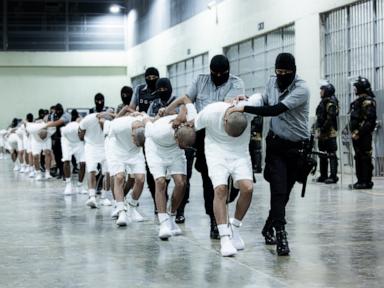
It is a place built to defy the imagination. A sprawling, white-walled fortress designed to hold tens of thousands of suspected gang members. The images beamed out by the Salvadoran government are deliberately striking: thousands of men, heads shaved, stripped to white shorts, packed torso-to-back on concrete floors under the glare of ceaseless floodlights. There are no visitors allowed. There are no programs. There is only the endless, static passage of time behind layers of steel and concrete.
For someone like Mateo, being sent back under these conditions is not merely a change of address. It is a roll of the dice with absolute oblivion. Under El Salvador's ongoing state of exception, normal constitutional rights are suspended. An anonymous tip is enough to land a person in handcuffs. A tattoo, a youthful mistake, or simply being the wrong age in the wrong neighborhood can route an individual directly into the maw of CECOT without a trial.
When American immigration authorities rush a deportation in violation of a court order, they are not just bypassing a legal hurdle. They are potentially handing a human being over to a system where the concept of due process has been entirely erased. The terror of the flight is not just the journey itself, but the knowledge of what waits at the end of the tarmac.
The Architecture of Defiance
When the contempt inquiry began, the government’s defense did not rest on a denial of the facts. They did not argue that the flight stayed on the ground. Instead, they retreated into the fortress of procedural immunity.
The argument put forward by government lawyers is chillingly simple: the courts lack the jurisdiction to hold immigration officials in contempt over these types of enforcement decisions. They argue that the machinery of border enforcement is too vast, too complex, and too deeply tied to national security to be micromanaged by federal judges issuing late-night stays.
Consider the implications of that stance. It creates a zone of execution where the law cannot reach. If a court cannot enforce its own orders through the mechanism of contempt, then those orders are nothing more than polite requests.
During the initial hearings, the tension in the courtroom was palpable. Lawyers wrestled over decades of precedent, parsing the exact meaning of statutory language. But the underlying argument was about power. The executive branch was asserting that in the high-stakes arena of immigration enforcement, speed and efficiency take precedence over judicial oversight.
The panel of judges split. The disagreement was so profound, the questions raised so fundamental to the structure of American governance, that the entire appeals court took the rare step of vacating the earlier ruling. They ordered the case to be reheard en banc—meaning every single active judge on the circuit will sit on the bench together to decide the matter.
The Human Cost of High-Speed Justice
It is easy to get lost in the academic thrill of a constitutional crisis. Law professors will debate this case for years. But for the people trapped in the gears, the debate is measured in heartbeats and sleepless nights.
Think of the families waiting for news, refreshing tracking portals, calling lawyers who have no answers to give. When the system breaks its own rules, it breeds a deep, corrosive cynicism. If the government does not have to follow the law, why should anyone else?
The legal team representing the deportees faces an uphill battle. They are fighting against a narrative of administrative inevitability. The government often portrays these incidents as simple bureaucratic errors—a breakdown in communication, an email sent too late, a shift change that dropped the ball. They paint it as a tragic but unavoidable consequence of managing a massive crisis at the border.
But a footnote in a legal brief cannot erase the terror of a man being marched off a plane into the hands of waiting security forces in San Salvador. It cannot undo the reality that a federal judge said stop, and the state said no.
The Unseen Verdict
When the full appeals court convenes, the room will be quiet. The arguments will be polite, measured, and deeply technical. There will be no raised voices, no dramatic tears, no sudden confessions.
Yet the ghost in the courtroom will be the image of that idling plane, carrying people toward a penal system designed to swallow them whole. The judges will have to decide if their signatures still hold power, or if the executive branch has successfully built a parallel system that operates outside the reach of the judiciary.
The decision will ripple far beyond the specific individuals on that flight. It will dictate how immigration enforcement operates for the next generation. If the court retreats, signaling that its contempt powers are useless against the shield of administrative expediency, the paper shield vanishes completely.
The machine will run faster. The flights will leave earlier. And the voices crying out for a pause will find themselves shouting into an empty sky, while the shadow of the mega prison grows longer every day.