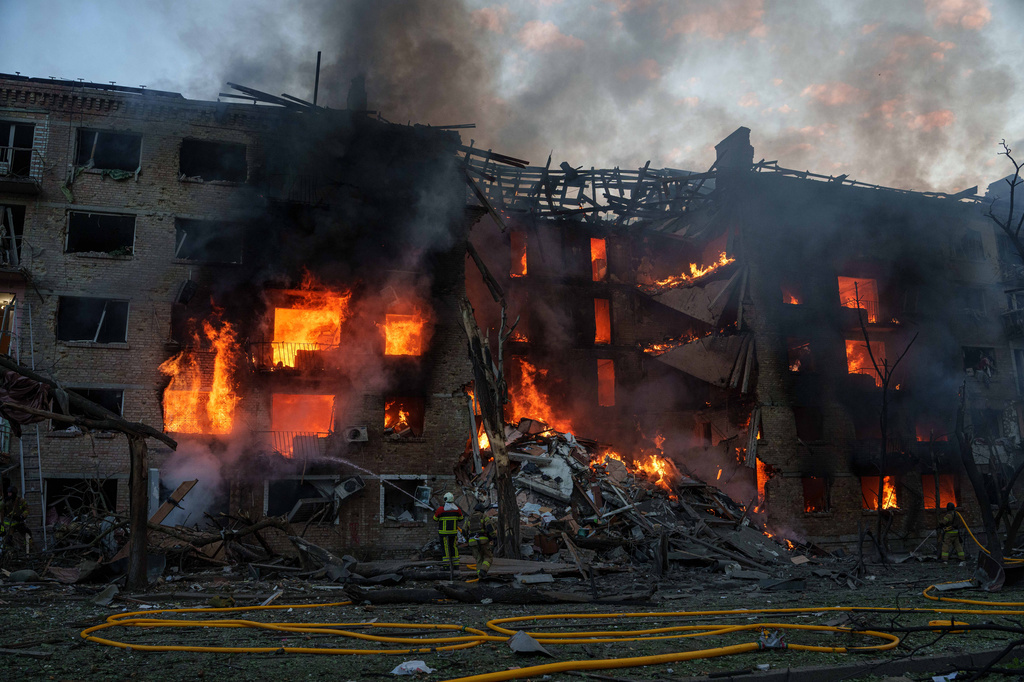
Russia did not shift the military balance in Europe by launching a nuclear-capable ballistic missile into the Kyiv region. It simply rebranded an old Cold War concept to mask a much more dangerous, conventional reality.
When the multi-warhead Oreshnik intermediate-range ballistic missile tore through the upper atmosphere early Sunday morning to strike the city of Bila Tserkva, headlines across the West panicked over the specter of nuclear brinkmanship. But focusing on the theater of Russia’s "hazelnut" missile misses the actual tactical crisis. The real threat is not a singular, hyper-expensive experimental missile designed for political blackmail. The threat is the sheer, unprecedented volume of the broader air campaign that accompanied it—a massive saturation strategy that is quietly grinding down Ukraine’s Western-supplied air shields through brute math.
The Mirage of Hypersonic Novelty
To understand why the Oreshnik is more of a political scare tactic than a technological breakthrough, one must look at the mechanics of ballistic flight. Vladimir Putin has repeatedly boasted that the weapon travels at Mach 10 and is entirely immune to interception.
That claim relies on a deliberate conflation of terms. Nearly every intermediate-range ballistic missile (IRBM) or intercontinental ballistic missile (ICBM) ever built travels at hypersonic speeds during its terminal phase. A weapon plunging from a suborbital trajectory naturally achieves velocities exceeding five times the speed of sound.
The Oreshnik is not a highly maneuverable hypersonic boost-glide vehicle like the Avangard. Intelligence assessments indicate it is essentially a modified, road-mobile RS-26 Rubezh—a decades-old solid-fueled design stripped of a booster stage to reduce its range to intermediate parameters.
What makes the system distinctive in this conflict is its payload delivery mechanism, not its speed. The strike on Bila Tserkva, much like the previous deployments in Dnipro and Lviv, showcased Multiple Independently Targetable Reentry Vehicles (MIRVs). Surveillance footage captured the distinct, chilling sight of six separate warhead buses splitting apart in the upper atmosphere, each shedding sub-munitions that slammed into the ground in rapid succession.
This is the first time MIRV technology has been used in active combat. Yet, multiple intelligence reports suggest these warheads contained inert kinetic penetrators rather than massive high-explosive payloads. Firing an incredibly expensive, multi-stage ballistic carrier just to drop heavy pieces of metal onto a domestic infrastructure target makes zero economic sense. It is a showpiece weapon used because Russia has very few of them.
"If the weapon were inherently terrifying on its own, the Kremlin would just use it," notes Dr. Jeffrey Lewis, an arms control expert who analyzed the platform's footprint. "Instead, they have to hold press conferences afterward to explain exactly how scared everyone is supposed to be."
The Tyranny of the Interception Matrix
While the Oreshnik commands the attention of international diplomats, the true battlefield devastation during Sunday's barrage came from a far more conventional calculus. The strike was merely the kinetic centerpiece of a massive, multi-vector saturation campaign aimed squarely at crushing the logistical and administrative framework of the Ukrainian capital.
The Sunday assault deployed an astonishing array of weaponry:
- 600 strike drones launched from multiple sectors to flood radar screens.
- 90 air, sea, and ground-launched missiles, including sea-skimming cruise missiles and Kinzhal aeroballistic platforms.
- A single Oreshnik IRBM acting as a psychological spearhead.
Ukrainian air defense units performed with historic efficiency, neutralizing or electronically jamming 549 drones and 55 missiles. That represents an overall interception rate that would be deemed impossible in any standard Western military doctrine.
But a 90% success rate still means 16 heavy missiles and 51 kamikaze drones breached terminal defense lines.
The unintercepted munitions caused severe urban damage, collapsing a five-story residential building in the Shevchenkivskyi district and igniting a high-rise complex in Solomyanskyi. This exposes the brutal math facing Ukraine's defenders. Air defense batteries like Patriot, NASAMS, and IRIS-T are highly sophisticated, but they are bounded by physical limits. They can only track and engage a finite number of targets simultaneously before their fire-control radars are saturated, and their missile magazines are depleted.
By mixing cheap, mass-produced drones with a handful of high-tier hypersonic and ballistic threats, Russia forces Ukrainian commanders into an impossible dilemma. They must choose whether to expend a million-dollar interceptor on a low-cost decoy or save the munition and risk a catastrophic impact on critical infrastructure.
The INF Treaty Vacuum
The re-emergence of weapons like the Oreshnik is the direct consequence of a collapsing international security architecture. For decades, the Intermediate-Range Nuclear Forces (INF) Treaty banned both the United States and Russia from ground-launching ballistic and cruise missiles with ranges between 500 and 5,500 kilometers.
When that treaty collapsed in 2019, it legally freed Moscow to revive shelved projects like the RS-26 Rubezh and adapt them into the intermediate system witnessed today.
By deploying these mobile launchers to eastern Belarus, Russia has effectively extended its conventional and nuclear reach deeper into Central Europe. From these positions, an Oreshnik variant can easily strike almost every major European capital within fifteen minutes of launch.
This reality shifts the burden of deterrence back onto NATO's shoulders. The alliance cannot rely solely on defensive shields to protect European airspace from high-velocity ballistic threats. Air defense is inherently reactive and economically asymmetrical; the interceptor often costs far more than the target it destroys.
The only long-term countermeasure to a mobile IRBM threat is a robust counter-battery capability—the explicit threat that the launch platforms themselves will be hunted down and destroyed before they can cycle their payloads. Until Western powers acknowledge that defensive shields alone cannot win a war of industrial attrition, cities like Kyiv will continue to bear the weight of Russia's calculated, high-speed blackmail.


