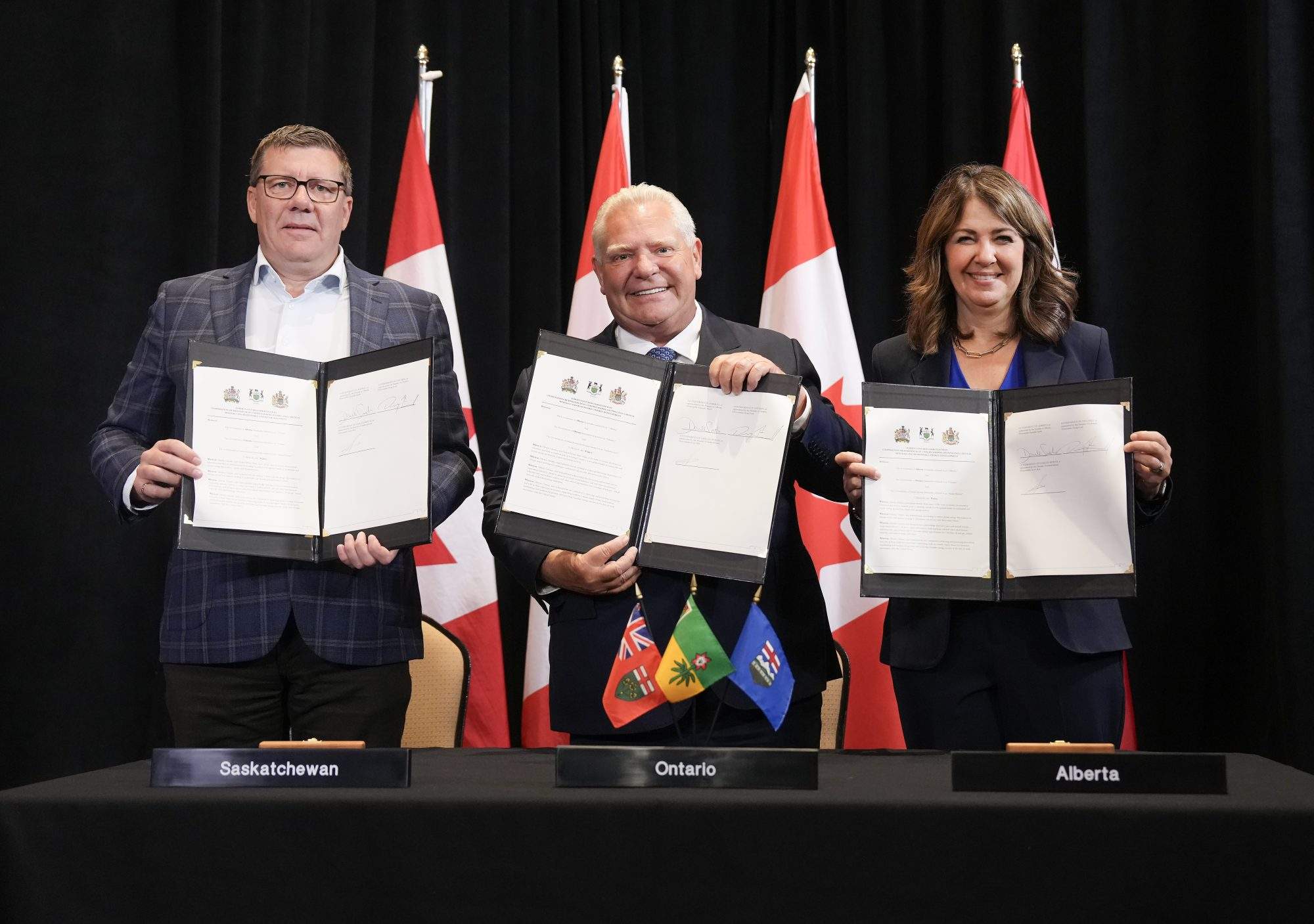
When Ontario Premier Doug Ford and Alberta Premier Danielle Smith stood together in Calgary to announce the proposed Northern Shield Energy Corridor, the press release made it sound like a done deal. A 3,300-kilometer pipeline pumping up to 800,000 barrels of crude oil per day from Hardisty, Alberta, straight to the refining hub in Sarnia, Ontario.
It sounds great on paper. An all-Canadian route meant to protect domestic energy security and end reliance on vulnerable cross-border infrastructure like Michigan's contested Line 5. Saskatchewan Premier Scott Moe's office quickly issued a brief statement labeling the proposal "positive news."
Look closer at that podium. Premier Moe wasn't standing up there. Neither was Manitoba Premier Wab Kinew.
Saskatchewan's quiet written endorsement—issued after the fact—tells a much bigger story about the political and economic reality facing western Canada right now. Behind the optimistic press releases lies a complicated web of regional politics, extreme labor constraints, missing federal backing, and a sharp tactical game that provincial leaders are playing.
What the Northern Shield Proposal Actually Is
The Northern Shield Energy Corridor is a massive infrastructure concept designed to route western Canadian crude through Saskatchewan, Manitoba, and around Lake Superior into southwestern Ontario.
The baseline numbers sound impressive:
- Length: Approximately 3,300 kilometers across four provinces.
- Capacity: Initial target of 500,000 barrels per day (bpd), engineered for expansion up to 800,000 bpd.
- Primary Goal: Supply Ontario's refining belt directly with Alberta oil, bypassing American regulatory choke points.
- Secondary Scope: Potential extension branches north to the Port of Churchill in Manitoba for ocean export.
The underlying rationale isn't wrong. Canada produces massive volumes of oil in the west while eastern refineries historically import foreign oil or rely on pipeline routes that pass through the United States. Recent legal disputes over Enbridge's Line 5 in Michigan proved that relying on American jurisdictions to move Canadian oil to Canadian consumers is a massive geopolitical risk.
Building an all-Canadian corridor fixes that security flaw. But a grand vision doesn't equal a shovel in the ground.
The Curious Case of Saskatchewan's Missing Premier
Why wasn't Scott Moe at the press conference?
Ontario and Alberta signed a Memorandum of Understanding alongside Saskatchewan months ago to explore trade and energy corridors. Yet, when it came time to launch the Northern Shield vision, only Ford and Smith stepped into the spotlight. Alberta Premier Smith's press secretary, Sam Blackett, later clarified that the three provinces are supposed to collaborate on next steps, acknowledging that the current plan doesn't have formal Saskatchewan approval yet.
Industry observers and political analysts aren't buying the standard official line.
Political scientist Ken Coates noted how odd it was for Saskatchewan to be left out of the headline moment given the route travels straight through the province. Economist Moshe Lander went further, arguing that press conferences without full interprovincial representation often indicate a political trial balloon rather than a fully realized project.
There are two distinct theories explaining Saskatchewan's low-key response:
1. The Labor and Capital Bottleneck Is Real
Saskatchewan is already bursting at the seams with mega-projects. The province is currently managing massive developments in potash, copper mining, and critical minerals. Adding thousands of specialized construction workers for a mega-pipeline creates an immediate labor crunch. There simply aren't enough skilled tradespeople in the region to build four or five concurrent multi-billion-dollar projects without driving costs into the stratosphere.
2. The British Columbia Playbook
Saskatchewan might be playing deliberate hardball. Premier Moe understands how much leverage his province holds. A pipeline from Hardisty to Sarnia cannot skip Saskatchewan. By keeping its distance early on, Regina leaves plenty of room to demand massive federal and interprovincial concessions—much like British Columbia did during past pipeline disputes. Saskatchewan wants guarantees on economic spinoffs, tax revenue, or infrastructure funding before putting its full political weight behind Ontario's energy dreams.
Regulatory Hurdles, Manitoba, and Missing Private Sector Capital
Even if Alberta, Saskatchewan, and Ontario iron out their differences, the Northern Shield project faces formidable obstacles that no press release can handwave away.
Manitoba Has Not Signed On
The proposed pipeline must pass through Manitoba to reach Ontario. Premier Wab Kinew's government has been cautious. While Ontario is dangling the carrot of a pipeline extension to Manitoba's Port of Churchill, Manitoba's Crown-Indigenous partnerships and local environmental considerations mean any deal will require lengthy, complex negotiations.
Private Capital Is Watching from the Sidelines
Who pays for this? Neither Ford nor Smith attached a final price tag or guaranteed private sector buy-in. While public-private partnerships are being tossed around, private energy companies remain extremely cautious after watching previous Canadian pipeline projects endure decades of litigation, regulatory delays, and skyrocketing budget overruns. The Trans Mountain expansion proved how costly Canadian linear infrastructure can become. Without locked-in commercial contracts from shippers, major private infrastructure funds won't drop billions on a conceptual line.
Federal Approvals and Indigenous Consultation
An interprovincial pipeline falls directly under federal jurisdiction and requires rigorous reviews, environmental assessments, and comprehensive Indigenous consultation. Ontario announced it has begun preliminary discussions with Indigenous communities, emphasizing equity ownership models. However, getting dozens of First Nations along a 3,300-kilometer path aligned takes years of careful, authentic partnership building.
What Needs to Happen Next
If the Northern Shield Energy Corridor is going to evolve from a political talking point into real steel in the ground, concrete steps need to happen through late 2026 and beyond:
- Wait for the 2026 Feasibility Study: Ontario expects to complete its comprehensive feasibility study by late 2026. This study will finally detail estimated construction costs, route refinements, and commercial transport models.
- Watch the Trilateral Bargaining: Keep a close eye on negotiations between Regina, Edmonton, and Toronto. Saskatchewan's eventual formal buy-in will signal whether the province secured the labor force support and financial returns it needs.
- Monitor Indigenous Equity Models: Pay attention to how the provinces structure ownership opportunities. Real equity stakes for Indigenous communities are now the baseline requirement for any major energy infrastructure project in Canada.
- Track Federal Reactions: Watch whether Ottawa engages constructively or introduces regulatory friction. A project of this magnitude cannot move forward without alignment across federal energy regulations.
The Northern Shield corridor has potential to redefine Canadian energy independence, but treating it as a guaranteed success ignores the massive economic and political hurdles ahead. Saskatchewan's cautious, measured stance isn't a lack of interest—it's a realistic reflection of how hard building big infrastructure in Canada really is.