North Korea just crossed a lines-in-the-sand boundary that military analysts have been dreading for years. For the first time, Pyongyang publicly confirmed it test-fired tactical cruise missiles equipped with onboard artificial intelligence for terminal guidance.
Don't mistake this for a standard, run-of-the-mill missile test. This isn't just about longer ranges or bigger payloads. It's a fundamental shift in how the Kim Jong Un regime intends to fight a war on the Korean Peninsula. By introducing AI into its frontline arsenal, North Korea is actively attempting to bypass the sophisticated air defense networks built by South Korea and the United States.
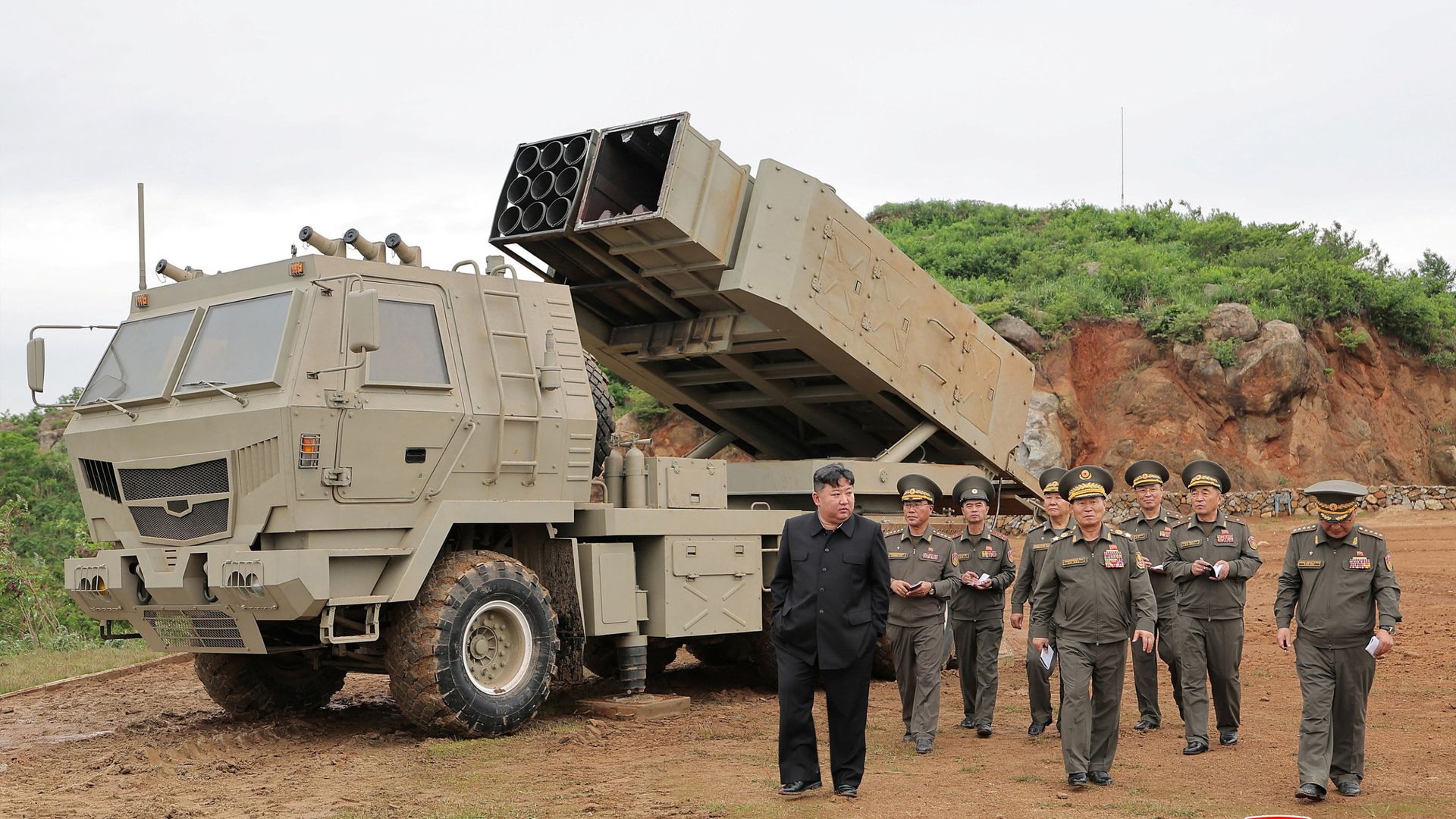
The tests, overseen directly by Kim Jong Un, involved a mixed bag of hardware launched from the Chongju area in North Pyongan Province. The military demonstration featured a simultaneous "mixed-fire" launch of close-range ballistic missiles (CRBMs), 240mm guided artillery rockets, and these new AI-guided tactical cruise missiles.
The real question everyone is asking is simple: Is North Korea's AI legit, or is this just more state-sponsored hype?
To understand what's actually happening, you have to look closely at the hardware they tested and how these systems work together.
The Reality Behind Pyongyang's Intelligent Missiles
When the Korean Central News Agency (KCNA) announced the tests, they dropped some highly specific technical jargon. They claimed the new tactical cruise missile uses a three-layered navigation system: ultra-precision autonomous navigation, terrain contour matching (TERCOM), and an AI terminal guidance function.
What does that actually mean in plain English?
Basically, the missile doesn't rely on GPS signals, which the US or South Korea could easily jam during a conflict. Instead, it uses sensors to look at the ground below it, matching the landscape against pre-loaded digital maps to find its way. Then, as it gets close to the target—the terminal phase—the internal AI takes over.
According to military experts like Yang Uk from the Asan Institute for Policy Studies, this AI is focused entirely on automated target recognition. The missile uses an onboard computer chip to analyze real-time video or radar data of the battlefield, independently identifying its assigned target and adjusting its flight path to strike with pinpoint accuracy.
North Korea claims these cruise missiles have a range of 100 kilometers. That number is highly intentional.
The demilitarized zone (DMZ) is less than 60 kilometers from Seoul. By deploying these new missiles to frontline long-range artillery brigades along what Kim Jong Un now calls the "southern border area," North Korea places the entire South Korean capital, its government centers, and key military bases directly in the crosshairs.
Why Mixed-Fire Tactics Nightmare for Missile Defense
The inclusion of AI is frightening on its own, but the real danger lies in how North Korea plans to deploy these weapons. They aren't going to fire these AI cruise missiles in isolation.
During the latest tests, Pyongyang purposely utilized a "mixed shooting" strategy. They fired short-range ballistic missiles, heavy artillery rockets, and cruise missiles all at the same exact time.
Think about how air defense works. Systems like South Korea’s Patriot batteries or the US THAAD system are exceptionally good at tracking and intercepting high-altitude ballistic missiles. But cruise missiles fly incredibly low, hugging the terrain to stay hidden under radar coverage.
When you launch a massive volley of artillery rockets and ballistic missiles, you flood the radar screens of defendents. While air defense crews are frantic trying to track and shoot down the incoming ballistic threats, the low-flying, AI-guided cruise missiles slip through the chaos undetected.
Once they get past the primary defense perimeter, the AI allows these missiles to independently lock onto specific high-value targets, like command bunkers or radar installations, without requiring any external communication or human intervention.
Legit Tech or Pyongyang Propaganda?
It's easy to dismiss North Korean tech claims. The country is economically isolated, heavily sanctioned, and prone to inflating its military capabilities. Analysts like Hong Min from the Korea Institute for National Unification point out that it's nearly impossible to independently verify the exact sophistication of North Korea's software.
But dismissing this as pure fiction is a dangerous mistake.
Over the past few years, academic researchers have tracked a surge in North Korean scientific papers focusing on machine learning, computer vision, and neural networks. They aren't building ChatGPT; they are focusing heavily on target recognition software and automated command systems.
Furthermore, we can't ignore the geopolitical elephant in the room. North Korea has significantly deepened its military cooperation with Russia, supplying millions of artillery shells and ballistic missiles for use in Ukraine. In exchange, intelligence agencies fear that Moscow may be sharing advanced military technology with Pyongyang—including software, sensor tech, and AI algorithms refined on the battlefields of Europe.
Even if North Korea’s AI is relatively primitive compared to Western standards, it doesn't need to be perfect to be effective. If an automated target recognition system increases a missile's accuracy from a 50-meter radius to a 5-meter radius, that's an existential leap in capability for frontline forces.
The Breakdown of Inter-Korean Deterrence
This technical escalation matches Kim Jong Un's broader, hyper-aggressive political strategy. At the end of 2023, Kim officially discarded the decades-old policy of seeking peaceful reunification with the South. He declared South Korea the "principal enemy" and redefined inter-Korean relations as a relationship between "two hostile states."
Since then, the regime has physically torn up cross-border rail lines, fortified frontline positions, and adjusted its military doctrine to allow for immediate, preemptive strikes.
The deployment of AI-guided tactical weapons to the "southern border area" is the hardware realization of this political shift. It signals that Pyongyang is moving away from purely strategic deterrence—holding nuclear weapons just to prevent an invasion—and moving toward tactical war-fighting capabilities. They are building weapons meant to be used in a localized conflict, designed specifically to overwhelm the defenses of the Seoul metropolitan area.
What Happens Next
The introduction of AI into North Korea's arsenal changes the calculus for regional security. Traditional electronic warfare and GPS-jamming techniques won't be enough to stop these weapons if they can navigate autonomously via terrain mapping and optical target recognition.
For military strategists in Seoul and Washington, the priority must shift toward upgrading close-in weapon systems (CIWS) and expanding automated drone-and-missile interception capabilities that can counter low-altitude, autonomous threats. Additionally, intelligence efforts will need to focus heavily on tracking the transfer of dual-use technologies and software components flowing into North Korea from foreign networks.
The era of autonomous warfare is no longer a future projection for East Asia. It's happening right now on the frontlines of the DMZ, and the margin for error just got razor-thin.