Every time Pyongyang rolls a new munition out onto a test range, the defense press reacts like a startled flock of pigeons. The headlines write themselves. Kim Jong-un unveils terrifying new weapon. Regional tensions spike. Escalation reaches fever pitch.
It is predictable. It is lucrative for clicks. And it is dead wrong.
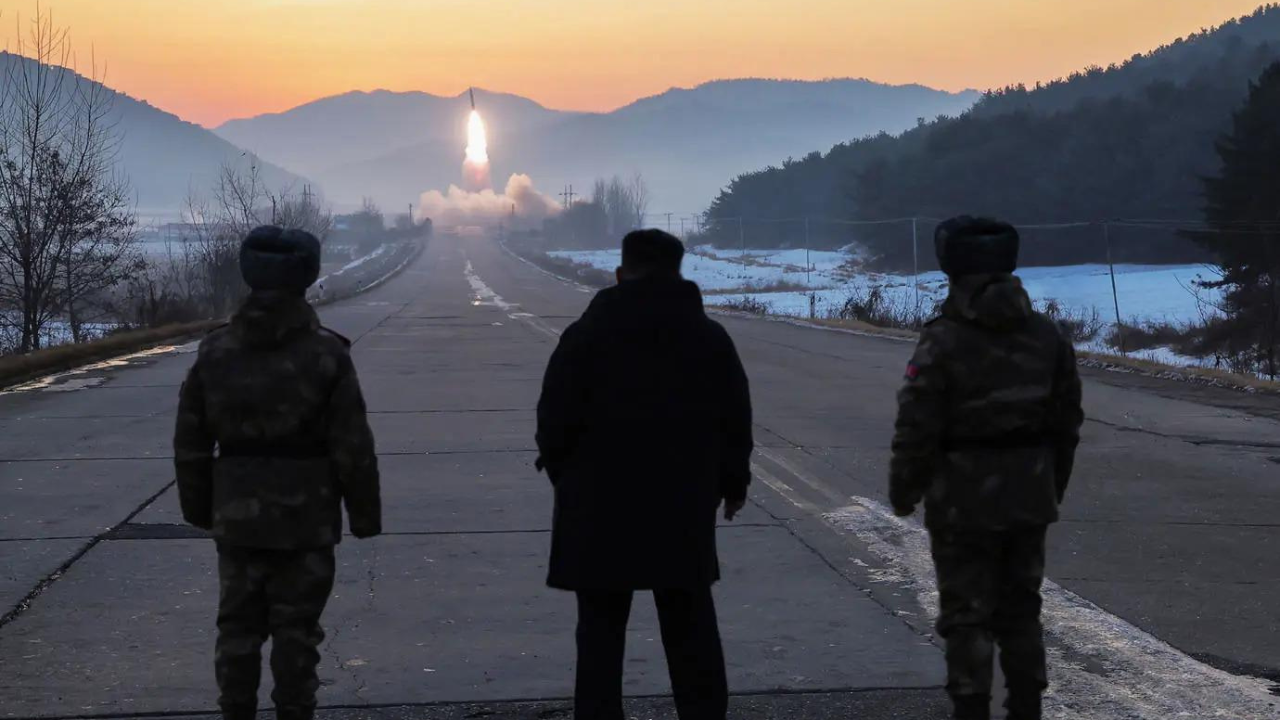
The latest wave of breathless coverage surrounding North Korea’s test of a cluster-bomb warhead follows this exact script. Mainstream analysts look at the state-media photos of submunitions scattering across a target zone and immediately default to panic. They frame this as another reckless leap toward regional annihilation, an unpredictable dictator rattling a shiny new saber just to watch Seoul and Washington squirm.
That lazy consensus misses the actual mechanics of modern warfare. Worse, it blinds policymakers to what the Korean People’s Army (KPA) is actually doing.
North Korea isn't testing cluster warheads because Kim Jong-un woke up feeling unusually bellicose. They are doing it because nuclear weapons are functionally useless for winning a conventional war on the Korean Peninsula, and Pyongyang finally realized its Cold War artillery doctrine has a massive, fatal flaw.
The Nuclear Illusion and the Conventional Reality
For twenty years, defense commentators have treated North Korea’s nuclear program as the sole metric of its military threat. If it has a mushroom cloud attached to it, it gets front-page coverage. If it doesn't, it gets relegated to a three-paragraph wire brief.
This obsession with megatons has rotted strategic analysis from the inside out.
A nuclear warhead is a suicide pact. Kim Jong-un knows that the exact second a nuclear-tipped ballistic missile leaves a Transporter Erector Launcher (TEL) aimed at a U.S. base or a South Korean city, his regime ceases to exist. Nuclear weapons are survival insurance, not war-fighting tools. They keep foreign armies from marching on Pyongyang, just as they did for decades during the Cold War.
If North Korea ever actually intends to fight—or even credibly threaten to fight—a limited conflict, it cannot use nukes. It has to rely on conventional firepower.
And here is the dirty secret that rarely makes it into mainstream news coverage: North Korea’s conventional artillery force, long hyped as an unstoppable "sea of fire" capable of flattening Seoul in hours, is largely obsolete.
I have spent years dissecting satellite imagery of KPA hardened artillery sites (HARTS) along the Demilitarized Zone and reviewing the post-strike assessments of legacy Soviet-bloc ordnance. Most of North Korea’s tube artillery consists of aging 122mm, 130mm, and 152mm systems firing standard high-explosive (HE) fragmentation shells. Against dug-in troops, reinforced concrete bunkers, and modern mobile air defense batteries, a standard unitary HE warhead is remarkably inefficient. If a shell lands fifty meters away from a Patriot radar unit or an armored personnel carrier, it kicks up dirt and dents some paint. It does not achieve a mission kill.
To destroy a dispersed military target with unitary shells, you have to fire hundreds of rounds, which gives South Korean and U.S. counter-battery radars—like the AN/TPQ-53—all the time they need to triangulate your position and drop precision-guided munitions directly onto your gunners' heads.
Enter the cluster warhead.
How Submunitions Actually Change the Math
To understand why Pyongyang is pouring resources into Dual-Purpose Improved Conventional Munitions (DPICM) and rocket-delivered submunitions, you have to stop looking at the politics and look at the physics of lethality.
A unitary warhead puts all its explosive mass in one spot. The blast radius drops off exponentially—specifically, according to the cube-root scaling law of explosives. Doubling the weight of a single warhead does not double its lethal radius; it barely increases it by about 26 percent. You get massive overkill at ground zero and almost zero effect a short distance away.
A cluster warhead breaks that geometric trap. Instead of one 500-kilogram block of TNT, a missile or large-caliber rocket carries hundreds of tiny, fist-sized bomblets.
When the carrier vehicle reaches a predetermined altitude over the target, a bursting charge splits the skin open. Centrifugal force or aerodynamic drag disperses those bomblets over a footprint the size of several football fields. Each individual submunition typically combines two lethal mechanisms:
- A shaped-charge copper liner: Upon impact, the explosive collapses the copper cone into a hyper-velocity jet of metal capable of punching through several inches of rolled homogeneous armor—more than enough to penetrate the thin top deck of a main battle tank or self-propelled howitzer.
- A scored steel casing: This shatters into hundreds of high-velocity fragments designed to shred exposed infantry, radar dishes, fuel bladders, and unarmored logistics trucks.
Look at what that does to the operational math on the Korean Peninsula.
South Korea and the United States rely heavily on networked, mobile assets. THAAD batteries, Patriot launchers, K9 Thunder self-propelled howitzers, and forward command posts do not sit in neat little rows waiting to be hit by a single precision missile. They disperse. They hide in valleys. They move.
With a unitary warhead, North Korea needs exact, real-time coordinates—down to a few meters—to destroy a mobile air defense battery. North Korea’s intelligence, surveillance, and reconnaissance (ISR) satellites are still primitive. They don't have the targeting fidelity required for precision strikes against moving targets.
With a cluster warhead, they don't need precision. They only need to know roughly which grid square the battery is hiding in. One rocket saturates the entire grid square. Suddenly, North Korea’s lack of high-end targeting satellites doesn't matter anymore. Area saturation compensates for terrible accuracy.
The Ukraine Lesson Nobody Wants to Admit
Mainstream articles love to frame Kim Jong-un’s weapon tests as the erratic behavior of an isolated madman. That framing is comforting because it implies our adversaries are irrational.
They aren't. Pyongyang is running one of the most aggressive, real-time military R&D feedback loops on the planet right now, funded and informed directly by the war in Ukraine.
When Western nations finally caved and sent DPICM artillery shells to Kyiv in 2023, the battlefield impact was immediate and brutal. Russian infantry assaults that had shrugged off standard artillery barrages were suddenly shredded in open fields. Trench networks that took weeks to clear with unitary shells were neutralized in minutes.
North Korea was watching. More importantly, North Korea was supplying millions of rounds of ammunition to Russia, giving KPA observers front-row access to how modern high-intensity artillery duels actually play out.
They saw two undeniable realities:
- Precision weapons run out fast, and electronic warfare degrades them. GPS-guided rockets lose their edge when heavy jamming blankets the front lines. Dumb submunitions dispersed over a wide area cannot be jammed. Gravity and physics do not care about electronic countermeasures.
- Massed area denial is king. In a war of attrition, a single rocket that does the work of twenty standard shells saves barrel life, reduces logistical strain, and minimizes the time firing units spend exposed to counter-battery fire.
By testing and fielding cluster warheads on its larger tactical guided weapons and multiple launch rocket systems (MLRS)—like the 240mm and 300mm platforms—North Korea is directly importing the bloodiest lessons of Eastern Europe to the 38th Parallel.
Dismantling the "Unexploded Ordnance" Distraction
Whenever cluster munitions hit the news cycle, the conversation inevitably detours into humanitarian law. Commentators bring up the 2008 Convention on Cluster Munitions, cite dud rates, and express shock that Pyongyang would field weapons that leave unexploded bomblets scattered across the landscape for decades.
This is a complete waste of analytical oxygen.
First, neither North Korea, South Korea, nor the United States has signed the Convention on Cluster Munitions. The Korean Peninsula is one of the few places on earth where both sides openly maintain stockpiles of cluster munitions precisely because the terrain and force densities demand them.
Second, focusing on the postwar hazard of unexploded ordnance (UXO) ignores how Pyongyang actually views UXO during a war. To a KPA commander, a 10 to 15 percent dud rate isn't a humanitarian tragedy; it’s a tactical bonus.
Imagine a scenario where North Korean forces launch a surprise barrage of cluster rockets onto South Korean airbases at Osan or Kunsan. The initial strike craters the runways, destroys parked aircraft, and kills ground crews. Now, South Korean engineering battalions have to rush onto the tarmac with bulldozers and quick-setting concrete to repair the runway so fighter jets can launch.
If 15 percent of those submunitions failed to detonate on impact, that runway is now covered in hair-trigger anti-personnel mines. Cleanup crews cannot just drive heavy machinery over the tarmac; they have to clear every square meter by hand under the threat of follow-up strikes. A sortie generation rate that should have recovered in four hours is suddenly delayed for two days.
In military doctrine, that is called area denial. Pyongyang knows this. Treating their adoption of cluster warheads as some kind of moral shock or treaty violation completely misunderstands the cold, utilitarian calculus of the KPA General Staff.
What Everyone Gets Wrong About North Korean Deterrence
If you ask the average defense pundit, "Why is North Korea testing cluster bombs now?" they will tell you it’s to influence an upcoming U.S. election, or to extort sanctions relief, or to distract from domestic food shortages.
That diplomatic parlor-game analysis is completely backwards.
North Korea tests weapons when the engineers say the weapons are ready to be tested. Period. R&D timelines in defense manufacturing are dictated by metallurgy, propellant chemistry, and fuze reliability, not by the CNN news cycle.
Furthermore, this test reveals a critical shift in how Pyongyang views deterrence. For years, North Korea relied on strategic deterrence—threatening to burn down cities with nuclear ICBMs. The problem with strategic deterrence is that it isn't credible for small provocations. If a border skirmish breaks out in the West Sea, nobody believes Kim Jong-un will launch an ICBM at Washington over a sunken patrol boat.
By building out a devastating, non-nuclear, area-saturation capability, Pyongyang is establishing escalation dominance at the conventional level.
They are signaling to Seoul and Washington: Even if we keep this fight strictly non-nuclear, we can paralyze your airbases, wipe out your forward artillery, and shred your maneuver brigades before your reinforcements ever cross the Pacific.
The Flaw in Pyongyang's New Toy
Before anyone starts building a backyard bunker, we need to be honest about the limitations of North Korea’s new cluster capability. Just as mainstream media overhypes the political drama, hawkish think tanks often overestimate the technical execution of North Korean hardware.
Developing a reliable cluster warhead is notoriously difficult. It is not as simple as stuffing grenades into a pipe.
- Dispersion Mechanics: If the bursting charge is too weak, the submunitions clump together and hit the exact same spot, wasting the entire point of a cluster weapon. If the charge is too strong, it destroys the delicate fuzes inside the bomblets before they even reach the ground.
- Fuze Reliability: North Korea’s industrial base struggles with mass-producing precision micro-components. During the war in Ukraine, Russian forces discovered that significant batches of North Korean artillery shells had erratic propellant loads and faulty fuzes. A cluster warhead requires hundreds of tiny, identical mechanical or piezoelectric fuzes to function simultaneously upon hitting dirt, asphalt, or steel at oblique angles. If their quality control slips, a terrifying "area-saturation weapon" quickly turns into expensive scrap metal raining harmlessly onto a hillside.
- Countermeasures: Modern armor is increasingly fitted with explosive reactive armor (ERA) and active protection systems, while infantry units rely on hardened overhead cover and dispersal tactics honed specifically to survive drone and submunition threats.
North Korea has solved a doctrinal problem on paper, and their test footage looks impressive on state television. Proving that their factories can mass-produce hundreds of thousands of these complex warheads without crippling defect rates is an entirely different beast.
Stop Watching the Parades, Start Watching the Logistics
If you want to actually understand whether North Korea is preparing for war—or simply modernizing its deterrent—stop reading articles that breathlessy translate KCNA propaganda releases every time Kim Jong-un wears a leather jacket at a missile launch.
Look at the boring stuff instead:
- Track the production of large-caliber MLRS chassis. A warhead is useless without a launcher. Watch how many 240mm and 300mm wheeled launchers roll out of the February 11 Plant.
- Monitor underground storage expansion near the DMZ. Cluster munitions are bulky and sensitive to moisture and temperature swings. Fielding them at scale requires upgraded logistics depots close to the front lines.
- Watch South Korea’s response. Ignore what politicians say at press conferences; watch what the Republic of Korea Armed Forces buy. If Seoul suddenly accelerates procurement of counter-rocket, artillery, and mortar (C-RAM) laser systems, hardened aircraft shelters, and autonomous runway-repair drones, you know their intelligence community takes the submunition threat seriously.
The media wants you to believe North Korea’s latest test is another irrational tantrum from a rogue state. It isn't. It is a cold, calculated adaptation to modern warfare that makes a conventional conflict on the Korean Peninsula vastly more lethal—and infinitely harder for the U.S. and its allies to contain without going nuclear.