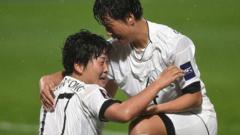
Western sports media loves a lazy predictable script. Whenever the North Korean women's national football team rolls into a tournament—whether it’s a regional clash in Seoul or a FIFA youth championship—the headlines write themselves. Journalists fall over themselves to paint these athletes as robotic anomalies, isolated underdogs, or mysterious products of a secretive regime pulling off shocking victories against all odds.
It is a comfortable narrative. It is also entirely wrong.
The assumption that North Korea’s dominance in women’s football is a fluke born of isolated desperation misses the actual mechanics of how international sports development works. Having spent years tracking the infrastructure of Asian football and analyzing FIFA’s development pipelines, I can tell you that Pyongyang’s success is not a mystery. It is a highly calculated, heavily funded institutional machine. They are not underdogs fighting for a title against the odds; they are the structural favorites who treat anything less than a trophy as an institutional failure.
To understand why the mainstream sports press gets this wrong, you have to dismantle the premise of how elite athletes are actually made.
The Mirage of the Isolated Underdog
The standard commentary views the North Korean squad through a lens of geopolitical pity. Outlets highlight the lack of internet access, the travel restrictions, and the political tensions of playing in Seoul to imply that these women are somehow structurally disadvantaged on the pitch.
This is flawed logic. In professional sports, isolation is often a competitive advantage, not a hindrance.
While South Korean, Japanese, and American players navigate the exhausting realities of modern professional sports—juggling club contracts, commercial sponsorship obligations, media scrutiny, and the constant threat of burnout from year-round league play—the North Korean system operates on a centralized military model.
- Year-Round Resident Training: The core national team pool lives and trains together almost continuously at the Pyongyang International Football School and dedicated state complexes.
- Tactical Telepathy: While rival national coaches get their players for mere days during FIFA international windows, North Korea's staff commands what is essentially a permanent club team operating at the international level.
- Zero Distractions: There are no commercial shoot days, no agent negotiations, and no social media controversies.
When you see their players display suffocating synchronization on the pitch, it isn't magic. It is the direct result of thousands of hours of collective tactical drilling that no Western federation can replicate without violating labor laws or player union agreements.
The Institutional Blueprint of the Pyongyang Machine
Let’s look at the hard data the mainstream media ignores. In 2013, the state established the Pyongyang International Football School, a massive facility designed to scout and house hundreds of the country's most elite young talents. This wasn’t a minor vanity project; it was a systemic redirection of state sports funding toward a discipline where they realized they had a massive structural edge: women's youth football.
Historically, global investment in women’s sports was abysmal. While the men's game was hyper-competitive and saturated with billions of dollars, the women’s international landscape was wide open for decades. North Korea recognized this market inefficiency earlier than almost anyone else.
By aggressively funding elite academies for young girls while European and South American federations were still treating their women's teams as underfunded afterthoughts, North Korea secured a generational stranglehold on youth tournaments. Look at the record books. They aren't just competitive; they are multi-time FIFA U-17 and U-20 Women's World Cup champions.
The players arriving at senior tournaments are not wide-eyed newcomers. They are tournament-hardened veterans of a brutal internal selection process that weeds out anyone who cannot handle elite physical duels.
Deconstructing the People Also Ask Fallacies
When fans look up the team during tournaments, the search queries reveal just how deeply the misconceptions run. Let’s answer the most common questions with brutal honesty rather than media-friendly platitudes.
How does North Korea produce world-class footballers without a major domestic pro league?
The premise of this question assumes that a commercial, Western-style professional league is the only mechanism to produce elite talent. It isn't.
A domestic league like the NWSL or the WSL relies on commercial viability, ticket sales, and television rights. The North Korean system replaces market demand with state mandate. Elite clubs like April 25 Sports Club and Amrokkang Sports Club operate under the purview of military and government agencies.
The players do not need a commercial league to stay sharp because their domestic calendar is structured entirely around preparing the national pool for international stages. They lack the commercial fluff, but they possess an elite, concentrated competitive environment.
Are North Korean players technically inferior to Western stars?
This is a patronizing myth born of Eurocentric bias. Watch the tape. The technical profile of a North Korean midfielder is characterized by incredibly tight ball control, rapid transitional passing, and flawless physical conditioning.
Because they train under a centralized curriculum from childhood, their fundamental technical baselines are uniform. There are no stylistic outliers or tactical wildcards on the pitch. Every player understands pressing triggers, spatial coverage, and recovery runs with mechanical precision. They do not rely on individual star power like an Alex Morgan or a Sam Kerr; they rely on systemic suffocating pressure.
The Hard Truth of the Centralized Model
To be absolutely clear, this system has profound downsides that no free society should ever wish to emulate. The psychological pressure on these athletes is immense. A poor performance on the international stage does not just mean bad press or a dropped sponsorship deal; it carries severe institutional consequences and a loss of state privilege. The lack of personal autonomy means these players cannot choose their career paths, negotiate their own livelihoods, or test their skills in the top-tier leagues of Europe or North America.
But hiding behind moral superiority shouldn't blind us to the objective sporting outcomes of their system.
When sports analysts pretend that North Korea wins purely through sheer grit, nationalistic fervor, or "mystery," they are giving Western federations a pass for their own historic neglect of women’s sports development.
North Korea wins because they treated women’s football as a serious geopolitical priority long before the rest of the world bothered to pay attention. They built the infrastructure, centralized the talent, and treated the sport with cold, calculated seriousness.
Stop analyzing this team as a curiosity or an emotional underdog story. They are an elite, highly structured footballing powerhouse designed to exploit the tactical and organizational weaknesses of open-market federations. When they step onto the pitch in Seoul, they aren't fighting for a miracle. They are executing a blueprint.


