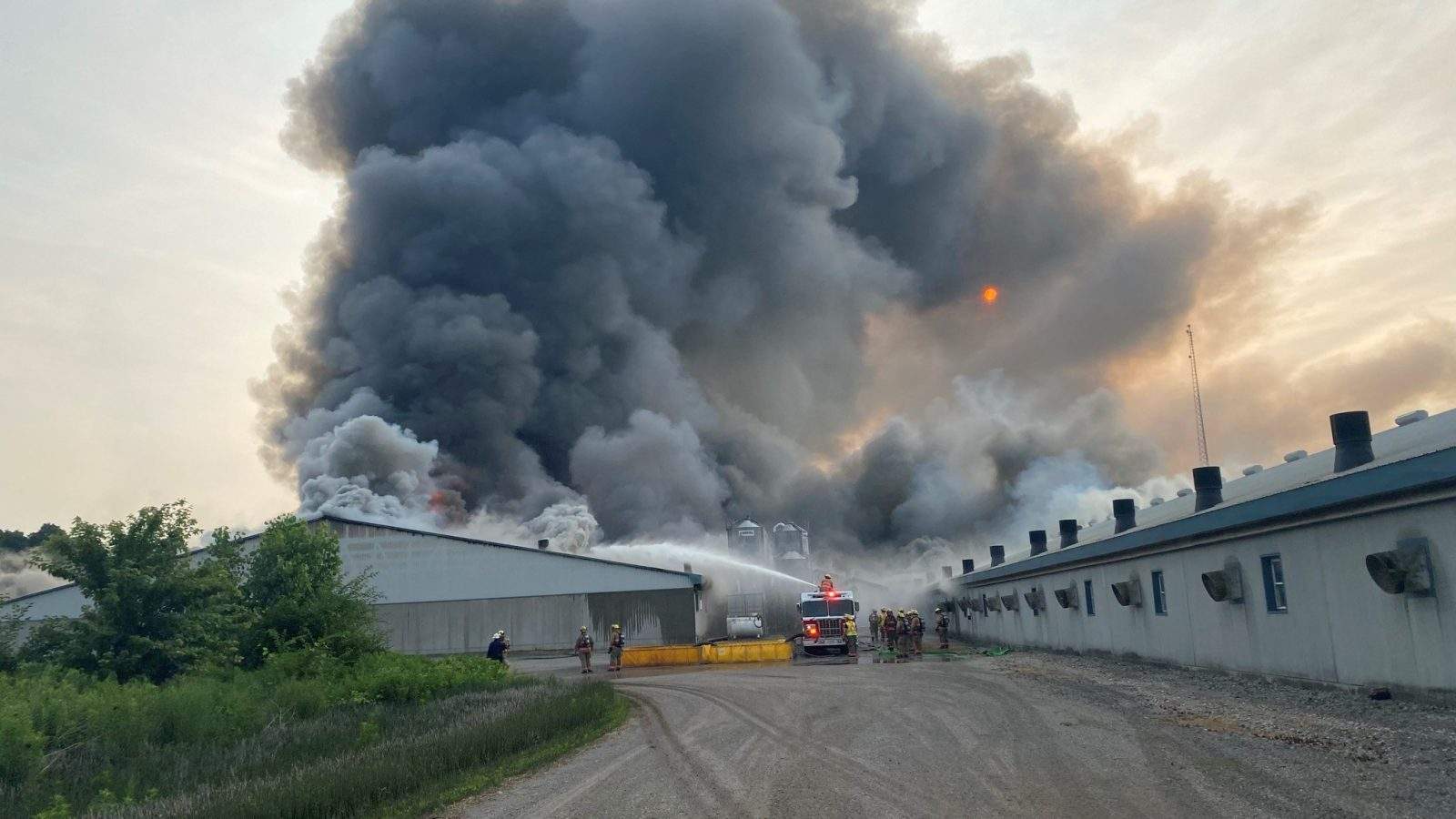
A four-acre barn doesn't just catch fire; it becomes an uncontrollable furnace in minutes.
On Tuesday morning, July 14, 2026, a massive blaze ripped through a hog farm on Highway 3 just west of Simcoe, Ontario. The scale of the disaster is staggering: an estimated 20,000 hogs perished in the flames. This makes it one of the most devastating agricultural fires in the province’s recent history.
As forty firefighters from eight different stations battled the inferno under a sweltering summer heatwave, the incident highlighted a harsh reality. Modern mega-barns are highly efficient, but when something goes wrong, the scale of the loss is almost unfathomable.
What Happened on Highway 3
Farm staff first noticed smoke creeping through the facility around 6:30 a.m.. Within minutes, the situation escalated. By the time emergency crews received the call at 6:45 a.m., the building—a sprawling, 200,000-square-foot facility—was already fully engulfed.
The building was roughly the size of four football fields. Because of the intense heat and the rapid spread of the fire, firefighters couldn't save the animals. The entire structure was declared a total loss.
Norfolk County Fire Response at Peak:
- 8 fire stations deployed
- 40 to 50 firefighters on scene
- 14 to 15 emergency apparatuses used
Thankfully, no farm staff or firefighters were injured. However, battling a blaze of this magnitude in the middle of a Southern Ontario heatwave took a severe physical toll on the crews.
Why Barn Fires Spread So Fast
Many people wonder how a modern farming facility can burn down so quickly, leaving zero chance for evacuation. If you've ever spent time inside an industrial livestock barn, you know the environment is a perfect storm for fire hazards.
- High Dust Levels: Feed dust and dried dander are highly combustible. Once suspended in the air, they act like fuel, accelerating a small spark into an explosion of flame.
- Corrosive Environments: The air inside a hog barn contains high levels of moisture, ammonia, and hydrogen sulfide. Over time, these gases corrode electrical conduits, outlets, and heating equipment, causing short circuits.
- Massive Open Spaces: To maximize efficiency, modern barns feature massive open floor plans. Without firewalls or physical barriers, drafts push heat and smoke through the entire building in seconds.
Norfolk County Deputy Fire Chief James Robertson noted that while the cause remains under investigation, the fire is not considered suspicious. The Ontario Fire Marshal has been notified, though the sheer destruction of the four-acre facility will make pinpointing the exact ignition source incredibly difficult.
The Broader Impact on Local Communities
The tragedy doesn't stop at the property line. Norfolk County issued an advisory urging nearby residents to stay indoors.
A combination of extreme summer heat, high humidity, and heavy smoke created a plume of poor air quality that drifted across the region. For locals downwind, the air wasn't just unpleasant—it was a health hazard.
Meanwhile, Ontario Provincial Police closed down Highway 3 between Charlotteville East Quarter Line and Windham East Quarter Line Road to allow water tankers to shuttle back and forth to the scene.
How Farmers Can Protect Their Livestock
While the local farming community rallies to support the owners of this operation, this disaster serves as a stark reminder for other producers. You can’t eliminate fire risk entirely, but you can dramatically reduce the odds.
1. Upgrade to Corrosive-Resistant Electrical Systems
Don't cut corners on wiring. Standard residential or commercial electrical boxes don't hold up in livestock environments. Use dust-tight, watertight, and corrosion-resistant fixtures (NEMA 4X rated) to prevent arc flashes.
2. Implement Thermal Imaging Inspections
Have an electrician inspect your barn annually using infrared thermal imaging. This technology detects hot spots in breaker panels, motors, and heaters before they actually spark a fire.
3. Install Smart Heat and Smoke Detection
Standard smoke detectors get clogged with dust instantly in a hog barn. Instead, invest in aspirating smoke detection systems or rate-of-rise heat detectors that are built to handle dirty agricultural environments. Connect these to a smart alarm system that alerts your phone immediately.
4. Create Fire Breaks
If you're building new facilities or renovating existing ones, design them with firewall partitions. Dividing a massive barn into smaller, sealed zones can buy firefighters the precious time they need to contain a localized fire and rescue livestock in adjacent rooms.