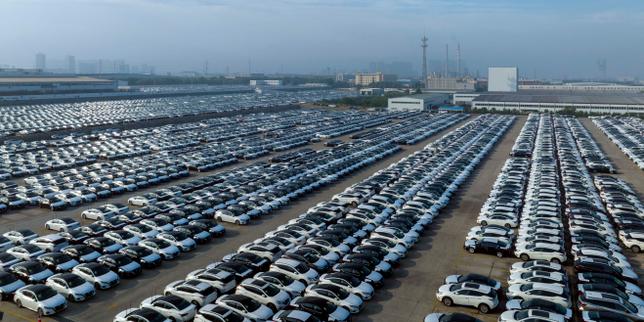
The financial press is obsessed with the "fall" of Nissan. They point at shrinking margins in China and a desperate scramble to overhaul manufacturing as proof of a terminal decline. They call it a collapse. I call it a long-overdue amputation.
Most analysts are looking at the wrong metrics. They see the surge of BYD and Xiaomi as a death knell for the legacy Japanese guard. They assume that because Nissan is closing plants and slashing 9,000 jobs, the brand is circling the drain. That is lazy thinking. Nissan isn't being "laminated" by the competition; it is being forced to shed the bloated, inefficient skin of the Carlos Ghosn era.
If you think Nissan's problem is just "Chinese EVs," you haven't been paying attention to the structural rot that has plagued the Renault-Nissan-Mitsubishi Alliance for a decade. The current restructuring isn't a retreat. It is a violent, necessary correction of a volume-at-all-costs strategy that nearly bankrupted the firm years before a single MG or Zeekr hit the European market.
The Myth of the Chinese Juggernaut
The narrative is simple: China moved faster, and Japan slept. It’s a convenient story, but it misses the fundamental physics of the automotive market. The Chinese EV market is currently sustained by a brutal price war that is incinerating capital. While firms like BYD have achieved impressive scale, dozens of other Chinese players are burning through cash at a rate that would make a Silicon Valley startup blush.
Nissan’s struggle in China isn't a failure of engineering. It is a failure of local relevance and a refusal to compete in a race to the bottom on price. The "lazy consensus" says Nissan must spend billions to catch up. The contrarian truth? Nissan should stop trying to beat China at its own game.
China is a sandbox for subsidized experimentation. The real war is being fought on global operational efficiency. Nissan’s "The Arc" plan, which targets a 30% reduction in the cost of next-generation EVs, isn't about matching Chinese software; it’s about fixing the broken industrial math that Ghosn left behind.
The Ghosn Hangover Nobody Wants to Discuss
To understand why Nissan looks "weak" now, you have to understand the damage of the 2010s. Under previous leadership, Nissan chased market share like a drug addict. They pushed massive incentives to rental fleets. They lowered credit standards to move units. They over-extended their global footprint until they were producing cars in 20 different ways across 30 different regions.
That complexity is a silent killer.
I have seen companies blow millions trying to maintain legacy platforms while simultaneously pivoting to new tech. You cannot do both. Nissan's current "desperation" is actually the first time in twenty years the company has prioritized profitability per unit over raw volume.
The goal isn't to be the biggest anymore. It is to be the most efficient. Reducing global production capacity by 20% isn't a sign of defeat; it is an admission that the previous targets were delusions of grandeur.
Smart Manufacturing is Not a Buzzword
The critics scream that Nissan is "revising its industrial model" too late. They are wrong about the "late" part. They are also wrong about what "revising" means.
We are talking about the move toward gigacasting and modular production. Everyone credits Tesla for this, but the implementation is where the battle is won. Nissan’s focus on integrated powertrains—where the motor, inverter, and reducer are standardized across models—is the only way to survive.
Consider the $X$-in-1 approach. By sharing components between internal combustion engines (ICE) and EVs, Nissan is hedging its bets. While the "EV or die" crowd demands a total shift, Nissan is quietly ensuring they don't go broke if the EV transition takes twenty years instead of five.
This isn't "hedging." It's intelligent risk management.
The People Also Ask Fallacy
Most people asking "Will Nissan go bankrupt?" are looking at the $1.1 billion operating loss reported in recent quarters. They ignore the $13 billion in cash and equivalent assets. Nissan isn't broke; it’s just poorly optimized.
Another common question: "Why can't Nissan just copy Tesla?"
Because Nissan is a mass-market manufacturer with a global legacy footprint. You cannot "copy" a greenfield startup when you have thirty plants and a hundred thousand employees. You have to transform the existing mass. That is a 10x harder engineering challenge than building a factory in a desert and starting from scratch.
The Internal Combustion Engine is Not Dead
Here is the most polarizing take: Nissan’s salvation lies in its e-POWER technology, not its pure EVs.
The Western media loves a binary choice. Either you are all-electric or you are a dinosaur. But the global south, Southeast Asia, and large swaths of the United States are nowhere near ready for a total EV infrastructure. Nissan’s e-POWER—a system where a gas engine acts as a generator for an electric motor—is the perfect bridge.
It provides the EV driving experience without the "range anxiety" that remains a very real barrier for 80% of the world’s car buyers. By doubling down on this, Nissan is capturing the "silent majority" of buyers who aren't ready to go full-BEV but want better fuel economy.
The Cost of the "Clean" Pivot
Is there a downside to this strategy? Absolutely.
By slashing 9,000 jobs and reducing capacity, Nissan risks losing its best engineering talent to more "exciting" startups. There is a morale tax to being a company in "restructuring" mode. It becomes harder to recruit the software developers needed to make the digital cockpits that modern consumers crave.
Furthermore, by reducing their model lineup, they are ceding territory. They are moving from a "department store" model to a "boutique" model. If they pick the wrong segments to abandon, they might find themselves with a very efficient production line for cars that nobody wants.
Stop Asking if Nissan Will Survive
Start asking what the global auto industry looks like when the "growth at all costs" bubble finally bursts.
When the subsidies in China dry up and the true cost of raw materials for batteries hits the bottom line, the companies that will survive are the ones that spent 2024 and 2025 gutting their overhead.
Nissan is doing the hard, ugly work now. They are taking the headlines about "crisis" and "failure" on the chin while they quietly re-engineer their entire cost base. They are moving away from the "bigger is better" fallacy that destroyed Detroit in the early 2000s and nearly killed them in 2019.
The competitor's article sees a victim. I see a predator that is cutting off its own trapped limb to get out of a snare. It's not pretty. It's not "seamless." But it's the only way to live.
Sell the stock if you want a short-term pump. Hold it if you want to see what happens when a legacy giant finally stops lying to itself about its own math.
Nissan isn't being erased. It's being edited.