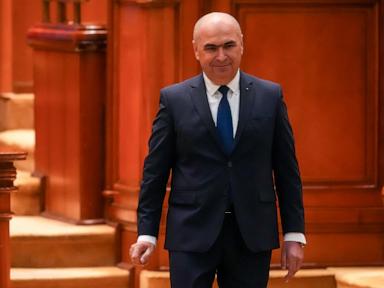
The air inside the Palace of the Parliament doesn’t circulate. It sits heavy, smelling of floor wax and the ghosts of a communist past, trapped within walls so thick they seem designed to muffled the very idea of dissent. Somewhere in the labyrinth of the world's second-largest administrative building, a man sits at a mahogany desk, watching a digital clock tick toward his professional execution.
Prime Minister Marcel Ciolacu is not just fighting for a job. He is fighting for the right to remain the face of a nation that is tired of looking at its own reflection. Outside, the cobblestones of the Old Town are slick with a light drizzle, and the people drinking sour cherry brandy in the cafes aren’t talking about "legislative frameworks" or "budgetary deficits." They are talking about the price of eggs and the fact that their children keep moving to Berlin.
This is the reality of a no-confidence motion. To a political scientist, it is a mechanism of democratic accountability. To the Romanian people, it is a Tuesday.
The Theater of the Absurd
In the grand hall, the microphones are being tested. Check. One. Two. The sound echoes off the marble. The opposition benches are a sea of sharp suits and practiced indignation. They hold folders full of grievances like sharpened daggers. The charge is simple: incompetence. The subtext is far more complex.
Politics in Bucharest has always been a contact sport. It is a game played with long memories and short tempers. The current government stands accused of steering the ship into the rocks of inflation while the crew argues over who gets to wear the captain's hat. But to understand why this moment feels different, you have to look past the podium.
Consider a hypothetical citizen named Elena. She is sixty-two years old and lives in a fourth-floor apartment in Sector 3. When the television news talks about a "no-confidence motion," Elena doesn’t see a constitutional process. She sees the possibility that her pension increase—the one promised to cover the skyrocketing cost of heat—might vanish in the legislative smoke. For Elena, the Prime Minister is a distant figure, but the stability he represents is the only thing standing between her and a cold winter.
The stakes are invisible until they aren't.
A House Built on Shifting Sands
Romania’s political landscape is not a solid foundation; it is a marsh. Alliances are forged in the morning and dissolved by dinner. The current coalition, an awkward marriage of the Social Democrats and the National Liberals, was always a union of convenience rather than conviction. They came together because the alternative was chaos, and now, ironically, chaos is exactly what the no-confidence motion promises to deliver.
The opposition argues that the government has failed to tap into the billions of euros in European Union recovery funds. They point to unfinished highways that end abruptly in fields of sunflowers. They point to hospitals where the paint is peeling like sunburned skin.
"They are eating the future," one opposition leader shouts into the microphone. It is a good line. It will make the evening news. But it ignores the structural rot that has plagued the system for decades. No single man, not even one sitting at the head of the table, can fix a machine where half the gears are missing and the other half are rusted shut.
The Prime Minister’s defense is predictable. He speaks of "stability in a time of regional war." He gestures toward the border with Ukraine, reminding everyone that while they bicker, a much larger fire is burning next door. He is playing the "adult in the room" card. It is a classic move, designed to make the opposition look like squabbling children.
Yet, the tension is real. You can see it in the way his knuckles whiten as he grips the edges of the lectern. He knows that in this building, loyalty is a currency that devalues faster than the leu.
The Arithmetic of Betrayal
Voting begins. It is a slow, agonizing process. Each name called is a heartbeat.
The math of a no-confidence motion is cold. You need 234 votes to topple the government. The opposition counts their supporters like beads on a rosary. They whisper in corners. They make phone calls to wavering deputies, promising committee chairmanships or local infrastructure projects in exchange for a "yes" vote.
This is where the human element becomes most transparent. We like to think our leaders vote based on ideology or the best interests of the electorate. In reality, many are voting based on the fear of being on the losing side. No one wants to be the last person off a sinking ship, but no one wants to be the first to jump if the leak can be plugged.
If the motion passes, the government falls. The President must then appoint a new Prime Minister, and the cycle of negotiation begins again. It is a merry-go-round that never stops, and the music is starting to grate on the nerves of the public.
The View from the Street
While the deputies cast their ballots, life in Bucharest continues in its frantic, beautiful way. The Dacia Spring electric cars zip through traffic, dodging the ancient trams that clatter along the tracks. In the parks, young couples sit on benches, their glowing phone screens illuminating faces that seem indifferent to the drama unfolding in the Palace.
This indifference is perhaps the most dangerous thing of all.
When a people stop caring about who leads them, it isn't because they are satisfied. It’s because they have lost hope that the leadership matters. They have seen Prime Ministers come and go like the seasons. They have heard the same promises of reform and the same accusations of corruption so many times that the words have lost their meaning.
Is Ciolacu a villain? Is he a hero? He is likely neither. He is a man caught in a system that rewards survival over vision. He is a product of a political culture that prizes the "combinazione"—the clever deal—over the long-term strategy.
But the "combinazione" doesn't fix the schools. It doesn't bring back the three million Romanians who have left the country to pick strawberries in Spain or write code in London. It only keeps the lights on in the Palace for another night.
The Weight of the Silence
As the final votes are tallied, a hush falls over the chamber. The shouting has stopped. The grandstanding is over. Now, there is only the rustle of paper and the soft murmur of the clerks.
The Prime Minister waits. He looks out over the room, perhaps wondering if this is the last time he will see it from this vantage point. He has lived through the transition from communism to democracy, through the wild West years of the 90s, and into the era of EU membership. He has seen it all. And yet, in this moment, he looks remarkably small against the backdrop of the massive marble pillars.
Politics is often described as a game of chess, but that implies a level of logic and foresight that rarely exists. It is more like a game of poker played in a dark room with a deck that is missing the aces. You play the hand you are dealt, you bluff when you have to, and you hope that when the lights come up, you’re the one holding the chips.
The result is announced. The government survives—barely.
The opposition groans. The government benches erupt in a half-hearted cheer. There are handshakes and pats on the back, but the celebration is hollow. Everyone in the room knows that surviving a no-confidence motion is not the same as winning. It is merely a stay of execution. The underlying problems remain. The inflation is still there. The brain drain is still there. The peeling paint in the hospitals is still there.
The Long Walk Home
The Prime Minister leaves the building. His motorcade waits, engines idling, exhaust plumes white in the cool night air. He disappears into the back of a black sedan, and the heavy gates of the Palace swing shut behind him.
Across the city, Elena turns off her television. She doesn't feel relieved, and she doesn't feel disappointed. She simply feels tired. She goes to the kitchen and checks the seal on the window to make sure the draft isn't getting in. She has survived another government.
The lights stay on in the Palace of the Parliament, casting a long, imposing shadow over the city. It is a monument to power, but tonight, it feels more like a monument to inertia. The motion failed, the man stayed, and the country waited for something—anything—to actually change.
Tomorrow, the sun will rise over the Carpathian Mountains. The farmers will head to the fields, the tech workers in Cluj will log on to their servers, and the politicians will return to the Palace to begin planning the next move. The cycle continues, spinning faster and faster, while the people on the ground try their best to keep their balance.
In the end, a no-confidence motion isn't about the man at the desk. It’s about the distance between that desk and the rest of the world. And tonight, that distance has never felt greater.