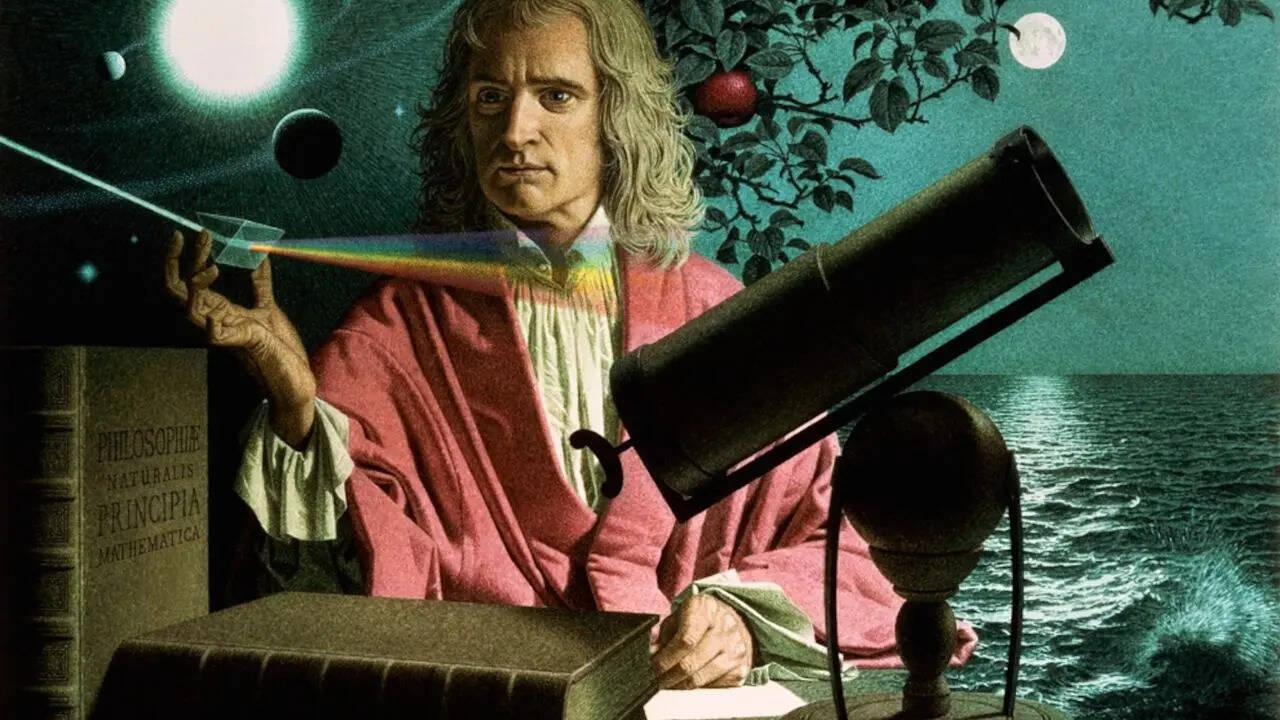
Isaac Newton did not just predict the end of the world in 2060. He calculated it using a blend of radical theology and mathematical precision that would baffle a modern physicist. While the public remembers him as the father of gravity, the man himself spent more time hunting for the hidden codes of the Creator than he did polishing the Principia. To understand why 2060 mattered to him, we have to look past the apple tree myth and into the dark, soot-stained laboratory where he spent decades trying to turn lead into gold and scripture into a timeline.
Newton arrived at the year 2060 by analyzing the Book of Daniel. He believed the "time, times, and a half" mentioned in biblical prophecy equated to 1,260 years. By pinning the start of this period to the year 800 AD—the coronation of Charlemagne—he landed on a date that is now less than four decades away. For Newton, this wasn't about a fireball from the sky. It was about the transition to a new era of divine order. He was a man obsessed with the idea that the universe was a giant clock, and he was the only one smart enough to find the key.
The Hidden Heretic of Trinity College
Newton lived a double life that would ruin a modern academic career. On the surface, he was the Lucasian Professor of Mathematics at Cambridge. In private, he was a radical anti-Trinitarian who believed the Church had corrupted the true nature of God. Had his private papers been published during his lifetime, he likely would have been stripped of his titles or worse.
He viewed his scientific work as a religious duty. To Newton, the laws of motion were simply the "operating system" of a divine architect. He didn't see a conflict between calculating the orbit of the moon and decoding the dimensions of Solomon’s Temple. He believed the temple's floor plan was a mathematical map of the universe. This wasn't a hobby. It was a primary mission that consumed more of his ink and parchment than calculus ever did.
The Toxic Cost of Discovery
The brilliance of Newton’s mind may have been sharpened—or shattered—by heavy metal poisoning. His laboratory notes reveal a man who didn't just observe chemical reactions; he tasted them. He frequently recorded the flavors of various substances, including mercury and antimony.
By 1693, Newton suffered what we would call a nervous breakdown. He became paranoid, accused his friends of plotting against him, and suffered from chronic insomnia. While many historians attribute this to overwork, modern hair analysis of Newton's remains showed mercury levels dozens of times higher than normal. The man who defined the laws of the physical world was physically falling apart because of his obsession with the occult world. He was a high-functioning mercury poisoning victim who managed to reshape human history between bouts of tremors and delusions.
Gravity was a stopgap measure
We are taught that Newton "discovered" gravity, but he hated the implications of his own theory. He could describe how gravity worked with the formula $F = G \frac{m_1 m_2}{r^2}$, but he could not explain why two objects could attract each other across a vacuum without touching. He called this "action at a distance" an absurdity.
He spent years trying to find a mechanical explanation—an invisible "ether" that pushed planets around. When he failed, he quietly attributed the force to the constant intervention of God. For all his mathematical genius, Newton's universe required a divine hand to occasionally wind the clock back up. He believed the solar system was inherently unstable and that without periodic adjustments, the planets would eventually crash into the sun or fly off into deep space.
The Master of the Mint and the War on Counterfeiters
In 1696, Newton left the quiet halls of Cambridge for the gritty reality of the Royal Mint. This wasn't a ceremonial retirement. England was in a currency crisis, with "clippers" shaving the edges off silver coins and counterfeiters flooding the market with fake currency.
Newton approached the hunt for counterfeiters with the same cold intensity he applied to optics. He built a network of informants and personally interrogated criminals in the dark cells of the Tower of London. He was responsible for the execution of William Chaloner, a master counterfeiter who had managed to mock Newton in public. Newton didn't just want the man stopped; he wanted him erased. He successfully lobbied for Chaloner to be hanged, drawn, and quartered. The greatest scientist in history spent his final years as a ruthless high-stakes detective.
The Invention of the Serrated Edge
If you look at the edge of a quarter or a dime today, you are seeing Newton’s handiwork. To stop people from shaving the edges of silver coins, Newton implemented "reeding"—the tiny grooves on the side of a coin. If the grooves were missing, the merchant knew the coin had been tampered with. It was a simple, elegant mechanical solution to a complex economic problem. It remains one of his most lasting contributions to daily life, yet it rarely makes it into the textbooks.
The 2060 Timeline and the Logic of Prophecy
Newton’s obsession with the 2060 date wasn't a random guess. He was terrified of "date-setters" who predicted the end of the world every few years. He felt these failed predictions made religion look foolish. By pushing the date out to 2060, he was effectively telling his contemporaries to stop panicking and get back to work.
His calculations were based on several key assumptions:
- The "Apostasy" of the church began in 609 AD or 800 AD.
- The prophetic "days" in the Bible represent literal years.
- The "Beast" of Revelation had a specific, measurable reign of 1,260 years.
He arrived at 2060 as a minimum date. He wrote that the world could end later, but he saw no reason for it to end sooner. This shows a man who was using his analytical tools to provide social stability. He used math to debunk the doomsday cults of the 17th century.
The Secret Library of a Madman
When Newton died in 1727, he left behind over ten million words of manuscript. The majority of these words were not about physics. They were about alchemy, biblical prophecy, and ancient history. His heirs were horrified. They feared that if the public saw the "real" Newton—the man who spent years trying to find the Philosopher’s Stone—it would discredit his scientific achievements.
Most of these papers were marked "not fit to be printed." They remained hidden for over two centuries. In 1936, a large portion of these manuscripts was sold at auction. The buyer was none other than John Maynard Keynes, the famous economist. After reading them, Keynes famously remarked that Newton was not the first of the age of reason, but the "last of the magicians."
Why the 2060 date haunts us now
As we approach the mid-21st century, Newton's 2060 date takes on a new, secular chill. We are currently grappling with climate tipping points and the rise of autonomous technologies that many experts believe will reach a crisis point around the same time. While Newton was looking for the return of a messiah, we are looking at the potential for a self-inflicted collapse.
Newton’s brilliance came from his refusal to compartmentalize. He didn't see "science" and "mysticism" as different things. To him, they were both tools for uncovering the truth. We have spent three hundred years separating the two, yet we find ourselves back at his doorstep, staring at a timeline that is rapidly shrinking.
If you want to understand the modern world, stop looking at Newton's laws of motion and start looking at his obsession with the 2060 deadline. It reveals a man who knew that knowledge without a moral or chronological framework is a dangerous thing. He gave us the tools to build the modern world, but he died terrified that we wouldn't know when to stop. Check the date on your calendar and realize that the man who mapped the stars also mapped our exit.