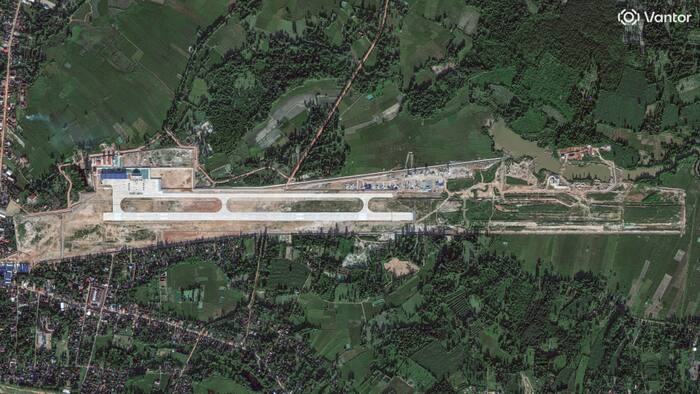
Satellite photos show unfinished dirt and fresh workshops next to a freshly minted runway in Vientiane Province. Yet Beijing and Vientiane already held an opening ceremony in late September 2026 for the China-Laos Joint Support and Training Center at Ban Keun Airport.
Ceremonies happen early in geopolitics. Concrete takes longer.
When China opens a joint airfield in Laos while construction is still rolling, defense watchers pay attention. Not because an inland airstrip in landlocked Laos flips the regional balance overnight, honestly. It doesn't. What matters is what this site signals about Beijing's overseas basing habits, Vientiane's tight financial and diplomatic bind, and how neighboring capitals—especially Hanoi and Bangkok—read the map.
Why This China Laos Joint Airfield Raised Eyebrows So Fast
Let's get the basics straight first. On September 29, 2026, official Chinese military channels announced that the China-Laos Joint Support and Training Center at Ban Keun Airport—along with the China-Laos Friendship Aviation Academy—had officially gone into operation. Beijing framed it around pilot training and practical military cooperation, stressing it wasn't aimed at any third party.
Commercial and defense satellite imagery tells a messier, more revealing story. Images reviewed by outlets like Breaking Defense and Radio Free Asia show a roughly 2,000-meter (6,560-foot) runway, a parking apron, hangars, and ongoing work around workshops and support areas—partly built over what analysts note was an older airstrip site from the Vietnam War era. In late September and early October 2026, imagery analysts spotted K-8 (also known as JL-8) light attack and training aircraft on the ground before they appeared to move inside hangars.
That distinction between an ribbon-cutting and a finished base is huge. Opening a facility before all construction wraps up lets Beijing claim a milestone, start pilot instruction early, and normalize a People's Liberation Army (PLA) presence without triggering the immediate diplomatic shock of a fully built, heavily armed forward base.
If you're looking for giant bombers or mass fighter squadrons parked in Laos today, you're looking at the wrong thing. Right now, it looks much more like a training hub and a foot in the door.
The Real Military Role Versus the Hype
Defense analysts are split on how much immediate military punch Ban Keun actually adds for China. That's a fair debate, and we shouldn't overstate what an inland airstrip in Laos can do on day one.
China already has airbases inside its own southern provinces much closer to the South China Sea. Flying combat sorties out of a landlocked country with mountainous terrain and limited local logistics isn't some magic shortcut that replaces coastal airfields. Plus, a 2,000-meter runway is solid for trainers, light aircraft, and transport or utility operations, though heavy operations and long-term base resilience always depend on fuel storage, radar, air defenses, and legal access agreements.
Still, dismissing Ban Keun completely would be a mistake. Military planners don't just look at today's runway length; they look at optionality.
- Pilot pipelines and influence: Training Lao pilots on Chinese-linked systems builds long-term technical dependence, doctrine alignment, and future procurement ties. If Laos upgrades its air fleet down the road, Chinese aircraft become the natural fit.
- Logistics and rail links: Laos is landlocked, which used to make supplying an inland site slow and expensive. Now the China-Laos high-speed railway links Kunming in Yunnan province to Vientiane, giving Beijing a overland supply artery that didn't exist a few years ago.
- Future surge or surveillance potential: Analysts noted in coverage of the opening that while immediate combat value is modest, facilities like Ban Keun could theoretically support intelligence, surveillance, logistics, or pre-positioned aircraft if rules and infrastructure expand later.
As defense commentators have pointed out when comparing this move to Ream Naval Base in Cambodia, Beijing's overseas footprint often grows incrementally—turning modest access, joint projects, and infrastructure upgrades into durable footholds over time.
What Vietnam, Thailand, and Washington Are Watching
Laos is a small country of roughly eight million people wedged between China, Vietnam, Thailand, Myanmar, and Cambodia. When anything shifts inside Laos, neighbors feel it right away.
Vietnam has the sharpest security lens here. Hanoi and Vientiane share deep historical and political ties, yet Vietnam has long viewed Chinese influence on its western flank with quiet wariness. Analysts have pointed out that an airfield in Laos gives Beijing alternate air routes around Vietnam and another vantage point near mainland Southeast Asia and South China Sea dynamics.
Thailand sits just across the Mekong River from Vientiane Province. Thai media and security observers immediately flagged the proximity to the border, even as officials weigh economic ties and avoid provoking either Beijing or Vientiane.
The United States and regional partners see Ban Keun as part of a broader pattern. Across the Indo-Pacific, Washington and allied capitals track every overseas port, airfield, or dual-use facility linked to the PLA. Even if Ban Keun isn't a massive military base right now, it adds another data point to a map that looks much busier than it did a decade ago.
A Target of Opportunity for Vientiane Too
One thing folks outside the region sometimes miss is agency. Laos isn't just a passive piece of clay pushed around by Beijing.
As Southeast Asia expert Gregory Poling noted in reporting on the airfield, decisions like this can be a target of opportunity for Laos—a way to gain training, equipment, and strategic backing—rather than purely a masterstroke imposed from outside. At the same time, Vientiane's tight fiscal space and heavy debt pressures limit its bargaining leverage.
When a cash-strapped government partners with a superpower on a military training airfield and keeps quiet about the exact terms of joint management, outsiders naturally wonder who actually calls the shots on the ground. Transparency hasn't exactly been a strong suit of the rollout.
Practical Ways to Track How This Base Evolves
If you follow Southeast Asian security, defense policy, or regional trade—or just want to separate real developments from sensational headlines—here is how to watch Ban Keun smartly:
- Check multi-date satellite imagery, not single snapshots. One photo showing aircraft or trucks doesn't prove permanent deployment. Compare images over months to see whether hangars multiply, fuel farms or hardened shelters appear, or construction stalls.
- Watch aircraft types and rotation patterns. Light trainers like the K-8/JL-8 tell a very different story than long-range patrol planes, drones, or heavy transports. Look for sustained rotations rather than one-off visits.
- Read regional reactions in context. Pay close attention to statements and diplomatic moves from Vietnam, Thailand, and ASEAN forums—plus major defense analyses from outlets like Defense News and Breaking Defense.
- Separate capability from intent. A runway and training academy create options. Keep an eye on bilateral agreements, joint exercises, and rail freight trends to see whether Ban Keun stays a pilot school or grows into something heavier.