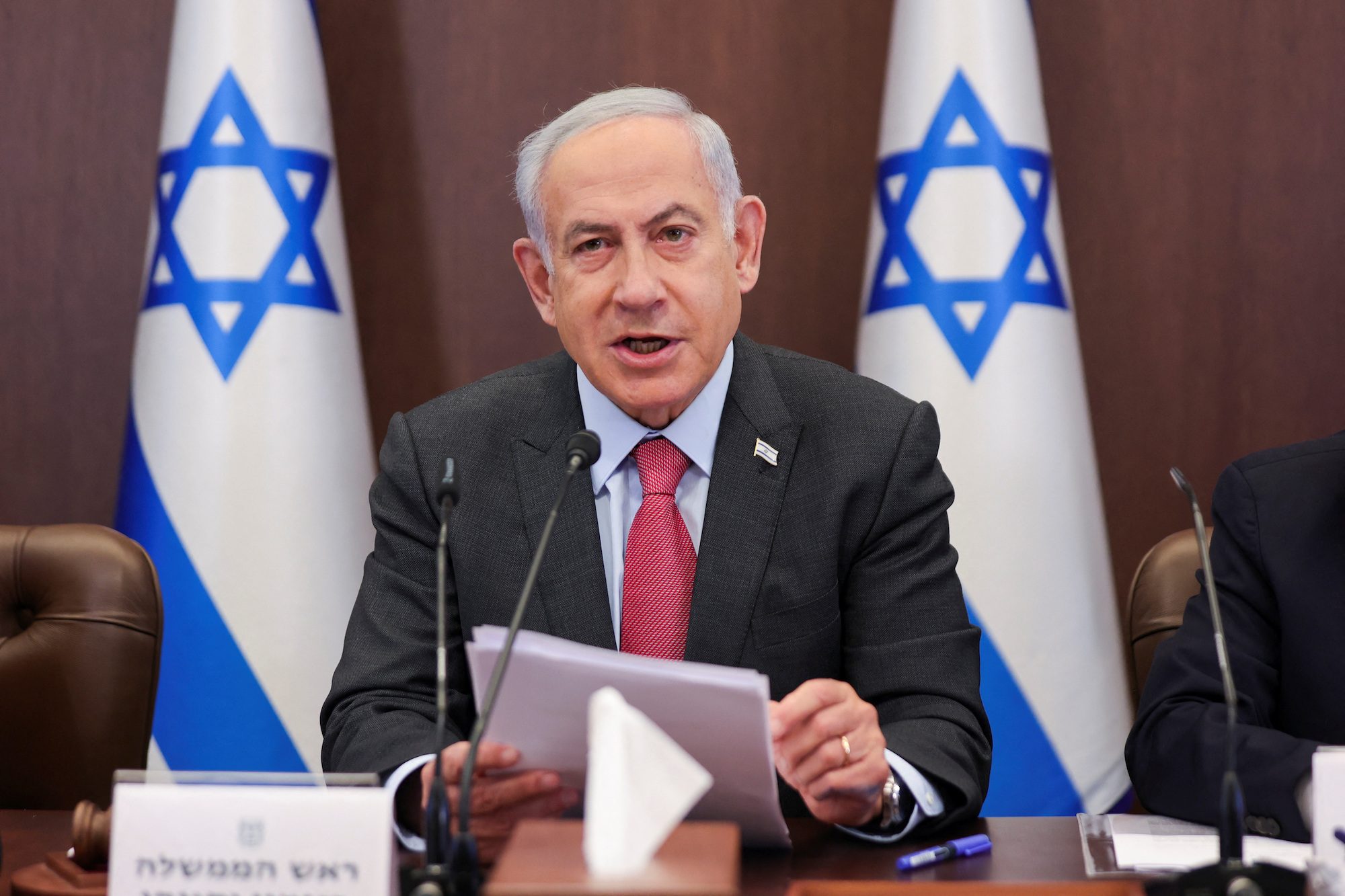
Benjamin Netanyahu wants a broad national government. On the surface, it sounds noble. Unifying. The exact kind of steady-handed statesmanship a country needs when staring down existential threats.
Don’t buy it.
When The Jerusalem Post and mainstream political commentators cover Netanyahu’s push for an "anti-terror" unity coalition, they routinely fall into the same trap. They treat it as a strategic response to external security crises. They analyze the seating chart. They debate which opposition leaders have the moral obligation to answer the call for national solidarity.
They are asking the wrong question entirely. The real question isn't who will join Netanyahu to fight terror; it is why Netanyahu suddenly needs political human shields to survive his own coalition.
Having spent two decades watching Knesset mechanics chew up and spit out seasoned political operators, I can tell you that "national unity" in Israeli politics is rarely about unity. It is almost always an emergency brake pulled by a Prime Minister whose current vehicle is careening toward a cliff.
The Myth of the "Anti-Terror" Consensus
Let’s dismantle the premise right out of the gate. Defining a coalition requirement as "anti-terror" in Israel is like defining a restaurant requirement as "anti-food poisoning." It is the absolute baseline of the entire political spectrum, excluding a tiny fringe.
By framing his invitation around an "anti-terror" mandate, Netanyahu isn't setting a bold ideological boundary. He is setting a rhetorical trap.
If opposition figures like Benny Gantz, Yair Lapid, or Avigdor Liberman refuse to join, Netanyahu’s media machine gets to paint them as putting petty politics ahead of national security. If they accept, they instantly neutralize themselves as viable alternatives, absorb the political fallout of Netanyahu’s past policy failures, and extend his tenure by years.
Mainstream coverage misses this completely because it takes political rhetoric at face value. In parliamentary systems—especially one as fractured as Israel's—coalition building is not an exercise in ideological alignment. It is an exercise in mathematical survival.
Why Broad Coalitions Actually Paralyze Security Policy
The lazy consensus assumes that a wider government equals stronger, more decisive action against external enemies. History proves the exact opposite.
Consider the mechanics of a bloated, ideologically contradictory cabinet:
- Veto Paralysis: When you put far-right ultra-nationalists in the same room as center-left pragmatists, you don’t get a synthesis of the best ideas. You get mutual cancellation. Every major military operation, diplomatic overture, or hostage negotiation gets watered down to the lowest common denominator so nobody storms out of the room.
- The Leak Factory: Broad unity governments in Israel are notorious for weaponized leaking. Instead of fighting the enemy, ministers spend their energy briefing journalists to prove to their respective bases that they were the "tough ones" in the security cabinet while their coalition partners were weak.
- Zero Accountability: When everyone is in the government, nobody is responsible for failure. Mistakes get blamed on "compromises required for unity," while successes are claimed by everyone.
We saw this play out during the 2020 Netanyahu-Gantz rotation government. Formed under the banner of fighting a generational crisis, it collapsed within months because neither side trusted the other to hold a sharp object, let alone run a country. It didn't produce decisive leadership; it produced legislative gridlock and an election cycle that cost taxpayers billions of shekels.
The Real Target Isn't Terror—It’s the Right-Wing Flank
To understand why Netanyahu is making this pitch right now, stop looking at Gaza, Lebanon, or Iran. Look at the seats immediately to Netanyahu’s right in the Knesset plenum.
Netanyahu’s most narrow, right-wing coalitions have historically made him a hostage to his smallest, most extreme partners. Figures like Itamar Ben-Gvir and Bezalel Smotrich understand that without their seats, the government falls. That gives them disproportionate extortion power over budgets, West Bank policy, and judicial appointments.
Netanyahu hates being extorted. Throughout his career—as political scientists like Gideon Rahat and Reuven Hazan have extensively documented—Netanyahu’s preferred governing model is a right-wing bloc anchored by a moderate "fig leaf" party from the center or center-left.
Think back to his past coalitions:
- 2009: He brought in Ehud Barak’s Labor Party to balance out Avigdor Liberman and Shas.
- 2013: He leaned on Yair Lapid and Tzipi Livni to dilute the influence of Naftali Bennett.
- 2023: He brought Benny Gantz into the war cabinet not to share power, but to provide international legitimacy with Washington while keeping his domestic right-wing base intact.
The "broad national government" pitch is simply the latest iteration of this exact playbook. By dangling ministerial portfolios in front of opposition leaders, Netanyahu sends a crystal-clear warning to his rebellious right-wing partners: Behave, or I will replace you.
Dismantling the "People Also Ask" Fallacies
When voters and analysts search for answers about this political maneuvering, they usually get fed sanitized talking points. Let’s strip the bark off the three biggest misconceptions surrounding this move.
Does Israel actually need a unity government to win a war?
No. Israel’s most decisive military victories—including the 1967 Six-Day War, despite the last-minute inclusion of Menachem Begin as a minister without portfolio—were driven by clear, unified military doctrine and an empowered general staff, not a bloated cabinet. Adding twenty more ministers with competing egos to the security cabinet does not make the IDF shoot straighter. It slows down decision-making at the exact moment speed is critical.
Would opposition leaders be betraying the country by saying no?
Only if you believe that eliminating democratic accountability during a crisis is a virtue. A functioning democracy requires a robust, vocal opposition—especially during a war. When the opposition joins the government, parliamentary oversight dies. The Knesset Foreign Affairs and Defense Committee becomes a rubber stamp. Saying "no" to a flawed coalition isn't unpatriotic; it is often the only way to preserve an actual check on executive power.
What happens if Netanyahu fails to expand the coalition?
If the opposition holds the line and refuses the bait, Netanyahu is forced to govern with the exact coalition he built. He loses his international diplomatic shield, faces relentless domestic protests, and has to own every single policy outcome—good or bad—without anyone else to blame. That is precisely why he is working overtime to avoid it.
The Downside of the Contrarian View
To be completely candid, rejecting a unity government carries real, undeniable risks for the opposition.
First, the optics are brutal. During periods of high security anxiety, voters instinctively crave the comfort of seeing their leaders standing shoulder-to-shoulder. Refusing a call for unity allows Netanyahu’s surrogates to hammer the opposition as divisive and self-serving, a narrative that sticks with swing voters who don't follow daily Knesset intrigue.
Second, standing outside the tent means having zero direct influence over critical, irreversible decisions regarding hostage deals, regional alliances, and military strategy. For leaders like Gantz or Eisenkot, who possess deep military backgrounds, watching from the sidelines while less experienced ministers make life-or-death calls is agonizing.
Imagine a scenario where a pivotal diplomatic window opens with Washington and Riyadh, and the only thing blocking it is a junior far-right minister threatening to topple the coalition. In that moment, an opposition leader sitting inside the cabinet could theoretically provide the parliamentary safety net needed to push the deal through. That is the seductive trap that pulls center-left politicians into Netanyahu’s orbit every single time.
How to Read the Next 30 Days
If you want to cut through the noise of Israeli political journalism, stop listening to the press conferences and watch the actual leverage points.
Ignore any rhetoric about "brotherhood," "shared destiny," or "anti-terror solidarity." Those are marketing slogans designed for evening news soundbites. Instead, watch three specific indicators:
- Veto Power Over the Agenda: Will Netanyahu offer any opposition leader actual veto power over cabinet decisions, or just glorified advisory roles? In 2023, Gantz joined the war cabinet only to realize that when the real decisions were made, Netanyahu still deferred to his original coalition partners. Any opposition leader who joins without formal, legally binding veto power is walking into an ambush.
- An Agreed Election Date: A true emergency unity government always comes with a predetermined expiration date. If Netanyahu refuses to lock in an agreed date for national elections as a precondition for forming the government, the "emergency" isn't about national security—it's about cancelling the next election cycle.
- The Reaction of the Ultra-Orthodox Parties: Watch Shas and United Torah Judaism. They are the ultimate barometers of Israeli political survival. If they start signaling openness to bringing in secular opposition figures, it means they believe the current coalition is terminally ill and are looking for a lifeboat.
Benjamin Netanyahu is the most skilled political survivor in modern democratic history. He has outlasted rivals, indictments, wars, and mass protests by mastering one simple rule: never fight a battle on your enemy’s terms when you can redefine the battlefield entirely.
Calling for a broad, anti-terror national government isn't an olive branch extended to heal a fractured nation. It is a masterclass in political misdirection—a way to turn his own coalition's dysfunction into a loyalty test for his opponents.
The opposition doesn't need to pass Netanyahu's test. They need to stop taking the exam.