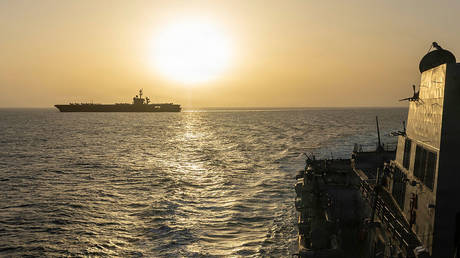
Dawn in the Persian Gulf does not arrive with a gentle wash of pink. It hits like a hammer of molten brass, burning the horizon until the sea and the sky blur into a single, blinding furnace of heat. Out on the water, the air smells of thick diesel exhaust, salt, and the faint, sweet tang of crude oil leaking invisibly from a dozen over-stressed manifolds.
Captain Ahmed Al-Harthi stands on the bridge of a quarter-mile-long supertanker, watching the green sweep of the radar screen. His shirt is soaked through with sweat, clinging to his back, but he hasn't moved from the console in four hours. He doesn't dare.
They are entering the bottleneck. Twenty-one miles wide at its absolute broadest, but pinched down to just two narrow shipping channels—each barely two miles wide—through which a staggering portion of the planet's daily energy lifeblood must squeeze. This is the Strait of Hormuz. A strip of blue water no wider than a stretch of highway, yet it acts as the primary carotid artery for global commerce. If it clots, the world gasps.
Recently, the rhetoric thickening the airwaves has grown heavy. Threats from Tehran to close, choke, or severely police what officials call "illegal" transit routes through these waters have shifted from background static to a sharp, metallic screech. To an office worker in Chicago or a commuter in Frankfurt, a threat over the Strait sounds like abstract theater—geopolitical posturing played out across cable news chyrons. But to Ahmed, and to the eighty thousand souls currently steering steel leviathans across these contested currents, it is the sound of a tripwire snapping.
Consider what happens next when a state actor decides that the rules of the sea no longer apply.
For decades, the global economy has operated on a quiet, deeply fragile assumption: that water is free. We built our modern civilization on the promise of the open ocean, the idea that a tanker loaded with two million barrels of light crude could slip out of the Persian Gulf, round the Arabian Peninsula, and feed the refineries of Asia, Europe, and the Americas without interference. It is a system built on maritime law, international navigation rights, and the sheer inertia of global trade.
Yet, law is only as strong as the grey-hulled warships willing to enforce it.
When Iranian officials signal their intent to clamp down on unauthorized or suspicious routes through their maritime approaches, they are not merely talking about drawing lines on a map. They are challenging the architecture of globalization. They are pointing a finger at the chokepoint and reminding everyone who lives outside the region of a terrifying truth: your comfort, your electricity, your ability to drive to the grocery store or heat your home in winter, depends entirely on the goodwill of governments you never voted for, navigating waters you will never see.
To understand why this matters, you have to look down at the scale of the operation. Imagine trying to thread a charging elephant through the eye of a needle while blindfolded. Now imagine that needle is patrolled by fast attack craft, armed with heavy machine guns and anti-ship missiles, darting between the container ships like water striders on a pond.
The legal justification Tehran uses rests on sovereignty and the regulation of its Exclusive Economic Zone. Under the United Nations Convention on the Law of the Sea, transit passage allows continuous and expeditious navigation through international straits used for international navigation. But what happens when a coastal state reinterprets the boundaries, declares certain paths illegal, or demands inspections for smuggling, sanctions-busting, or security violations?
Chaos. Quiet, compounding, expensive chaos.
Insurance rates spike overnight by hundreds of thousands of dollars per voyage. Crew members stop volunteering for Persian Gulf rotations, demanding hazard pay or refusing to sign contracts altogether. Shipowners begin turning off their transponders, plunging into a cat-and-mouse game of ghost navigation, slipping through the dark waters with running lights doused, hoping radar operators on the shore are looking the other way.
This is the hidden cost of geopolitical friction. It does not start with a sudden explosion or a declaration of total war. It starts with a whisper of hesitation in a corporate boardroom in Tokyo, a delayed tanker off the coast of Fujairah, and a penny-by-penny creep at the fuel pumps that eventually balloons into inflation.
Ahmed remembers his first passage through Hormuz twenty years ago. Back then, the tension felt contained, managed by unspoken rules and predictable postures. Today, the margin for error has evaporated. Drone swarms hum invisibly in the coastal thermals. Electronic jamming scrambles GPS signals, forcing navigators to drag out paper charts and rely on visual bearings taken from burning flare stacks on the horizon. A miscalculated rudder turn, a misunderstood radio hail, or a twitchy trigger finger on a patrol boat could turn a localized maritime dispute into an international flashpoint before the coffee on the bridge has even gone cold.
The world watches the Strait through a keyhole, waiting to see if the threats will materialize into chains across the water. But the chains are already there, forged of rising insurance premiums, military escorts steaming with turrets uncovered, and the mounting anxiety of men like Ahmed who carry the weight of global industry on hulls of corrugated steel.
The sun finally dips below the jagged silhouette of the Iranian coast, casting long, bruised shadows across the dark water. The radar blips multiply—dozens of them, silent, heavy, and pressing forward into the narrow dark.