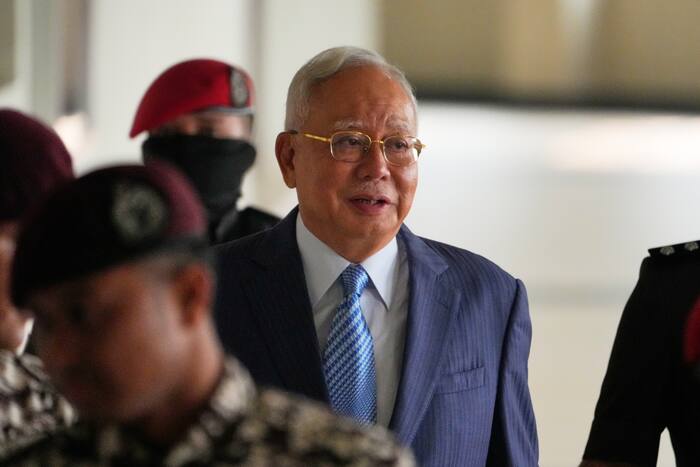
Najib Razak isn't going home anytime soon. Despite months of intense legal maneuvering, royal addendum rumors, and political backroom whispers in Kuala Lumpur, the former Malaysian Prime Minister remains behind bars at Kajang Prison after his bid for house arrest hit a brick wall.
If you've been following Malaysia's longest-running political soap opera, you know nothing about the 1MDB scandal ever moves in a straight line. One week, Najib's legal team claims a secret royal decree grants him the right to serve the rest of his sentence from the comfort of his private residence. The next, the courts slam the brakes on the whole arrangement, leaving him right back in his cell.
Honestly, it's a mess. And if you want to understand why this house arrest order got stalled—and what it actually means for Malaysia's fragile unity government—you have to look past the surface headlines and dig into the constitutional tug-of-war happening behind closed doors.
What Actually Happened With Najib's House Arrest Bid
Let's strip away the legal jargon. Najib Razak has been serving a prison sentence at Kajang Prison since August 2022, following his final conviction in the SRC International case—a subsidiary of the notorious 1Malaysia Development Berhad (1MDB) sovereign wealth fund. His original 12-year sentence was later halved to six years by Malaysia's Pardons Board in early 2024, alongside a massive reduction in his fine from RM210 million to RM50 million.
That sentence reduction alone sparked outrage across Malaysia. Critics argued it sent a terrible message about accountability for high-level corruption.
Then came the twist. Najib's lawyers filed a judicial review application claiming that alongside the sentence reduction, the former King—Al-Sultan Abdullah Ri'ayatuddin Al-Mustafa Billah Shah—had issued a supplementary order, known as a royal addendum. According to Najib's camp, this document explicitly allowed him to serve the remainder of his reduced six-year term under house arrest.
The government didn't immediately confirm or deny the existence of this addendum, which only fueled public suspicion. When the matter reached the courts, judges put the house arrest push on hold, citing procedural hurdles, questions over the admissibility of new evidence, and the sheer lack of formal verification surrounding the alleged supplementary decree.
So Najib stays put. No plush living room. No private chef. Just Kajang Prison.
Why the Royal Addendum Became a Constitutional Headache
You can't talk about Najib's house arrest without talking about Malaysia's constitutional monarchy. And frankly, this is where most outside observers get tripped up.
In Malaysia, the King (Yang di-Pertuan Agong) holds the constitutional power to grant pardons, reprieves, and respites under Article 42 of the Federal Constitution. That power isn't exercised in a vacuum. The King acts on the advice of the Pardons Board, which includes the Attorney General and the Federal Territories Minister.
Here's the catch. If a supplementary order was drafted or signed outside the formal deliberations of the Pardons Board, is it legally binding?
Constitutional lawyers in Kuala Lumpur have been debating this nonstop. Some argue that the King's prerogative of mercy is absolute and cannot be questioned in court. Others point out that Article 42 requires strict adherence to procedure—meaning any decree issued without the board's formal process risks being declared invalid or unenforceable.
Think about the precedent this sets. If a monarch can issue a private addendum after a Pardons Board meeting ends, it fundamentally alters how clemency works in Malaysia. The courts knew this. Putting the house arrest on hold wasn't just a bureaucratic delay; it was a necessary pause to prevent a massive constitutional crisis.
The Political Tightrope Anwar Ibrahim Is Walking
Let's be real about the politics here. Prime Minister Anwar Ibrahim is stuck between a rock and a very hard place.
Anwar built his entire political brand over two decades on fighting corruption, cronyism, and the exact kind of kleptocracy Najib came to symbolize. Yet, after the 2022 general election resulted in a hung parliament, Anwar had to form a unity government with UMNO—Najib's old political party—just to take office.
It's an awkward marriage. UMNO leaders have been relentless in lobbying for Najib's release or, at the very least, house arrest. To them, Najib is still a powerful grassroots figure whose continued imprisonment hurts their standing with Malay voters. Meanwhile, Anwar's core reformist base is already furious over the initial halving of Najib's sentence and the discharge not amounting to an acquittal (DNAA) granted to Deputy Prime Minister Ahmad Zahid Hamidi in his own corruption trial.
If Anwar's administration had simply waved Najib into house arrest without a fight, his credibility as an anti-corruption reformer would have evaporated overnight. By letting the courts stall the process and insisting that everything follow strict legal channels, Anwar buys himself time. He can tell UMNO that his hands are tied by the judiciary, while telling his reformist voters that he isn't interfering with the rule of law.
It's smart politics. Doesn't make it any less cynical, though.
What Most People Miss About House Arrest in Malaysia
Here's something almost nobody mentions when discussing Najib's case: Malaysia doesn't actually have a comprehensive legal framework for house arrest for convicted white-collar criminals.
In countries like the United States or the United Kingdom, home detention is routine. Courts use ankle monitors, geofencing, strict visitation logs, and probation officers to enforce it. The rules are written into law long before a high-profile defendant ever steps into a courtroom.
Malaysia doesn't have that infrastructure ready to go for a former prime minister. Under the Malaysian Prison Act 1995, the Home Minister and the Commissioner General of Prisons do have certain discretionary powers regarding where a prisoner is detained. Technically, a private residence could be gazetted as a place of detention.
Gazetting a luxury mansion in Kuala Lumpur as a "prison" isn't just a logistical nightmare; it's a public relations disaster. Who pays for the 24-hour security detail? Who monitors his internet access and phone calls? How do you stop political allies from turning a "prison" into a de facto campaign headquarters?
Until Malaysian lawmakers actually pass clear statutory guidelines on how home detention works—something the government has floated for general prison overcrowding—applying it ad hoc to the country's most famous inmate looks like pure elite privilege.
The Ongoing 1MDB Trials Keep Complicating Things
Even if Najib had won his house arrest bid tomorrow, his legal troubles are nowhere near finished. People often forget that the SRC International case was just the tip of the iceberg.
Najib is still facing the main 1MDB trial, where he stands accused of 25 charges of abuse of power and money laundering involving roughly RM2.28 billion (around $480 million). That trial has been dragging on for years, and the prosecution has laid out a mountain of documentary evidence tracing funds directly into his personal bank accounts.
If he gets convicted in the main 1MDB trial, he faces another massive prison sentence and billions in fines. Putting him under house arrest now, while he's still fighting off the biggest corruption charges in Malaysian history, would look completely backwards to the public. You don't hand out leniency on case number one while case number two is still in full swing.
How This Impacts Public Trust in Malaysia's Institutions
At the end of the day, this whole saga isn't just about where Najib Razak sleeps at night. It's about whether ordinary Malaysians believe the justice system applies equally to everyone.
When a regular citizen steals a few hundred ringgit to feed their family, they go straight to jail. No pardons board. No secret addendums. No debates about turning their apartment into a gazetted detention facility.
When a former prime minister steals millions, the entire apparatus of the state bends over backward to debate whether a standard prison cell is too harsh for him. That double standard eats away at institutional trust faster than any political scandal ever could.
By keeping Najib in Kajang Prison while the courts sort out the validity of the royal addendum, the judiciary has preserved a shred of that trust. It signals that technicalities and backroom deals can't automatically override a final conviction handed down by the Federal Court.
What to Watch for Next in the Najib Case
If you want to keep track of where this goes from here without getting lost in partisan noise, pay attention to three specific developments over the coming months.
First, watch the Court of Appeal and Federal Court rulings on the judicial review itself. The core legal question isn't whether Najib deserves house arrest, but whether the courts have the jurisdiction to compel the government to produce and enforce an unverified royal addendum. If the appellate judges rule that the addendum cannot be introduced as fresh evidence, the house arrest bid is effectively dead.
Second, look out for new legislation on home detention. The Malaysian government has signaled plans to introduce a formal House Arrest Act aimed at reducing overcrowding in prisons for non-violent offenders. Keep a close eye on the fine print of that bill. If the language is broad enough to cover white-collar corruption convicts, it could become a backdoor route for Najib's legal team to try again.
Third, track the verdict timeline in the main 1MDB trial. As that trial moves toward its final stages, any conviction there will reset the entire board, making current debates over his SRC International sentence largely academic.
For now, the prison gates stay shut, and Najib Razak's legal team has a steep uphill climb ahead of them.