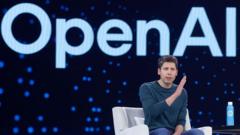
Sam Altman sat in a room that smelled faintly of expensive carpet and ozone, staring at a spreadsheet that would alter the course of human history. For years, the public narrative surrounding artificial intelligence was one of pure science. It was about code. It was about neural networks mimicking the firing of human synapses. But behind the closed doors of Silicon Valley, the story had changed. The science was no longer the bottleneck. The bottleneck was cash.
Every time a user asks a chatbot to write a poem, plan a vacation, or debug a line of code, a silent, microscopic transaction occurs. Thousands of specialized computer chips whir to life, consuming massive amounts of electricity. The cost of training the next generation of these models is no longer measured in millions. It is measured in tens of billions.
Now, OpenAI is preparing to take the ultimate leap to sustain this digital bonfire. They are planning to go public.
This is not just another initial public offering. This is an admission that the traditional structures of venture capital are crumbling under the sheer weight of AI’s financial demands. Across town, Anthropic—OpenAI’s fiercest rival, founded by a group of defectors who feared Altman’s aggressive commercialization—is watching. The investment race has entered a phase of terrifying intensity.
The Ghost in the Server Room
To understand why a company needs a hundred billion dollars, you have to look past the marketing gloss. Consider a software engineer named Sarah.
Sarah works at a mid-sized logistics firm. Five years ago, her day consisted of manual code reviews and tedious database management. Today, she sits before a glowing screen, guiding an AI agent that does the work of ten people. She feels a strange mix of awe and anxiety. The tool is brilliant, but it is also an invisible parasite on the global power grid and the global treasury.
Every single prompt Sarah types requires a massive infrastructure. The current industry estimate suggests that training a frontier model requires tens of thousands of Nvidia chips, each costing upward of $30,000, running continuously for months.
OpenAI started as a non-profit. Its original mission statement was bathed in idealism: to ensure that artificial general intelligence benefits all of humanity. But idealism does not pay the electricity bill at a data center in Iowa.
The transition from a utopian research lab to a commercial juggernaut has been chaotic. The brief, dramatic ousting and reinstatement of Sam Altman in late 2023 was the first public fracture. It was a ideological civil war disguised as a corporate boardroom dispute. The soul of the company was at stake. The commercial faction won.
By filing for an IPO, OpenAI is shedding the last vestiges of its academic armor. It is entering the arena of quarterly earnings reports, shareholder lawsuits, and the relentless pursuit of profit.
The Shadow Rivalry
But OpenAI does not exist in a vacuum. Every move they make is shadowed by Anthropic, the creators of the Claude models.
If OpenAI is the aggressive, expansionist empire, Anthropic positions itself as the cautious, safety-conscious republic. Founded by Dario and Daniela Amodei, siblings who walked out of OpenAI over safety concerns, Anthropic has raised billions from Amazon and Google.
The dynamic between these two companies resembles the Cold War space race, but instead of rockets, they are building minds.
+--------------------------------------------------------+
|              THE SILICON VALLEY ARMS RACE              |
+--------------------------------------------------------+
|  OPENAI                                     ANTHROPIC  |
|  - Aggressive commercialization   - Safety-first focus |
|  - Shifting to public markets     - Backed by Big Tech |
|  - Mass consumer adoption         - Enterprise-heavy   |
+--------------------------------------------------------+
When OpenAI announces an upcoming IPO, it forces Anthropic’s hand. The investment pool is not infinite. Sovereign wealth funds, massive mutual funds, and retail investors will soon have to choose where to park their capital.
If OpenAI secures a massive public valuation, they can weaponize that capital. They can buy up the world’s supply of chips. They can lock down exclusive energy contracts with nuclear power plants. They can outbid Anthropic for the tiny pool of elite researchers who actually know how to build these systems.
An IPO gives OpenAI a currency that private companies lack: liquid stock. When talent poaching becomes a matter of survival, being able to offer a potential hire shares that can be traded on the open market tomorrow morning is a devastating advantage.
The Hidden Cost of the Code
We often talk about technology as if it is weightless. We think of the cloud as an ethereal place, a digital sky where data floats freely.
The reality is heavy. It is concrete. It is copper. It is water.
Data centers require millions of gallons of water per day to keep the servers from melting. They require dedicated electrical substations. In some parts of the United States, tech companies are single-handedly delaying the retirement of coal-fired power plants because the grid cannot keep up with the demands of AI training.
This is the invisible stakes of the OpenAI IPO. The capital raised will not go toward hiring more customer service representatives or renting shinier offices in San Francisco. It will go toward buying terrestrial reality. It will buy land, turbines, and silicon.
Consider what happens next: a public OpenAI becomes beholden to Wall Street. Wall Street does not care about safety guidelines or ethical alignment. Wall Street cares about user growth, enterprise adoption, and margins.
The pressure to deliver will be immense. The temptation to cut corners on safety testing to beat Anthropic to the next major model release will intensify.
The Disruption of Everyday Lives
For the average person, this financial chess game feels distant. It feels like billionaires trading numbers on a screen.
But the money flowing into OpenAI and Anthropic will dictate the structure of your working life by the end of the decade.
Think back to Sarah, the logistics engineer. If OpenAI goes public and secures a war chest that allows them to achieve true artificial general intelligence, Sarah’s job description changes from "operator" to "redundant." The economic pressure on businesses to replace human labor with highly subsidized, hyper-efficient AI systems will become irresistible.
The massive influx of capital into the AI sector is creating a gravity well. It is sucking funding away from other critical technologies. Medical research, clean energy startups, and infrastructure projects are finding it harder to secure funding because every venture capitalist and investment bank wants to chase the insane returns promised by the AI boom.
We are witnessing a massive re-allocation of human wealth and ingenuity. We are betting the house on the assumption that these machines will solve more problems than they create.
The Uncertainty of the Paradigm
Is this a bubble?
It is a question that whispers through the corridors of power, even as the checks are being signed. Dot-com era comparisons are frequent, but this feels different. In 1999, companies went public with nothing but a domain name and a dream. Today, OpenAI has hundreds of millions of active users and billions in recurring revenue. The utility is real.
But the profitability remains elusive. The cost of serving an AI response is still orders of magnitude higher than a traditional Google search. The technology is scaling faster than the monetization strategies.
An IPO is a high-wire act without a net. If OpenAI lists its shares and the market realizes that the path to true profitability is longer and rockier than advertised, the correction will be brutal. A collapse in AI valuations would trigger a shockwave through the entire tech sector, dragging down the giants like Microsoft, Nvidia, and Amazon that have hitched their wagons to this star.
Dario Amodei at Anthropic knows this. He is playing a long game, betting that an enterprise-focused, safety-oriented approach will ultimately prove more resilient than OpenAI’s mass-market blitz. But resilience requires time, and time is a luxury that OpenAI’s public push might take away.
The race is no longer about who can build the smartest machine. It is about who can survive the financial friction of building it.
Sam Altman is stepping onto the trading floor, carrying the future of human intellect in his briefcase, waiting to see what price the market will set for the soul of the machine.

:max_bytes(150000):strip_icc():focal(665x0:667x2)/gettyimages-50733149-2000-8b129a2475974982a915418ce92a73d8.jpg)

