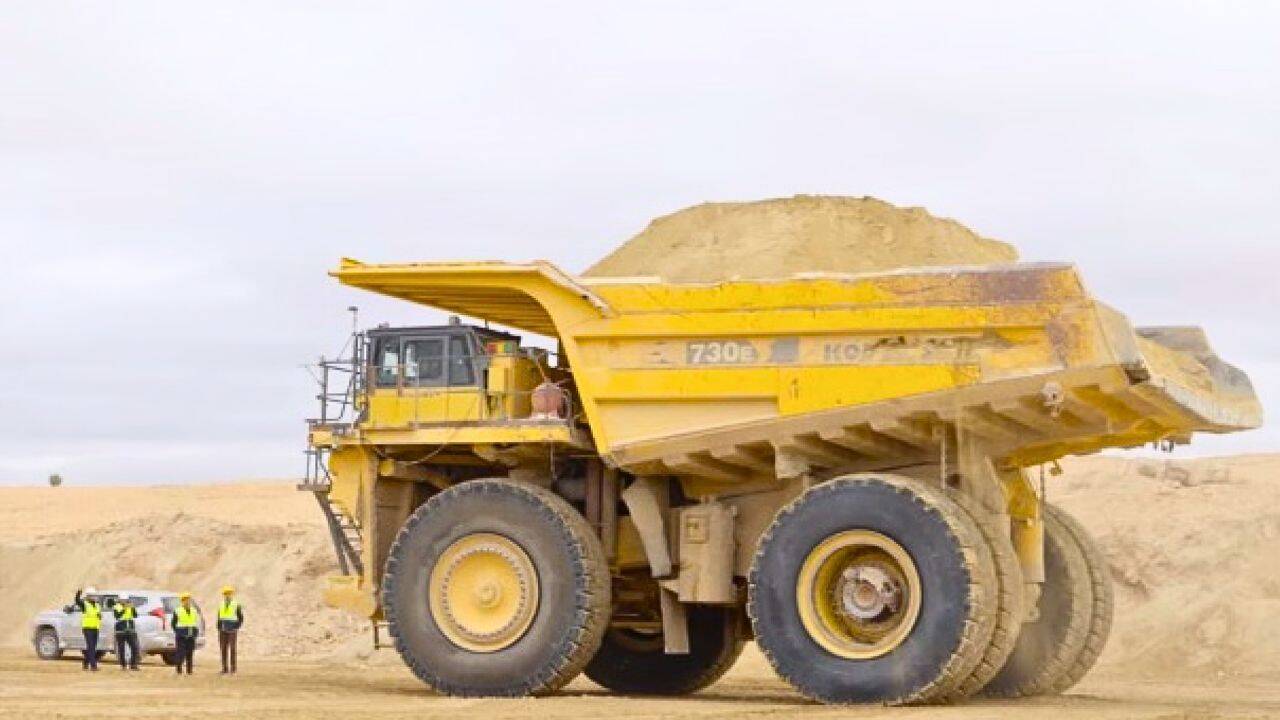
Open-pit mining has an optics problem, and it usually blows across the landscape at fifty miles per hour behind a two-hundred-ton dump truck. At the Benguerir phosphate mine in Morocco, heavy haul roads used to demand endless cycles of water spraying and mechanical grading just to keep particulate matter from blinding operators and choking local ecosystems. Unpaved tracks churned out average dust concentrations exceeding 91,000 micrograms per cubic meter.
Then the site engineers looked at the massive, sterile mounds of overburden sitting quietly at the edge of the concession and decided to pave their roads with the very material everyone else considered garbage.
By repurposing phosphate mine waste rock into a structured, multi-layered heavy-haul pavement, researchers and operators slashed airborne particulate emissions by 91 percent. It is an operational pivot that reframes waste streams not as an environmental burden to be managed, but as structural assets waiting for a civil engineering mandate.
Breaking Down the Haul Road Anatomy
Traditional mining logistics treat running surfaces as temporary dirt tracks meant to be scraped, watered, and rebuilt. That philosophy burns through capital. Heavy trucks moving tens of thousands of tonnes daily grind soft earth into fine powders, creating dense clouds of PM2.5 and PM10 that settle on machinery, accelerate engine wear, and destroy visibility.
The Benguerir project broke this cycle by designing a three-layer structural pavement specifically rated for extreme axle loads.
- The Sub-Base: A 0.35-meter foundation built from 0 to 100 millimeter crushed waste rock, functioning as the primary load-distribution platform.
- The Base Layer: A 0.25-meter intermediate stratum composed of 0 to 63 millimeter crushed fragments designed to maximize stiffness and arrest rutting.
- The Wearing Course: A 0.07-meter asphalt surface incorporating phosphate-derived flint and modified bitumen, engineered for thermal resilience and high shear stress.
Field testing verified that this waste-derived foundation achieved an average sub-base bearing capacity or EV2 value of 153 megapascals, with the base layer climbing to 181 megapascals. These metrics confirm that sedimentary overburdens—previously written off by rigid regulatory classification guides as low-value industrial by-products—exhibit mechanical competencies that rival virgin quarried aggregates.
The Geotechnical Reality Behind the Overburden
For decades, strict earthwork manuals barred the use of phosphate waste rock in road construction, classifying them alongside problematic organic soils or unstable industrial residues. That regulatory caution ignored basic mineralogy. Phosphate overburdens in regions like Gantour and Benguerir consist largely of natural sedimentary formations—carbonates, marls, flints, and clays—that have undergone zero chemical transformation beyond mechanical fragmentation.
Laboratory and field characterization revealed a material profile defined by high specific density, low methylene blue values, and minimal organic matter. Because these rocks feature heavy natural concentrations of calcite and dolomite, they possess intrinsic acid-neutralization potential, eliminating the risk of acid mine drainage.
Yet, changing the status of these materials from liability to aggregate required proving they could survive the worst-case mechanical stress test: a haul road corridor carrying over twenty-two kilotonnes of payload per day. Under continuous traffic from colossal mining trucks, unpaved surfaces deform, rut, and eject fine particles into the atmosphere. The experimental pavement managed to limit proportional rut depth to just 2.2 percent under optimized bitumen content.
Operational Dividends Beyond Emission Reductions
Environmental compliance targets often feel like expensive box-ticking exercises for heavy industry. In this case, the 91 percent drop in dust concentration directly altered the bottom line of mine site logistics.
Water trucks no longer need to make continuous circuits wetting down dry haul roads, cutting immense volumes from the site's daily freshwater consumption. Smooth, rigid surfaces reduce rolling resistance, which translates into lower fuel consumption per operating hour, extended tire life, fewer wheel-motor replacements, and a dramatic drop in vehicle maintenance intervals.
When a heavy haul fleet operates on a stable, paved geometry rather than a pulverized dirt track, mechanical shock loads on suspension components decrease. The capital expenditure required to lay the asphalt using onsite waste is offset rapidly by savings in grader hours, water truck fuel, and spare parts procurement.
The Friction of Regulatory Inertia
Despite clear technical viability, scaling this model across the global mining sector faces an institutional bottleneck. Mining codes and national civil engineering standards are historically conservative. They are built around traditional quarries, established supply chains, and standardized virgin materials.
When a material carries the legal designation of "waste," convincing municipal and national transit authorities to permit its use in public infrastructure or even private industrial roads requires exhaustive geological documentation, long-term pilot data, and localized regulatory amendments. The success at Benguerir provides the empirical benchmark needed to rewrite those frameworks, but institutional momentum moves slower than heavy machinery.
Operations that continue to stockpile millions of cubic meters of overburden next to open pits are ignoring a localized quarry. The data from Morocco demonstrates that the stone needed to build the infrastructure of extraction is already sitting on the ground, waiting for someone willing to crush it, grade it, and pave over the old way of doing things.