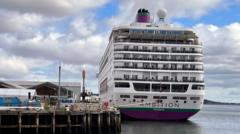
When a cruise ship passenger vanishes into the dark open ocean, the immediate public narrative rarely matches the grim operational reality of modern maritime travel. A cruise ship passenger feared to have fallen overboard triggers an immediate protocol of search and rescue efforts, but these operations are frequently executed against staggering physical odds, turning vast expanses of water into near-impossible search zones within minutes.
Maritime statistics indicate that dozens of people go overboard from cruise vessels every single year. The vast majority of these incidents do not result in rescue. Behind the flashing lights of the bridge and the carefully managed corporate statements from major cruise lines lies a quiet, persistent crisis regarding how these floating cities handle safety, liability, and the brutal physics of a human body hitting the water from a multi-story deck. Don't forget to check out our earlier coverage on this related article.
The Brutal Physics of the Fall
Most travelers vastly underestimate the height of a modern cruise ship. Standard mega-ships rise fifteen stories or more above the waterline, meaning a passenger standing on a private balcony or a top-deck promenade is looking down at a drop equivalent to a multi-story building.
When a person goes over the side, gravity dictates a terrifying acceleration. Hitting the ocean surface from that height is roughly equivalent to hitting a concrete barrier at high speed. If you want more about the context here, National Geographic Travel offers an informative breakdown.
Internal injuries, fractured bones, and immediate unconsciousness are common outcomes upon impact. Even if a passenger survives the initial blow, the shock of cold water can trigger sudden cardiac arrest or an involuntary gasp that fills the lungs with brine.
Time is the ultimate enemy. A cruise ship moving at twenty knots covers a significant distance before the bridge can even register that someone is missing. By the time the engines reverse, the ship can be miles away from the actual point of impact, leaving search crews to guess the location based on wind drift, currents, and delayed notifications.
The Technology Gap on Modern Vessels
Passengers often assume that high-tech radar and security cameras cover every square inch of a billion-dollar vessel. The reality is far more fragmented.
While closed-circuit television systems monitor public corridors and pool decks, private balconies remain intentionally unmonitored to protect guest privacy. This creates a massive blind spot. A significant percentage of overboard incidents happen from private stateroom balconies during the late-night hours when few witnesses are around.
Automated detection systems do exist. Advanced optical sensors, infrared cameras, and radar-based overboard detection systems can automatically alert the bridge the moment a body crosses the ship's rail. Yet, adoption across the global fleet remains surprisingly low. Major cruise operators have been slow to mandate these systems universally, largely due to the financial cost of retrofitting older ships and the persistent issue of false alarms triggered by seabirds, large waves, or stray luggage.
When a vessel lacks automated sensors, the timeline of discovery relies entirely on human observation. If a witness spots someone falling and immediately alerts crew members, the response time is measured in minutes. If nobody sees the fall, hours may pass before a housekeeping check or a missing person report alerts the staff. By that point, the ship might be operating in an entirely different maritime zone, making a coordinated search mathematically futile.
The Protocol After the Alarm
When an overboard alarm sounds, the response from the crew is swift, highly drilled, and rehearsed to meet international maritime standards. The bridge executes a designated maneuver, often the Williamson turn, designed to bring the vessel back along its exact wake.
The ship launches rescue boats if weather conditions permit. Other vessels in the vicinity are alerted via emergency channels to assist in scanning the water. Coast Guard units from the nearest jurisdiction are brought into the communications loop, deploying aircraft and surface vessels if they are within range.
Yet, searching for a single human being in the open ocean is notoriously difficult. Whitecaps mimic the appearance of a person's head or a life vest. Wind shifts rapidly alter drift patterns. At night, visibility drops to near zero, rendering visual sweeps virtually useless without sophisticated thermal imaging.
Cruise lines face a complex balancing act during these crises. They must mobilize every available resource for the rescue while simultaneously managing thousands of panicking passengers onboard who demand information. Communication from the captain's desk is typically sparse during an active search, fueling rumors and anxiety throughout the decks.
Legal and Regulatory Blind Spots
The governance of cruise safety sits in a complicated international framework. Most major cruise lines are registered under flags of convenience in countries like the Bahamas, Panama, or Liberia, even though their primary corporate headquarters and consumer markets are in the United States.
This means safety regulations are dictated by international maritime treaties rather than domestic consumer protection laws. While bodies like the Cruise Line International Association emphasize that going overboard is a statistically rare event relative to the tens of millions of passengers who sail annually, advocacy groups and families of victims argue that the industry has not done enough to prevent avoidable tragedies.
Legislation in the United States, such as the Cruise Vessel Security and Safety Act, mandates certain safety measures like raised balcony rails and mandatory reporting of crimes and missing persons to the FBI. However, enforcement and accountability remain weak when incidents occur in international waters outside the direct jurisdiction of local law enforcement.
The Human Element and Alcohol
Safety briefings and warning signs are ubiquitous on every ship, yet human behavior often defies structural precautions. Alcohol consumption plays a major contributing factor in a high proportion of overboard cases. The prevalence of all-inclusive drink packages, late-night deck parties, and relaxed vacation environments can impair judgment, reduce inhibitions, and compromise physical coordination near high edges.
Incidents rarely stem from pure malice or third-party foul play, though investigations must always treat every missing person case as a potential crime scene until proven otherwise. More often, a tragic mix of fatigue, poor lighting, impaired balance, and unsafe physical positioning leads to a fatal misstep. Leaning over balcony rails for photographs or attempting unauthorized climbs between decks accounts for an alarming share of preventable losses.
Navigating the aftermath leaves families shattered, searching for answers in an environment where corporations tightly control the narrative, legal liability is fiercely contested, and the ocean yields few clues. Until automated detection systems become a mandatory global standard rather than an optional luxury, the sea will continue to hold onto its secrets long after the rescue boats have been recalled.