The glow of a smartphone screen is exactly bright enough to blind you to the universe.
We live our lives inside a strict radius of artificial illumination. Desktop monitors, halogen streetlights, the pale blue glare of a tablet before sleep—they all conspire to pull our gaze downward, shrinking our world to the size of a sidewalk or a digital feed. We have traded the infinite for the immediate.
But once a year, the universe forces a reckoning.
It happens in the sweltering heart of August, when the air is thick enough to taste and the crickets are loud enough to shake the windowpanes. A quiet migration begins. People who haven't looked up in months pack blankets into their trunks, drive past the suburbs where the neon dissolves into ink, and lie flat on their backs in the dark. They are waiting for the Perseids.
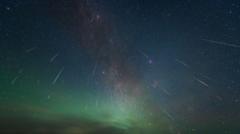
To the casual observer, it looks like a sudden, chaotic celebration in the stratosphere. Streaks of silver and pale green slashing through the constellations. In reality, it is a cosmic traffic accident that has been scheduled for thousands of years.
The Ghosts of Swift Tuttle
Imagine a block of ice and rock the size of a small mountain, hurtling through the deep freeze of outer space. This is Comet Swift-Tuttle, a celestial wanderer with a massive orbit that takes 133 years to circle the sun. Every time this dirty snowball draws near our star, the intense solar heat boils its icy surface, blasting a trail of dust, gravel, and ancient debris into its wake.
The comet itself is long gone, currently drifting through the dark outer reaches of our solar system, not to return until the year 2126. But it left its luggage behind.
Every August, Earth crashes directly into this orbital river of cosmic garbage.
When you sit in a dark field and watch a shooting star sprint across the sky, you are not watching a star die. You are watching a piece of cometary dust, often no larger than a single grain of sand, slamming into Earth’s upper atmosphere at an incomprehensible speed of thirty-seven miles per second. That is over one hundred and thirty thousand miles per hour.
At that speed, the air ahead of the particle cannot move out of the way fast enough. It compresses violently. Compression creates immense heat, raising the temperature to thousands of degrees. The tiny grain of dust vaporizes instantly, leaving behind a glowing trail of superheated air and ionized gas.
It is a violent, beautiful annihilation. A speck of dust that survived for billions of years in the freezing void of space meets its end by turning into a line of poetry written on our sky.
The Patient Art of the Dark
Let us consider a hypothetical observer named Sarah. She is seventeen, exhausted by the relentless rhythm of notifications, and currently sitting on the hood of a hatchback in a gravel turnout three miles outside of town. Her eyes hurt from a week of studying, and the darkness here feels heavy, almost oppressive.
For the first ten minutes, she sees nothing. The sky is just a massive, flat sheet of black.
This is the barrier most people fail to cross. We are an impatient species, conditioned by instant gratification and high-speed internet. If a video doesn't load in three seconds, we scroll past. If the sky doesn't perform on command, we turn the ignition key and go home.
But human eyes are biological machines, and they require time to adapt to the dark. A chemical called rhodopsin needs to build up in the rods of our retinas, a process that takes roughly thirty minutes in total darkness. Every flash of a headlights or peek at a phone screen resets that biological clock to zero.
Sarah waits. The air cools. Her pupils dilate to their absolute limit.
Suddenly, the sky changes. The flat black sheet separates into layers of unimaginable depth. Stars appear where there were none before. The pale, milky band of our own galaxy reveals itself, stretching like smoke from horizon to horizon.
Then, it happens. A spark.
It originates near the constellation Perseus in the northeast sky—the radiant point from which the shower takes its name—and zips across the zenith, leaving a ghostly green tail that lingers for two full seconds before dissolving into nothingness.
Sarah breathes out a breath she didn't realize she was holding.
She has just witnessed a piece of the solar system's history colliding with her home planet. The green hue she saw wasn't an illusion; it was the specific signature of nickel and iron burning up forty miles above her head, a chemical fingerprint broadcast across the night.
The Invisible Stakes of a Celestial Show
It is easy to dismiss a meteor shower as a mere novelty, a background event for a romantic date or a reason to stay up past midnight. But there is an underlying tension to the Perseids that speaks to our deepest vulnerabilities.
The very atmosphere that vaporizes these pebbles is the only thing shielding us from a hostile universe. Every streak of light is a reminder of a bullet dodged. The Earth is constantly under bombardment, traveling through a cosmic shooting gallery without armor, relying entirely on a thin, fragile blanket of nitrogen and oxygen to burn up the incoming debris.
During the peak of the Perseids, which typically falls between August 11 and August 13, the planet encounters the densest part of the comet's trail. The numbers are staggering. An observer in a truly dark location can expect to see anywhere from fifty to one hundred meteors every single hour. That is more than one every minute.
Think of the sheer scale of that interaction. Thousands of tons of space dust are raining down on our planet over the course of a few weeks. Most of it is so small it falls to the ground as invisible micrometeorites, settling into the soil, the oceans, and the roofs of our houses. We walk through the remnants of comets every day without ever knowing it.
Yet, looking up at the peak of the shower brings a strange sense of comfort rather than fear. It is a predictable cosmic rhythm in an unpredictable world. Governments rise and fall, technology transforms our societies, and our personal lives are fractured by anxiety and change. But the dust of Swift-Tuttle arrives precisely on time, every August, without fail, completely indifferent to human drama.
Finding the Forgotten Silence
To truly experience this event, you have to leave the comforts of the modern world behind. You cannot watch a meteor shower from your living room window, and a livestream on a monitor completely strips the experience of its power.
You need the sensory reality of the night.
You need to feel the dampness of the dew soaking through the back of your jacket. You need to hear the eerie, distant call of an owl or the rustle of wind through a cornfield. You need to experience the specific vulnerability of being small beneath an immense, uncaring sky.
When you lie there long enough, something shifts in your perception. You stop feeling like an audience member looking up at a screen. Instead, you realize you are riding on the windshield of a massive planetary spaceship, hurtling through a cloud of ancient debris at eighteen miles per second. The motion becomes palpable. You aren't watching the meteors fall to Earth; you are watching Earth charge headfirst into the meteors.
It is a profound shift in perspective. The worries that felt monumental an hour ago—the unreturned text message, the upcoming exam, the low bank balance—suddenly seem impossibly small when measured against the scale of geologic time and interstellar space.
Sarah sits on her car hood for two hours. She counts forty-seven meteors. Some are mere blips, faint scratches on the dark. Others are earthgrazers—long, slow-moving fireballs that skitter across the horizon, burning with the intensity of flares.
When she finally drives home, the town feels different. The streetlights seem aggressively bright, almost intrusive. The glow of her phone on the dashboard feels less like a window to the world and more like a distraction from it.
The Perseid meteor shower will end, as it does every year, as the Earth pulls away from the comet's trail and moves back into the cleaner lanes of space. The sky will seem quieter, emptier. We will return to our screens, our schedules, and our brightly lit rooms.
But for those who took the time to sit in the dark, the world is permanently altered. They will walk through the daytime streets knowing that just beyond the blue sky, the ancient dust is still waiting, and the universe is always moving, even when we forget to look.