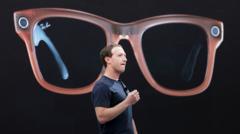
People are terrified of being recorded without knowing it. It’s a primal reaction. You walk into a coffee shop, see someone wearing thick-rimmed Ray-Bans, and wonder if your awkward morning face is currently being live-streamed to three hundred strangers. Yet, despite the outcry from privacy advocates, Meta’s smart glasses are flying off the shelves. Ray-Ban Meta glasses have surpassed expectations, proving that most consumers value convenience and cool factors over the abstract idea of digital "personal space."
The data doesn't lie. During recent earnings calls, Mark Zuckerberg noted that the demand for these frames is outstripping supply. This isn't just a tech fluke. We’ve reached a point where the hardware actually looks like something you’d want to wear. Unlike the disastrous Google Glass experiment of a decade ago, these don't make you look like a cyborg from a low-budget 80s movie. They look like Ray-Bans. That's the secret sauce.
The hypocritical nature of our privacy concerns
We’re a funny species. We scream about a tiny LED light on a pair of glasses while carrying around smartphones that track our every step, heartbeat, and late-night shopping habit. Most people argue that smart glasses are an "invasion," but they’re already living in a glass house.
The real shift isn't about the tech itself. It’s about the form factor. When you hold up a phone to take a photo, there’s a social contract. Everyone sees the "camera up" gesture. With smart glasses, that gesture disappears. Meta tried to fix this with a bright white light that shines when recording. But let’s be real. It’s easy to cover that light with a bit of tape or a well-placed finger.
Privacy groups like the Electronic Frontier Foundation have raised flags about this for years. They worry about the normalization of constant surveillance. But the market has already voted. Sales figures suggest that as long as the tech is useful, we’re willing to let the "creepy" factor slide. It happened with "Always On" smart speakers. It happened with doorbell cameras. Now, it’s happening on our faces.
Why people are actually buying them
It’s not just about taking photos. If it were, they’d be a gimmick. The reason Meta is winning is the integration of multimodal AI.
Imagine you’re hiking. You see a plant you don't recognize. You don't have to fumble for your phone, unlock it, open an app, and snap a photo. You just ask the glasses. "Hey Meta, what am I looking at?" The glasses analyze the view and tell you the answer in your ear. That’s powerful. It’s the kind of utility that makes people forget they’re wearing a surveillance device.
Audio quality that actually works
The open-ear speakers are surprisingly good. You can listen to a podcast or take a call while still hearing the world around you. It’s safer than noise-canceling earbuds when you’re walking through a city. You stay present. You aren't walled off in a digital bubble. This "heads-up" lifestyle is the primary selling point.
The social media pipeline
Meta owns the ecosystem. If you’re a creator, the ability to live-stream directly to Instagram from your point of view is a massive advantage. It creates a raw, first-person perspective that a handheld phone can't replicate. It’s "hands-free" storytelling. For the TikTok and Reel generation, this is a must-have tool, not a privacy threat.
The technical reality of the privacy light
Meta spent a lot of time on the "Capture LED." They designed it so the camera won't function if the light is tampered with or covered—theoretically. Tech hobbyists have already found ways around some of these software locks, but for the average user, the light is a permanent fixture.
Is it enough? Probably not. In a crowded bar, a small white light isn't going to stop someone from being recorded. But compare this to the hidden cameras people put in Airbnbs or the millions of security cameras perched on every street corner. Smart glasses are just the most visible version of a problem that already exists everywhere.
The Google Glass ghost is finally dead
Google Glass failed because it tried to be a computer first and glasses second. It was ugly. It was expensive. It made you a social pariah. Meta took the opposite approach. They partnered with EssilorLuxottica, the biggest name in eyewear. They made sure the glasses were stylish before they were "smart."
If you take the tech out, you still have a pair of Wayfarers. That’s the genius of the strategy. You aren't buying a headset; you’re buying a classic accessory that happens to have a brain. This shift in design philosophy is why we’re seeing a surge in adoption while other "wearables" gather dust in drawers.
Reality check on data collection
When you use Meta AI on these glasses, your data goes to Meta’s servers. Your photos are processed. Your voice commands are analyzed. Meta claims they don't use the content of your photos or videos to train their AI unless you explicitly share them or use the AI features, but skepticism is healthy.
We know the business model. Meta is a data company. The glasses are just another sensor for their network. By wearing them, you’re providing a first-person view of the world to one of the largest data-mining operations on the planet. For many, that’s a bridge too far. For others, the convenience of having an AI assistant on their face is worth the trade.
How to use smart glasses without being a jerk
If you're going to join the early adopters, don't be the reason people hate this tech. Social etiquette hasn't caught up to the hardware yet.
- Don't wear them in locker rooms, bathrooms, or doctors' offices. Even if they're off, it’s just weird.
- Tell people. If you're at a small dinner party, mention they're smart glasses.
- Don't record people without asking. It’s basic decency.
- If someone looks uncomfortable, take them off.
The future of these devices isn't just about photos. We're looking at a path toward full Augmented Reality (AR) where digital information is overlaid on the physical world. Meta’s current glasses are the "training wheels" for that future. They’re getting us used to having cameras on our faces and AI in our ears.
Privacy concerns won't go away. They’ll probably get louder as the cameras get smaller and the AI gets smarter. But if the current sales trends are any indication, the "privacy invasion" is a price millions are happy to pay for a more connected life.
Stop worrying about whether people are watching you. They probably are, but it's likely via the smartphone in their hand or the security camera above the door, not the person in the cool sunglasses. If you want to try them, go to a store and put them on. Feel the weight. Test the audio. You’ll quickly realize why people are choosing the "cool" tech over the "creepy" warnings. Buy the frames for the style, use the AI for the utility, and keep your hands off the recording button in private spaces. It’s that simple.