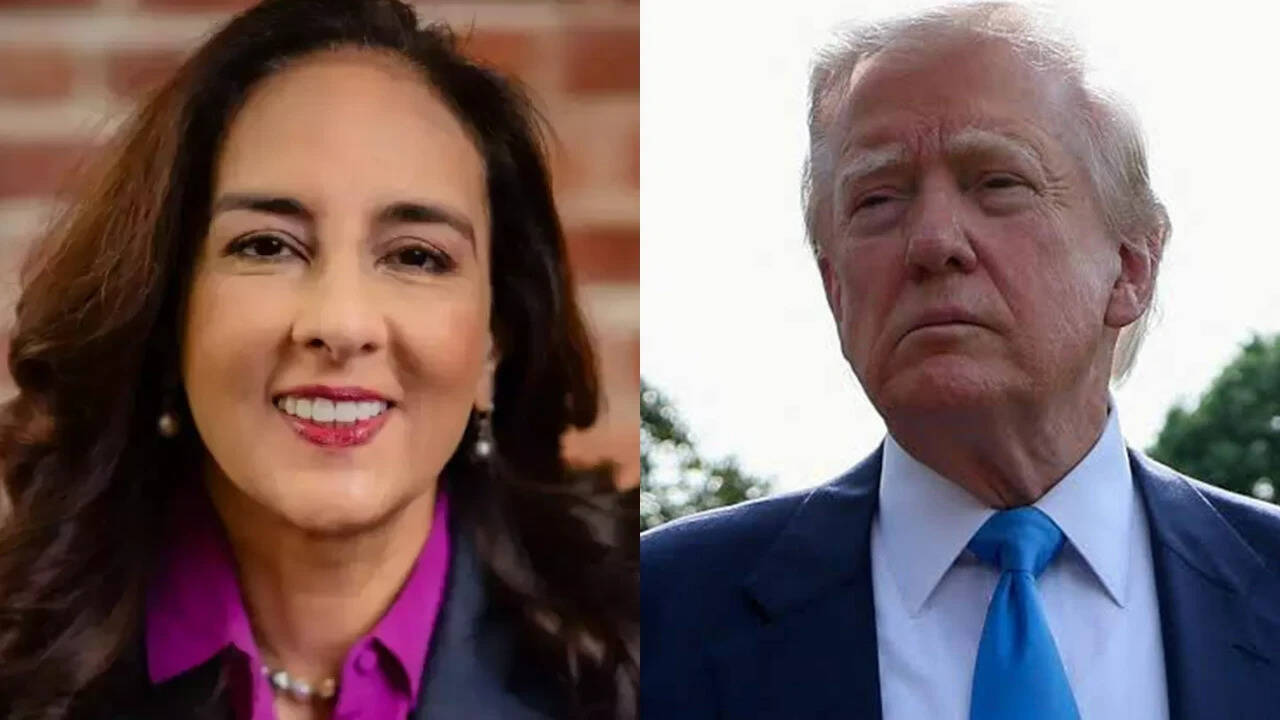
Political coverage often treats every reported disagreement inside a political movement as an existential crisis. When a report surfaced alleging that Donald Trump demanded Harmeet K. Dhillon be fired after watching her October 18 appearance on 60 Minutes, commentators immediately defaulted to a familiar narrative: palace intrigue, personal grievance, and imminent exile.
That framing misses the structural mechanics of modern political media strategy, legal positioning, and coalition management. To understand why reports like this generate massive heat while frequently producing little structural change, you have to look past the surface-level drama and examine how television appearances, legal advocacy, and political loyalty actually operate in high-stakes environments. Learn more on a similar issue: this related article.
The Illusion of the Career-Ending Broadcast
Cable news and digital aggregators thrive on binary outcomes. Either an official is completely in favor, or they are seconds away from being cast out. According to the report referenced in the headline, Trump reacted negatively to Dhillon’s October 18 60 Minutes interview and allegedly called for her removal. In standard Washington coverage, a reported demand for someone's ouster is treated as a definitive verdict on their standing.
In reality, political principals routinely express frustration with surrogates, attorneys, and allies after major network appearances without severing ties. High-profile interviews on legacy broadcasts like 60 Minutes are notoriously difficult environments for conservative figures. The editing process compresses hours of conversation into tightly scripted segments designed to advance a specific journalistic thesis. When a principal watches the final cut, they are reacting to a heavily curated product—one that rarely reflects the full scope of the arguments the interviewee actually made on camera. Additional journalism by NPR highlights similar perspectives on the subject.
Furthermore, equating an immediate, visceral reaction to a television broadcast with a permanent personnel decision ignores how political leadership actually functions. Verbalized frustration is often a tool for signaling expectations rather than an administrative directive. Treating every reported outburst as an irreversible firing order confuses emotional venting with organizational execution.
What Legacy Media Misunderstands About Legal Surrogates
Harmeet Dhillon is not a traditional press secretary whose sole mandate is repeating talking points verbatim. She is a prominent trial lawyer, a former vice chair of the California Republican Party, a Republican National Committee national committeewoman, and the founder of the Center for American Liberty. Her value to a political coalition rests on her legal credentials, courtroom experience, and institutional standing within the conservative legal movement—not on delivering flawless soundbites on Sunday evening newsmagazines.
When media outlets cover friction between a political leader and a prominent legal ally, they often overlook the asymmetrical incentives at play:
- The Principal's Incentive: A political leader evaluates media appearances through the lens of immediate narrative dominance, optics, and perceived strength. If a segment appears to concede ground or fails to aggressively counter the interviewer's framing, the leader views it as a tactical loss.
- The Attorney's Incentive: A practicing lawyer operating in the public square must balance political messaging with professional credibility, bar ethics, and ongoing litigation risks. Saying something reckless on national television might satisfy a short-term political appetite, but it can fatally undermine active legal cases in federal court.
- The Network's Incentive: 60 Minutes editors are not producing campaign commercials. They select clips that highlight tension, ambiguity, or apparent contradictions to build dramatic momentum for a broad audience.
When these three competing priorities collide on a single broadcast, friction is the default outcome. Interpreting that friction as a sign of total political collapse ignores the basic institutional realities each party has to navigate.
The Flawed Premise Behind the "Loyalty Test" Narrative
A common question surrounding reports of this nature is whether a single misaligned television appearance permanently disqualifies an ally from future influence or appointments. That question rests on a flawed premise: that political coalitions operate like rigid corporate hierarchies with zero-tolerance HR departments.
They do not. Political movements—especially populist ones—operate as fluid networks of utility and alignment. An individual's standing fluctuates based on what they bring to the table at any given moment. A legal strategist who faces criticism over a media appearance on a Sunday night can easily be back in the inner circle by Wednesday if a critical court filing, ballot access dispute, or constitutional challenge requires their specific expertise.
Consider the broader track record of figures within Trump's orbit over the past decade. Countless advisors, attorneys, and cabinet officials have been the subject of reports claiming they had lost favor, faced demands for termination, or been sidelined after a television interview went poorly. Yet many of those exact individuals remained active participants in legal battles, policy formation, and subsequent campaigns.
Why "Unnamed Source" Reports Require Structural Skepticism
Another critical blind spot in mainstream coverage is the uncritical amplification of behind-the-scenes reporting without examining who benefits from the leak. Whenever a story breaks claiming a leader demanded someone's firing over a TV segment, observers should immediately ask why that specific conversation became public.
In political ecosystems, leaks regarding personnel friction rarely originate from the principal. They almost always come from rival factions competing for influence, airspace, or future roles. Publicizing a leader's private frustration with a prominent surrogate serves a clear tactical purpose for internal competitors:
- Devaluing a Rival's Stock: By painting an ally as "on the outs," competitors attempt to discourage donors, media bookers, and coalition partners from working with that person.
- Signaling Alignment: Leakers demonstrate to the principal that they share the leader's dissatisfaction with the broadcast, positioning themselves as more attuned to the leader's instincts.
- Creating a Self-Fulfilling Prophecy: If enough outlets repeat the narrative that someone is finished, the resulting media coverage itself becomes a distraction—sometimes forcing the principal to distance themselves simply to stop answering questions about the story.
Analysts who take these reports at face value without accounting for internal factional warfare end up acting as unwitting force multipliers for rival staffers.
The Real Risk of High-Profile Network Interviews
None of this means Dhillon's—or any political figure's—appearance on 60 Minutes is without genuine strategic risk. Even if reports of immediate ouster are overblown, miscalculating a legacy media interview carries real consequences.
The core mistake many political surrogates make is assuming they can out-argue the edit. In a live cable news hit, an interviewee controls their pacing and can force a point onto the record in real time. In a pre-taped, multi-hour interview for a network magazine show, the interviewee surrenders total control over context. A nuanced, three-minute legal explanation can be reduced to a seven-second reaction shot paired with a voiceover that reframes the entire exchange.
For figures operating in high-stakes political environments, the lesson is straightforward:
- Never treat pre-taped network interviews like live debates. Nuance does not survive the editing bay. Every sentence must be self-contained, unambiguous, and incapable of being reframed out of context.
- Recognize the audience mismatch. Appearing on legacy broadcasts rarely persuades skeptical viewers, while simultaneously exposing the speaker to criticism from their own base if the final edit looks overly defensive or conciliatory.
- Separate legal precision from political framing. When discussing active controversies on television, technical accuracy alone is insufficient if the visual and tonal presentation reads as hesitation.
Looking Beyond the Headline
The obsession with whether Donald Trump demanded Harmeet Dhillon's firing after an October 18 60 Minutes broadcast reflects a media ecosystem addicted to instant drama over structural analysis. Reported demands for dismissal are a routine feature of modern political coverage, yet they rarely tell the full story of how power, legal utility, and coalition politics actually work.
A single edited television segment does not erase years of legal advocacy, institutional leadership, or ideological alignment. Until the media stops mistaking momentary backstage friction for permanent political exile, its coverage of internal movement dynamics will continue to miss the real mechanics driving decisions behind closed doors.