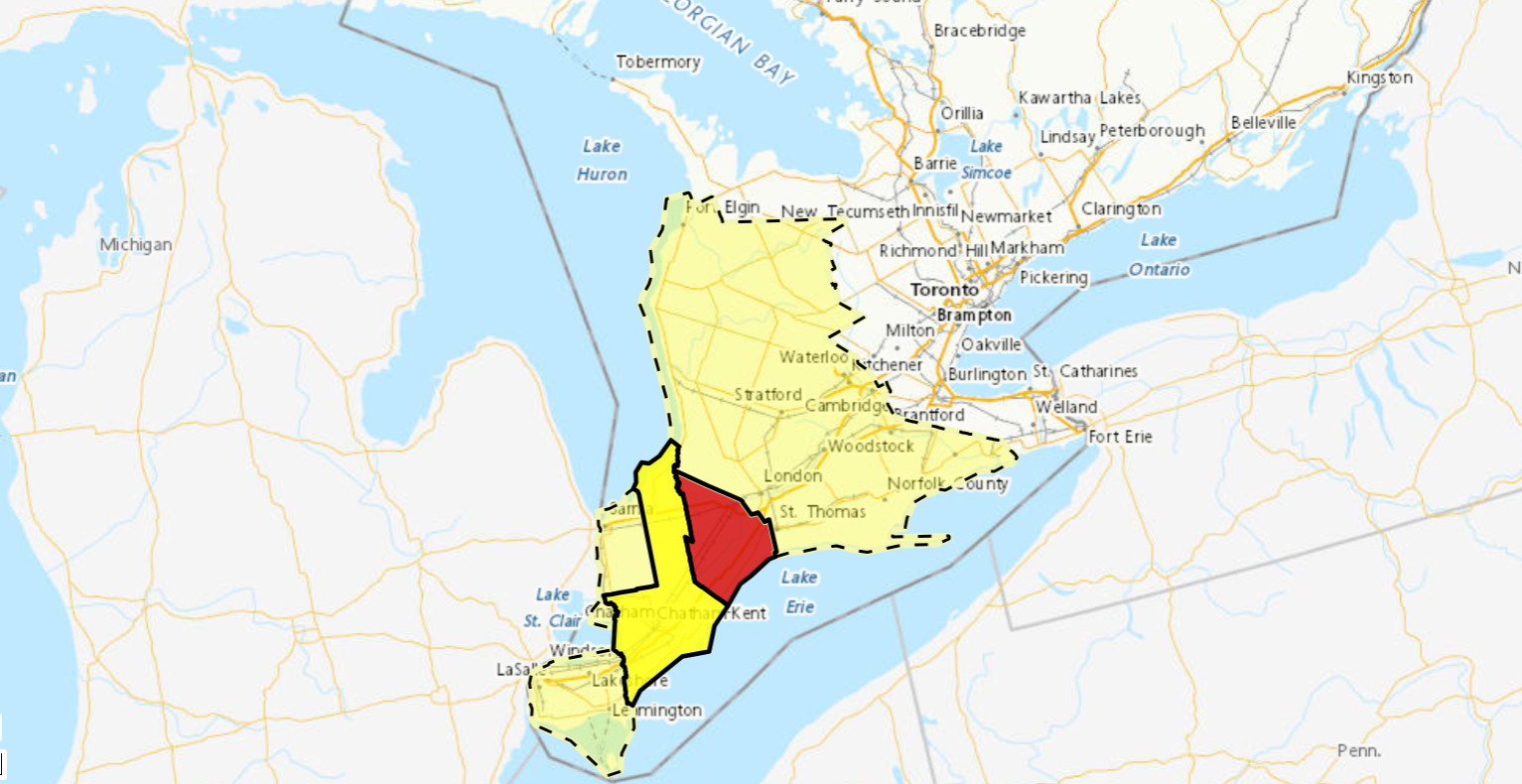
The atmospheric convergence zone over southwestern Ontario represents one of the most volatile microclimates in North America for severe convective development. On June 25, 2026, the rapid escalation from a severe thunderstorm watch to immediate tornado warnings across Chatham-Kent, Middlesex, and Elgin counties exposed the structural vulnerability of this geographic corridor. Evaluating these events requires discarding sensationalized weather reporting in favor of a rigorous thermodynamic assessment. The genesis of tornadic activity in this region is dictated by a predictable triad of variables: high boundary-layer instability, low-level wind shear, and local lacustrine boundary interactions.
The Thermodynamic Equation of Convective Instability
Convective development depends fundamentally on the vertical profile of the atmosphere. The primary metric for quantifying this potential energy is Convective Available Potential Energy (CAPE), expressed in Joules per kilogram ($\text{J/kg}$). CAPE measures the integrated buoyant energy of an air parcel ascending vertically through a theoretically undisturbed environment:
$$CAPE = \int_{LFC}^{LNB} g \left( \frac{T_{v,\text{parcel}} - T_{v,\text{env}}}{T_{v,\text{env}}} \right) dz$$
Where:
- $LFC$ is the Level of Free Convective ascent.
- $LNB$ is the Level of Neutral Buoyancy.
- $g$ is the acceleration due to gravity.
- $T_{v,\text{parcel}}$ and $T_{v,\text{env}}$ represent the virtual temperatures of the parcel and ambient environment.
During the late afternoon hours of June 25, solar radiation eliminated the convective inhibition (CIN) layer that had capped the boundary layer during the morning's heavy rainfall. This diurnal heating, combined with high dew points near the surface, created steep lapse rates—the rate at which atmospheric temperature decreases with an increase in altitude. When cool air in the upper atmosphere overlies a rapidly warming surface, the density differential forces intense vertical acceleration. The resulting updrafts form the structural core of severe thunderstorms.
Without sufficient vertical wind shear, these updrafts remain symmetric, causing rain-cooled downdrafts to choke off the warm inflow, terminating the storm's lifecycle within 30 to 60 minutes. The transformation into a supercell—a long-lived storm featuring a rotating updraft known as a mesocyclone—requires the introduction of directional and speed shear within the lowest six kilometers of the troposphere.
The Lacustrine Amplification Mechanism
The unique topography of southwestern Ontario, bounded by Lake Huron to the north and northwest, and Lake Erie to the south, introduces localized aerodynamic variables that absent in continental landmasses. This geographic positioning subjects the peninsula to the lacustrine amplification mechanism.
During high-insolation summer days, the differential heating rates of land and water surfaces generate lake breeze fronts. Land surfaces warm rapidly, causing air to expand and rise, which draws cooler, high-density air inland from the lakes. These lake breeze boundaries act as low-level mesoscale cold fronts.
When a regional synoptic-scale weather system moves through southwestern Ontario, its interaction with these lake breezes alters the localized wind profile in two distinct ways.
Helicity Enhancement
The collision of an incoming storm system with a lake breeze front sharply rotates the low-level wind vector. Winds near the surface shift to a southeasterly direction due to the lake breeze draw, while winds a few kilometers aloft continue to blow from the west or southwest. This structural shift creates high storm-relative helicity (SRH) in the lowest 1 to 3 kilometers. SRH quantifies the potential for cyclonic updraft rotation within a storm.
Mechanical Lifting
The dense, cool marine air mass forces the warm, humid continental air sharply upward along the narrow boundary line. This mechanical forcing accelerates the air parcel to its level of free convection far more rapidly than solar heating alone could achieve, triggering isolated, rapidly developing supercells directly along the lake breeze termination zones.
The warnings issued for areas such as Grand Bend, Strathroy, and Glencoe align with these precise boundary trajectories. The localized nature of these boundaries explains why regional forecasts often designate a low probabilistic risk for the entire province, while specific sub-counties experience imminent tornadic development.
Radar Interpretation and Operational Signal Deficiencies
Environment and Climate Change Canada (ECCC) issues tornado warnings based on a combination of ground-truth spotter reports and Doppler weather radar data. Interpreting this data requires understanding the mechanical limits of remote sensing technology.
Doppler radar functions by emitting microwave pulses and measuring the frequency shift of the returned signal to determine the velocity of hydrometeors (rain, hail) moving toward or away from the radar antenna. Forecasters monitor two primary arrays: reflectivity and velocity.
- Reflectivity Hook Echoes: In a classic supercell, the powerful rotation of the mesocyclone draws precipitation around the back of the updraft. This creates a distinctive hook-like extension on the southwest flank of the storm core.
- Velocity Inbound/Outbound Couplets: The definitive radar signature of a tornado or a strong mesocyclone is a rotational velocity couplet. This occurs when high-velocity winds moving toward the radar station sit immediately adjacent to high-velocity winds moving away from it.
Operational limitations complicate this analysis. The radar beam does not travel parallel to the curvature of the Earth; instead, it projects upward at an angle. As the distance from the radar station increases, the beam samples the storm at progressively higher altitudes, completely missing the lowest kilometer of the atmosphere where tornadoes physically manifest.
A storm displaying intense mid-level rotation at an altitude of three kilometers may fail to translate that rotation down to the surface due to friction or insufficient low-level buoyancy. Conversely, weak landspout tornadoes—which develop from the ground up along convergence lines rather than downward from a deep mesocyclone—frequently evade Doppler radar detection entirely until structural damage occurs. This creates a critical operational constraint where forecasters must balance the risk of false alarms against the lead time required for public evacuation.
Structural Risk Mitigation and Infrastructure Vulnerability
When a tornado warning scales from a theoretical forecast to an active hazard, the focus shifts to structural survival physics. The damage caused by tornadic winds is a function of dynamic pressure, projectile impact, and structural engineering integrity.
The force exerted by wind against a vertical surface increases quadratically with velocity:
$$P = \frac{1}{2} \rho v^2 C_d$$
Where:
- $P$ is the dynamic pressure ($\text{N/m}^2$).
- $\rho$ is the density of air (approximately $1.2 \text{ kg/m}^3$).
- $v$ is the wind velocity ($\text{m/s}$).
- $C_d$ is the drag coefficient of the structure.
A doubling of wind speed from 90 km/h (the threshold for a severe thunderstorm warning) to 180 km/h (an EF1 tornado) results in a fourfold increase in the structural load applied to walls and roofs. Standard residential construction across Ontario is designed to withstand vertical dead loads (the weight of the building itself) and snow loads, but it remains highly vulnerable to the lateral and upward aerodynamic forces generated by tornadic rotation.
The failure sequence of a standard residential building typically initiates at the roof-to-wall connections. As high-velocity winds pass over a gabled or flat roof, they generate severe aerodynamic lift, mirroring the physics of an aircraft wing. If the roof lifts off, the lateral support for the exterior walls is compromised, leading to immediate structural collapse under the pressure of the wind.
The secondary mechanism of destruction is atmospheric pressurization and debris impact. Unsecured objects—including patio furniture, construction materials, and broken tree branches—become high-velocity projectiles capable of penetrating exterior building envelopes. Once a window or garage door fails on the windward side of a building, internal pressurization occurs simultaneously with external aerodynamic lift. This internal-external pressure differential creates an explosive outward force that shears structural framing apart.
Logistical Protocol Execution
Mitigating the economic and human costs of these severe weather events requires an immediate transition from passive monitoring to active structural defense. The following operational protocol governs the immediate response window during a valid tornado warning:
- Isolate Civil Infrastructure: Facilities must immediately terminate high-risk operations, particularly crane operations, exterior electrical maintenance, and the transport of hazardous materials.
- Execute Vertical Evacuation: Personnel must move below grade or into engineered concrete reinforced cores. In high-rise structures, upper floors must be evacuated down to central, windowless interior hallways to maximize the distance between occupants and the exterior building envelope.
- De-energize Vulnerable Systems: Industrial plants and residential managers should prepare for grid instability. High wind gusts up to 90 km/h and localized tornadic impacts routinely down distribution lines via tree canopy failure. Proactive isolation of sensitive electrical equipment prevents surge damage during subsequent automated recloser cycles.
- Post-Event Structural Triage: Following the cancellation of a warning, facility managers must inspect roof anchor points, verify building envelope integrity, and check for natural gas line fractures before permitting re-entry or restoring system power.