Structural Anatomy of the 2026 Riksdag
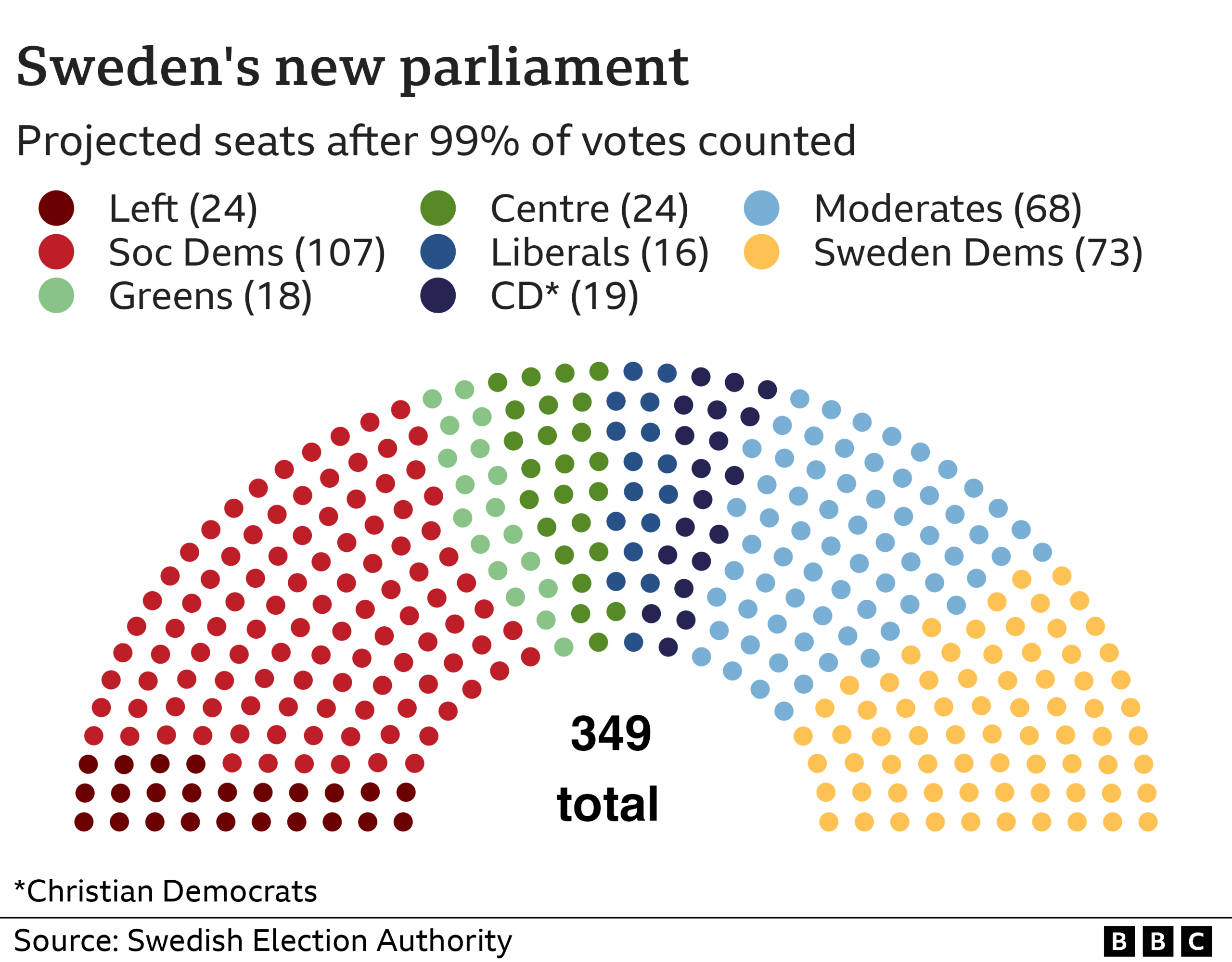
The 2026 Swedish general election delivered a political outcome frequently mischaracterized by international media as a straightforward ideological swing. Beneath surface-level narratives of victory and defeat lies a precise mathematical deadlock governed by the 349-seat Riksdag. Preliminary results established a razor-thin advantage for the four-party center-left opposition bloc, projecting 176 seats against 173 seats for the incumbent conservative-aligned parties. This distribution represents neither a broad public mandate nor an outright collapse, but rather a structural friction point rooted in proportional representation and rigid coalition mathematics.
To understand why this outcome generated systemic paralysis, one must evaluate the internal composition of both political formations. The Social Democrats finished first with approximately 28 percent of the vote, securing 99 seats. Yet this figure masks a historical electoral erosion; the party's baseline support has steadily retreated from older majoritarian highs, forcing it into deep reliance on smaller, ideologically divergent partners: the Left Party holding 30 seats, the Green Party with 22 seats, and the Centre Party with 25 seats. On the opposing side, Ulf Kristersson led the Moderates to 70 seats, while the Sweden Democrats secured 62 seats, the Christian Democrats 22 seats, and the Liberals 19 seats.
This numerical distribution reveals a profound governance bottleneck. Winning a plurality of votes or even a nominal majority threshold of 175 seats does not translate into operational executive power when internal coalition chemistry forbids cross-factional cabinet participation. The Swedish electorate did not vote for a unified governing direction; instead, voters partitioned power across a multi-polar spectrum where every coalition formula contains internal contradictions.
The Economics of Populist Retraction
The most notable structural deviation in the 2026 cycle was the measurable contraction of the Sweden Democrats. Having expanded their vote share steadily across successive electoral cycles to become the second-largest party in 2022 at roughly 20.5 percent, the party experienced a reversal, falling to approximately 17.6 percent of the vote and dropping 11 seats to finish with 62.
This retraction demands a rigorous analytical breakdown rather than a casual dismissal of populist appeal. First, the mainstreaming of hardline immigration policy by established center-right parties altered the competitive arena. When the incumbent conservative administration and its legislative allies adopted stringent border controls, stricter naturalization criteria, and expanded law enforcement powers, the Sweden Democrats lost their exclusive monopoly on anti-immigration rhetoric. Voters seeking strict migration management no longer required a populist protest vehicle to register their policy preferences; mainstream conservative alternatives offered institutional credibility combined with identical baseline restrictions.
Second, proximity to executive responsibility exposed internal strategic friction. As the party moved closer to formal cabinet participation—typified by the March agreement where the Liberals dropped their veto against far-right ministers—its voter base faced a different utility calculation. Protest movements thrive on external opposition; entering the machinery of government requires compromises that alienate ideological purists while reassuring moderate skeptics. The Sweden Democrats failed to balance this tension effectively. The eventual post-election decision by party leadership to drop ministerial demands and offer parliamentary tolerance reflects a calculated adaptation to this structural ceiling. Populist influence in Sweden operates more effectively via legislative pressure rather than vulnerable executive portfolios.
The Cost Function of Bloc Incompatibility
Systemic stability in parliamentary democracies relies upon predictable coalition alignments. Sweden's contemporary political architecture violates this principle through overlapping ideological vetoes that create an intractable game theory problem for any prime ministerial aspirant.
Consider the arithmetic facing Magdalena Andersson and the center-left bloc. Securing 176 seats mathematically clears the majority threshold. However, operationalizing this majority requires reconciling two parties with mutually exclusive red lines: the Left Party and the Centre Party. The Left Party demanded direct cabinet positions in return for its parliamentary backing, asserting that legislative support without executive presence undervalues its voter base. Conversely, the Centre Party explicitly campaigned on a platform refusing to support any government that includes the Left Party.
This creates a zero-sum structural impasse. If Andersson accommodates the Left Party to satisfy cabinet demands, she forfeits the Centre Party, dropping her effective legislative support below the majority threshold. If she appeases the Centre Party by excluding the Left, she loses the floor votes necessary to pass routine legislation or annual budget bills.
The right-wing bloc faces a parallel, albeit structurally distinct, set of friction points. Ulf Kristersson must maintain the cohesion of the four-party Tidö framework while managing the fallout from the Sweden Democrats' electoral decline. Although the Sweden Democrats agreed to step back from cabinet demands and transition to a tolerance model, the internal ideological friction between the economically liberal faction—exemplified by the Liberals—and nationalist populism remains acute. Every policy compromise exacts an electoral toll from the smaller constituent parties, threatening to push them below the four percent parliamentary threshold in future cycles.
Institutional Persistence of Restrictive Policy
A surface-level reading of the election might suggest that the setback suffered by the far right signals a return to Sweden's historical liberal humanitarian model. Such an inference misreads the depth of institutional change enacted over the preceding decade.
Immigration and integration policy underwent a structural shift long before the 2026 ballots were cast. The Social Democrats under Magdalena Andersson embraced a policy platform incorporating strict border controls, reduced asylum quotas, and expanded penal codes for gang-related crime. This convergence means that the victory of the center-left bloc does not herald a reversion to open-border liberalism. The political mainstream shifted permanently during the 2010s and early 2020s.
Therefore, the operational debate in Swedish governance is no longer about whether to restrict migration, but rather how to administer existing restrictions more efficiently while managing secondary socio-economic indicators such as labor market integration, residential segregation, and municipal fiscal imbalances. The institutional apparatus of the state—police forces, social welfare agencies, and municipal administrations—now operates under a legislative framework designed for containment rather than expansion. Even when populist formations lose electoral ground, the administrative machinery they helped pressure mainstream parties into adopting remains fully operational.
Strategic Forecast and Legislative Dynamics
Resolving Sweden's current legislative gridlock requires examining the mechanisms available to political actors when traditional majority coalitions fail. Parliamentary systems facing multi-polar fragmentation typically resolve deadlocks through minority governments operating under negotiated confidence-and-supply arrangements or iterative issue-based agreements.
The immediate post-election phase involves prolonged bargaining managed through the speaker of the Riksdag. Given that neither ideological bloc commands a cohesive, friction-free majority, executive authority defaults to whichever leader can minimize internal defections during routine budget votes. Minority cabinets in Sweden do not require active legislative majorities to pass every bill; they require only that opposing factions abstain or fail to unite behind a successful vote of no confidence—a principle known as negative parliamentarism.
This dynamic confers disproportionate bargaining power upon median parties such as the Centre Party or the Liberals. These smaller factions extract policy concessions by threatening to shift their votes on specific economic or environmental bills. However, this leverage carries high operational risk. Parties that oscillate between opposing blocs risk alienating their core electorates, as demonstrated by the existential polling struggles faced by the Liberals prior to narrowly clearing the four-percent threshold.
The structural trajectory points toward prolonged executive fragility. Governments formed under these conditions operate with reduced policy horizons, deferring long-term structural reforms in favor of short-term budgetary compromises. The defining characteristic of Swedish politics is no longer the clash between social democracy and conservative welfare capitalism, but rather the managed instability of a fragmented parliament where legislative survival depends on perpetual tactical negotiation.