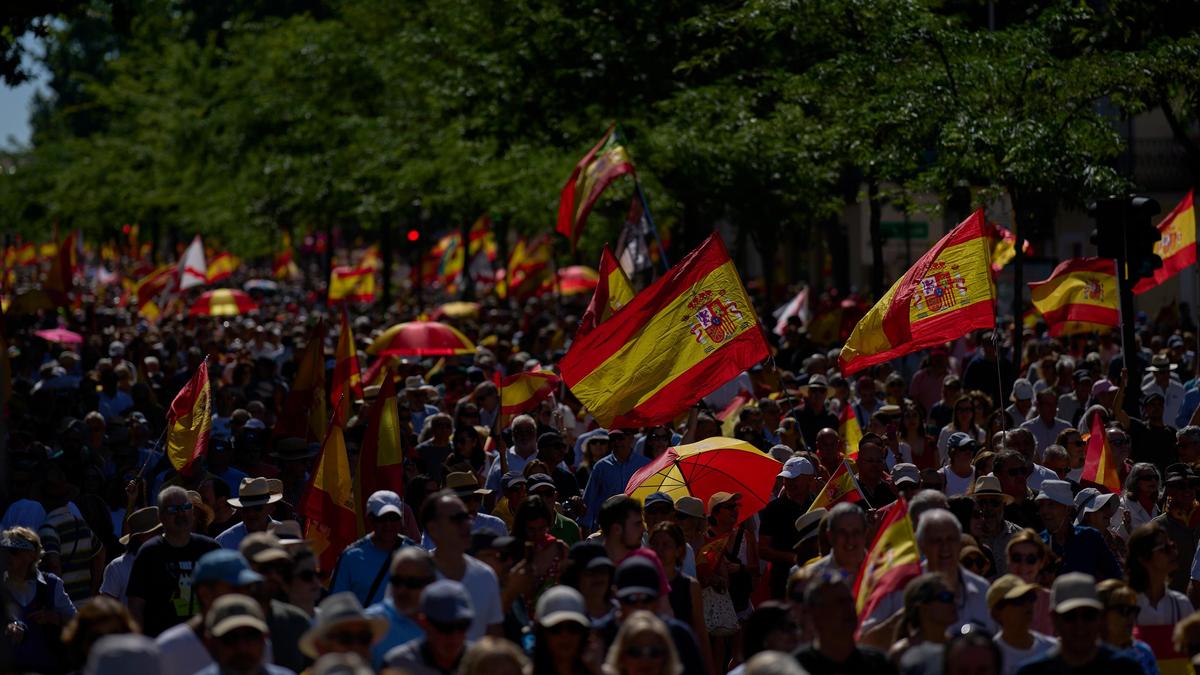
The survival of a minority coalition government depends on a precarious calculus: the capacity of the executive branch to maintain its legislative voting bloc while absorbing sustained reputational damage. The mass demonstration in Madrid on May 23, 2026, which drew between 40,000 and 80,000 protesters demanding the resignation of Prime Minister Pedro Sánchez, represents more than a localized public disturbance. It marks an intensification of systemic political attrition, driven by expanding judicial investigations that are destabilizing the fundamental structures of Spain’s ruling left-wing alliance.
To understand the trajectory of this political crisis, one must look past the street-level friction and evaluate the structural friction points confronting the Sánchez administration. The current instability is dictated by three operational variables: the broadening of the judicial perimeter, the breakdown of the government's defensive messaging framework, and the shifting risk-reward ratio for regional coalition partners.
The Judicial Perimeter: From Personal Allegations to Structural Contagion
The primary catalyst for the accelerated mobilization against the government is a shift in the nature of the judicial inquiries. For over two years, the executive branch treated corruption allegations as isolated incidents driven by political opponents. The escalation in May 2026 shattered this containment strategy.
The expansion of the judicial perimeter can be modeled through three distinct tiers of exposure:
- Tier 1: Familial and Immediate Circle Inquiries. This tier encompasses the initial investigations opened in April 2024 into the business activities of the Prime Minister’s wife, Begoña Gómez. While prosecutors recently requested the closure of this case, its persistence established a baseline of public vulnerability. This tier also includes the concluding trial phase of former Transport Minister José Luis Ábalos, Sánchez’s former right-hand man, which created direct exposure within the immediate core of the Socialist Workers' Party (PSOE).
- Tier 2: The Institutional Network. This tier emerged when a Spanish court announced a formal investigation into former Socialist Prime Minister José Luis Rodríguez Zapatero. The allegations involve the leadership of an influence-peddling and money-laundering network. Because Zapatero operates as a crucial strategic asset and mediator for the current administration, this inquiry escalates the crisis from a localized cabinet issue to an institutional threat.
- Tier 3: Executive Accountability. The systemic link between Tier 1 and Tier 2 forces the sitting Prime Minister into a defensive posture where executive authority is consistently diverted toward managing legal risks rather than executing policy.
The interaction of these tiers generates a cumulative negative effect on the administration's legislative throughput. When judicial actions move from peripheral actors to institutional power brokers like Zapatero, the executive branch loses its capacity to set the national policy agenda.
The Defensive Framework Break Down
The administration's primary defense mechanism has relied on a polarization framework: framing all judicial and civic pushback as an engineered campaign by right-wing and far-right actors. The "March for Dignity" in Madrid demonstrates that this framing is reaching a point of diminishing returns.
The demonstration was organized by the Spanish Civil Society association and drew participation from the leadership of the mainstream conservative People’s Party (PP) and the right-wing Vox party. While the executive branch continues to leverage this alignment to rally its base, the sheer volume of participants—even when taking the lower government estimate of 40,000 over the organizers' claim of 80,000—indicates that the anti-corruption sentiment has consolidated across a broad demographic spectrum.
A major breakdown in this defensive strategy occurred when a subset of masked protesters attempted to breach security barriers near the Moncloa Palace, resulting in clashes that left seven police officers injured and led to multiple arrests. Historically, the executive branch could use peripheral violence to discredit an entire protest movement. However, because the broader march remained peaceful, the focus of the public narrative remains fixed on the underlying judicial developments rather than tactical street disruptions.
The structural limitation of the government's communication strategy is its binary nature. By labeling every investigation as politically motivated, the executive branch leaves itself no mechanism for internal course correction. When new court disclosures occur, the assertion of political victimization yields diminishing utility among unaligned voters and moderate factions within the legislature.
Coalition Math: The Ultimate Arbiter of Stability
A prime minister in a parliamentary system does not resign purely because of public protests; resignation occurs when the parliamentary numbers required to govern dissolve. Sánchez's minority government relies on a highly fragmented legislative bloc, including regional nationalist parties from Catalonia and the Basque Country.
The stability of this arrangement is governed by a strict transaction cost function. Regional parties support the central government in exchange for specific concessions, such as fiscal autonomy, infrastructure funding, or legal amnesties. The viability of this exchange relies on the central government's ability to deliver these goods without dragging its partners down in a general electoral collapse.
The introduction of high-profile corruption inquiries alters this risk equation for regional partners in two specific ways:
- Legislative Paralysis: If the PSOE is entirely occupied with managing judicial defense and responding to systemic scandals, the processing of complex regional concessions slows down. This reduces the immediate value that regional parties can display to their own local electorates.
- Contagion of Reputational Risk: Regional parties must calculate the exact moment when supporting a scandal-plagued central administration costs them more local votes than the concessions are worth. If the investigation into Zapatero uncovers broader financial or institutional networks, the risk of reputational damage for supporting the coalition rises sharply.
Strategic Forecast and Outlook
The Sánchez administration is unlikely to collapse via voluntary resignation in the immediate term. The Prime Minister's historical precedent, notably his brief deliberation over resignation in April 2024 followed by a consolidation of power, suggests a preference for legal and political endurance. The executive response will likely involve a combination of defensive legal maneuvers, targeted anti-graft policy announcements designed to alter the media narrative, and a tightening of party discipline.
The critical variable to monitor over the next two quarters is not the scale of street demonstrations, but the specific progression of the Zapatero inquiry. If the court uncovers actionable evidence linking the alleged influence-peddling network to active members of the current cabinet, the transaction cost for regional nationalist parties will pass the threshold of utility.
The primary vulnerability for the Spanish executive branch lies in the upcoming national budget negotiations. If regional partners determine that the administration's political capital is spent, they will withhold their votes, triggering an architectural failure of the government and forcing early general elections. Capital allocations, sovereign debt yields, and domestic policy execution will remain highly volatile until this parliamentary math resolves.