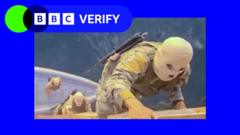
Iran’s maritime strategy in the Strait of Hormuz has pivoted from raw kinetic interruption to a sophisticated model of Informationized Warfare. Recent footage released by Iranian state media, depicting masked personnel rappelling onto commercial vessels, serves as a high-fidelity case study in "gray zone" signaling. While traditional reporting focuses on the visual shock of these boardings, a structural analysis reveals that the primary product of these operations is not the physical seizure itself, but the engineered perception of total regional dominance. By deconstructing the tactical, psychological, and logistical components of these "staged" events, we can map the exact cost-benefit function Iran utilizes to disrupt global energy markets without triggering a full-scale naval engagement.
The Triad of Coercive Signaling
The efficacy of Iranian maritime operations relies on three distinct pillars that transform a localized boarding into a global market event. If any pillar is removed, the operation degrades from a strategic maneuver to a mere criminal act.
1. Controlled Escalation Dominance
Iran utilizes the "escalation ladder" to maintain tension just below the threshold of an Article 5-style response from Western powers. By using masked personnel and high-production value cameras, they signal a high state of readiness. The choice of target—often a vessel with a loose or disputed legal standing—minimizes the diplomatic cost while maximizing the visual impact. The goal is to force a choice on the opponent: ignore the provocation and look weak, or overreact and risk a regional war.
2. Narrative Sovereignty
These videos are not "staged" in the sense of being fake; they are choreographed. The presence of multiple camera angles, including drone shots and helmet-mounted GoPros, indicates that a dedicated media unit is embedded with the tactical team. This creates a feedback loop where the IRGC (Islamic Revolutionary Guard Corps) controls the first 24 hours of the news cycle. Western intelligence agencies are forced to react to Iranian-provided visuals before their own satellite or drone reconnaissance can be synthesized.
3. Economic Friction Maximization
The kinetic action on the deck of a tanker is the least important variable in the long-term cost function. The real impact is the risk premium added to insurance rates for any vessel transiting the Persian Gulf. By demonstrating that any ship can be boarded at any time with zero effective resistance, Iran imposes a "shadow tax" on global trade. This friction serves as a direct lever in nuclear and sanctions negotiations.
Tactical Deconstruction of the Boarding Sequence
A frame-by-frame analysis of recent IRGC boarding maneuvers reveals a standardized tactical template. This consistency allows the Iranian command to scale these operations across different geographic points—from the Gulf of Oman to the Red Sea—with predictable results.
The Insertion Phase
Iranian forces typically utilize the Mil Mi-17 "Hip" helicopter or similar airframes for fast-rope insertions. This method is preferred over small-boat boarding because it provides a 360-degree overwatch of the deck, preventing the crew from barricading themselves in the citadel before the team lands. The timing is almost always dawn or dusk, utilizing low-light conditions to mask the helicopter's approach while ensuring enough ambient light for high-quality video capture.
The Masked Persona as a Force Multiplier
The use of masks is a deliberate psychological tool. In maritime law and international relations, the "state" is usually represented by uniformed, identifiable officers. By masking their faces, Iranian forces adopt the aesthetic of a Special Operations Unit or even a non-state actor. This ambiguity complicates the legal aftermath; it suggests that the personnel involved are part of an elite, "untouchable" tier of the military, which discourages immediate physical resistance from ship security details who are often instructed only to repel pirates, not state-sponsored commandos.
Weaponry and ROE (Rules of Engagement)
In nearly every released video, the tactical teams carry weapons in a "low ready" position. They rarely aim directly at the crew unless there is a specific movement. This reveals a strict ROE aimed at bloodless seizure. A dead sailor creates a martyr and a casus belli; a seized ship creates a bargaining chip. The tactical discipline shown in these videos is intended to prove to the world that Iran is a professional, albeit aggressive, maritime power rather than a chaotic insurgent group.
The Strategic Logic of Staged Aggression
Critics often dismiss these videos as "propaganda," but this misses the functional utility of the imagery. In modern asymmetric conflict, the image is the weapon.
The Deterrence Paradox
The IRGC understands that it cannot win a head-to-head naval battle against a U.S. Carrier Strike Group. Therefore, it must build a deterrence of inconvenience. By publicizing these boardings, they demonstrate a capability to seize high-value assets without firing a shot. This forces the U.S. and its allies to commit massive resources—destroyers, aerial patrols, and carrier time—to protect slow-moving commercial targets. This creates a massive resource-drain for the protector and a negligible cost for the aggressor.
Weaponizing Ambiguity
Is the video a training exercise or a live seizure? Is the ship in international waters or an Iranian-claimed zone? The IRGC thrives in the "gray zone" between these definitions. By releasing the footage through state-affiliated channels like Tasnim or Fars News, they maintain "plausible deniability" at the official diplomatic level while ensuring the message reaches the intended military audiences.
Measuring the Cost Function of Maritime Seizure
To understand why this strategy persists, we must look at the mechanical costs involved for all parties.
- The Aggressor (Iran): Costs include fuel for one helicopter, a 12-man tactical team, and a small media crew. Total estimated operational cost: <$50,000.
- The Target (Shipping Company): Costs include the loss of the vessel (valued at $50M - $150M), the value of the cargo ($20M - $100M), and the legal fees associated with recovery.
- The Protector (Combined Maritime Forces): Costs include the 24/7 deployment of Aegis-class destroyers, which cost roughly $700,000 per day to operate in high-tempo environments.
The ratio of Iranian investment to Western counter-investment is roughly 1:1000. This asymmetry is the core reason why these "staged" videos will continue to increase in frequency and production quality.
Structural Vulnerabilities in Western Response
The primary bottleneck for Western powers in responding to these videos is the Speed of Verification. By the time a Western government can confirm the legality of a seizure or the location of the vessel, the Iranian narrative is already the "truth" on social media and financial news tickers.
Furthermore, the "Citadel" strategy used by commercial ships—where the crew hides in a reinforced room—is ineffective against helicopter-borne boarders who can spend hours cutting through steel doors once they have control of the deck. This technological and tactical gap has no easy fix without placing armed military contractors on every commercial vessel, a move that most flag states (like Panama or Liberia) are legally hesitant to authorize.
The Shift Toward Autonomous Signaling
The next phase of this strategy involves the integration of Unmanned Surface Vessels (USVs) and Loitering Munitions into the visual narrative. We are moving away from the "commando rappelling" era into an era of Algorithm-Driven Blockades.
Iran has already begun testing "swarm" tactics where dozens of small, fast boats surround a tanker. When combined with drone footage, this creates a visual of "total encirclement" that is even more daunting than a single helicopter insertion. The strategic goal remains the same: to make the transit of the Strait of Hormuz feel so risky that the global community eventually concedes to Iranian political demands in exchange for "maritime stability."
The strategic play for the next 24 months is clear. Iran will continue to leverage high-definition tactical theater to compensate for its lack of conventional naval tonnage. Analysts and security firms must stop treating these videos as simple propaganda and start treating them as operational blueprints. The focus should shift from "why did they do this?" to "what tactical capability are they validating for their next move?"
The final strategic move for regional players is to decouple the "image of the threat" from the "actual threat." This requires a radical transparency in maritime data—real-time, public-facing AIS and sensor data that can debunk the "choreography" of these videos within minutes of their release. Until the verification speed matches the propagation speed of Iranian state media, the IRGC will continue to hold the psychological high ground in the Strait of Hormuz.