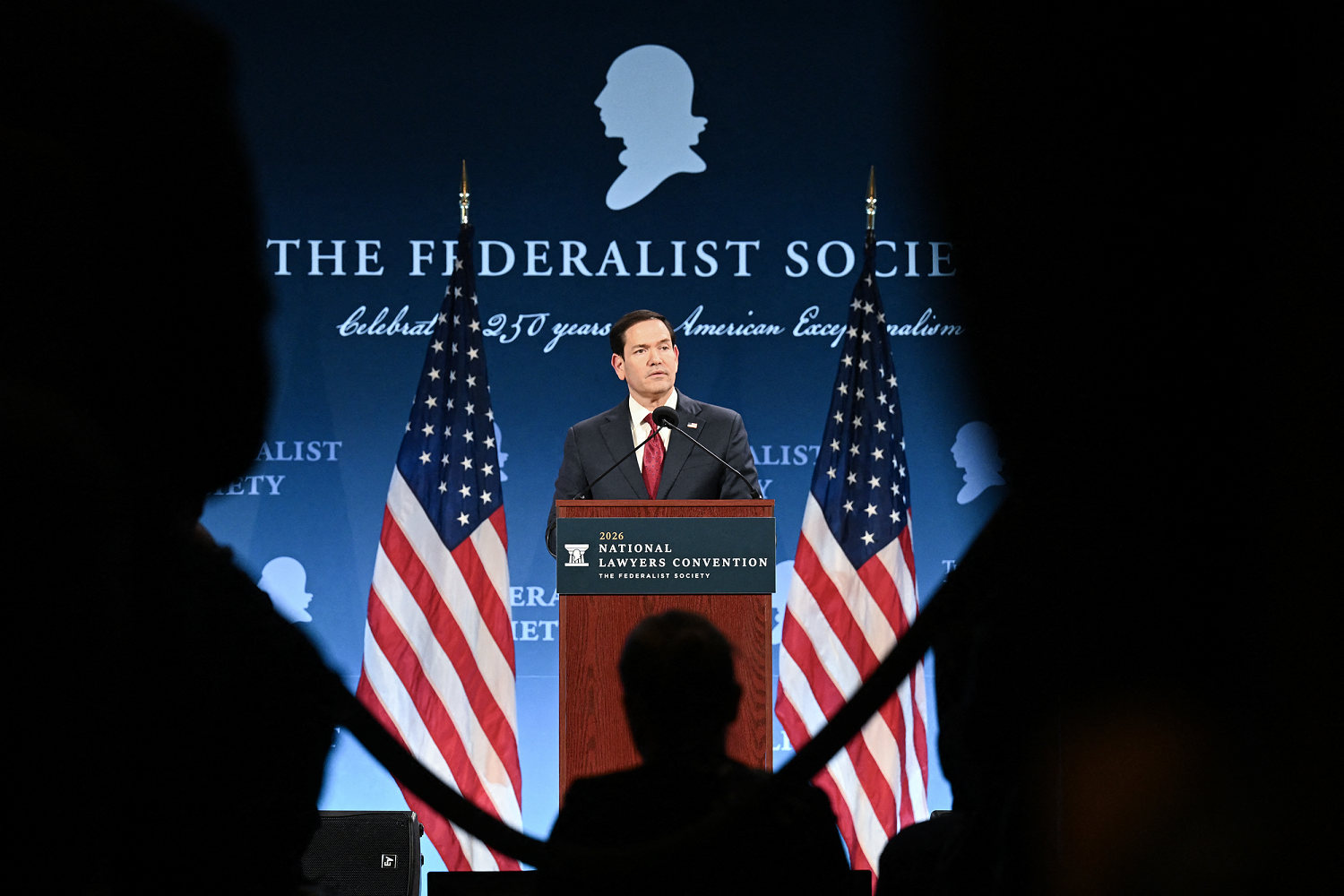
Ten days after Democrats swept both chambers of Congress, Marco Rubio walked onto a stage at Washington's Mayflower Hotel and told a room full of conservative lawyers to stop panicking. He didn't offer a forensic autopsy of the ballot box. Instead, the Secretary of State framed the November 3 rout as a minor speed bump on a multi-decade road.
"Great things that last are built in decades, not election cycles," Rubio told the Federalist Society's 2026 National Lawyers Convention on November 13. It was a striking pivot. While GOP lawmakers on Capitol Hill were busy pointing fingers over a net loss of 45 House seats and nine Senate seats, Rubio urged conservatives to uplift their core ideology and look past the immediate electoral wreckage. If you liked this post, you should look at: this related article.
Most coverage treats Rubio's Barbara K. Olson Memorial Lecture as standard post-election spin. That misses the point entirely. When you look closely at what Rubio actually said—and what he conspicuously avoided—his speech reads less like damage control and more like the opening argument for a post-Trump Republican Party.
What Actually Happened at the Mayflower Hotel
To understand why Rubio's message landed the way it did, you have to look at the room he was addressing. The Federalist Society isn't a populist rally crowd. It's the legal and intellectual backbone of the traditional conservative movement. For another look on this event, refer to the recent coverage from TIME.
When Rubio stepped up to deliver the 25th annual Olson lecture, Republicans were still reeling from a historic blue wave. Democrats hadn't just edged out narrow majorities. They flipped long-held GOP seats across the map—from Susan Collins in Maine and Jon Husted in Ohio to Roger Marshall in Kansas and even long-serving House veterans like Virginia Foxx. The Senate swung from a 53-47 Republican advantage to a 56-44 Democratic majority. The House collapsed to 173 GOP seats against 259 for Democrats, with three races still uncalled.
Rubio barely flinched. Rather than dissecting turnout models or candidate quality, he zoomed out to historical inevitability. "There will be more victories, and there will be more defeats," he told the crowd. "There will be more triumphs, and there will be more disappointments. This is the nature of all undertakings of this weight and of this magnitude."
He went further, arguing that no great cause in history succeeds without suffering setbacks along the way. By asking conservatives to measure their movement over "the next two, the next six, the next 20 years," Rubio deliberately detached conservative ideology from a single bad Tuesday in November.
The Economic Admission Nobody Expected
Here's the detail most political pundits glossed over. While Rubio brushed off the political fallout of the midterms, he didn't pretend voters were happy. In fact, he broke sharply from President Donald Trump's standard talking points on the economy.
Trump has repeatedly pointed to stock market performance as proof of economic strength. Rubio rejected that metric outright.
"I think we have to recognize that people are struggling. There's no doubt about it," Rubio said during his remarks. "The health of our economy has nothing to do with the stock market. The health of their economy is whether they have enough money to be able to afford the things they need."
That's a huge concession from a sitting Cabinet official. Rubio even acknowledged that ongoing geopolitical conflicts had driven up gasoline prices and everyday costs for American families, admitting that addressing structural economic problems is "not popular" and often inflicts short-term pain. By validating kitchen-table frustration while telling conservatives to stay confident in their principles, he threaded a needle few Republicans have managed since Election Day.
Why Uplifting Ideology Matters More Than Excuses
Political parties usually respond to a midterm shellacking in one of two ways. Either they tear themselves apart in public recriminations, or they abandon their core beliefs to chase whatever worked for the opposition. Both instincts usually backfire.
Rubio's push to uplift conservative ideology targets a deeper vulnerability inside the modern GOP. Over the past decade, Republican politics has revolved almost entirely around personality, grievance, and immediate tactical battles. When you build a coalition around short-term wins and a single leader, a sweeping defeat leaves the party with nothing to stand on.
In his speech, Rubio tried to rebuild that philosophical floor. He emphasized foundational themes—patriotism, faith, self-reliance, community, family, and constitutional self-government. He also took direct aim at international institutions like the International Criminal Court, framing national sovereignty and democratic consent as non-negotiable pillars of American identity.
Look at the strategy behind that framing:
- It stops the bleeding on morale. Activists and donors check out when they think their movement is permanently broken. Telling them that lasting political realignment takes decades gives them permission to stay in the fight.
- It separates principles from unpopular policies. Voters may have punished Republicans over gas prices, foreign entanglements, or executive overreach in 2026. Rubio's argument reminds conservatives that losing an election doesn't invalidate free-market self-reliance or constitutional limits.
- It speaks fluently to two warring factions. Traditional Reagan-era conservatives heard a defense of constitutional order and historical pride. Populist nationalists heard a sharp critique of global elites and a kitchen-table focus on working-class affordability.
The 2028 Elephant in the Room
You can't separate Rubio's speech from the calendar. With the 2026 midterms settled, the 2028 presidential race has effectively begun, and the midterm wipeout scrambled the GOP's succession plan.
For months, Vice President JD Vance was widely viewed as the default heir to the MAGA movement. Rubio himself had previously deferred to Vance when asked about future ambitions. That dynamic shifted almost overnight after Democrats captured 259 House seats and flipped nine Senate seats.
Suddenly, Republican strategists and donors started questioning whether doubling down on pure populist combat could win a national electorate in 2028. Reports began circulating that Rubio was weighing an eventual exit from the State Department to prepare a presidential bid of his own. When CNN's Kylie Atwood pressed him about his 2028 plans and his earlier support for Vance, Rubio cut off the questioning with visible frustration, saying he wouldn't talk about 2028 any longer.
He didn't need to talk about 2028 at the Federalist Society. His entire speech functioned as a proof of concept. While Vance spent the post-election window defending administration foreign policy in the heartland, Rubio stood before Washington's most influential conservative legal network projecting calm, ideological confidence, and long-term vision.
Where Rubio's Argument Runs Into Trouble
Even a sharp political pivot has blind spots, and Rubio's "build in decades" thesis faces three serious reality checks.
First, patience is a hard sell when the other party holds the gavel in both houses of Congress. Starting in January 2027, Democrats will control Senate confirmations, legislative agendas, and House oversight committees with subpoena power. Telling conservative voters to think in 20-year increments doesn't stop two years of gridlock or investigations.
Second, "uplifting ideology" only works if the party agrees on what its ideology actually is. Right now, the Republican coalition is split between fiscal hawks who want spending cuts, economic nationalists who favor tariffs and industrial policy, and foreign policy realists who clash with traditional hawks. A broad appeal to patriotism and family values papers over those cracks, though it doesn't resolve them.
Third, voters rarely reward ideological confidence if household budgets stay tight. Rubio earned credit for admitting that families are struggling to afford basic necessities. Yet voters in 2028 won't grade Republicans on whether they had an uplifting philosophy in 2026. They'll grade them on whether groceries, energy, and housing actually got cheaper.
How to Read Conservative Politics After the 2026 Midterms
If you're trying to track where the Republican Party goes from here, ignore the cable news shouting matches over individual House races. Watch three concrete indicators over the next six months instead:
- Track who steps down from the administration. Cabinet departures between now and mid-2027 will tell you immediately who is gearing up for a 2028 primary run and who is staying tied to the White House's legislative battles.
- Watch how GOP leaders talk about affordability. Notice whether other Republicans adopt Rubio's line—distinguishing stock market highs from everyday living costs—or stick strictly to defending existing administration policies.
- Pay attention to conservative legal and policy conferences. Events like the Federalist Society convention serve as early testing grounds for 2028 messaging. Candidates who can unite constitutional traditionalists with working-class voters without sounding defensive will set the pace for the primary.
Rubio's bet is simple. He's wagering that conservative voters are tired of panic and hungry for a leader who treats a bruising election not as an apocalypse, but as a reason to stand taller on core principles. Whether the rest of the GOP buys into that long game will define the fight for the party's soul over the next two years.
To see how Rubio framed this long-term ideological message directly to conservative leaders, watch Marco Rubio's Federalist Society keynote address. This full recording captures his exact arguments on generational movement-building and constitutional principles following the 2026 midterm elections.