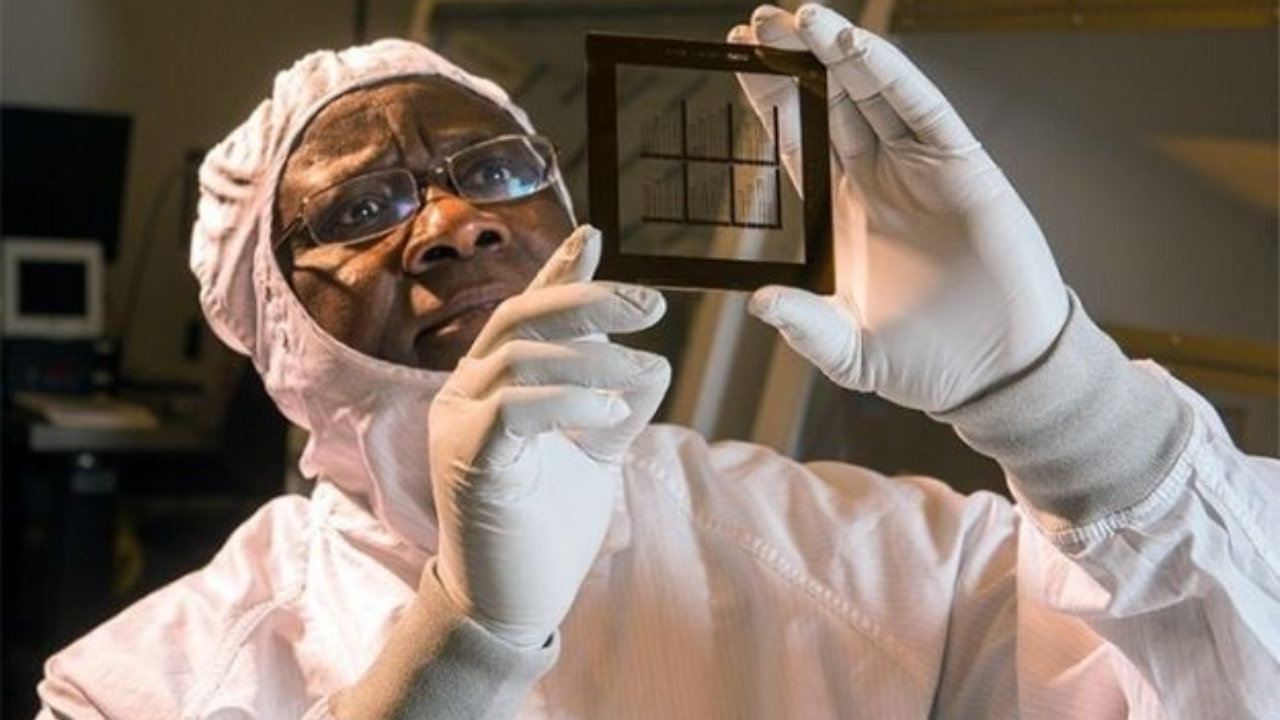
Walk into a cleanroom where aerospace sensors are fabricated, and you are greeted by an oppressive, clinical silence. Air filtration units hum at a constant, numbing frequency. Yellow light filters through specialized glass to protect light-sensitive polymers. Technicians move with the deliberate, agonizing slowness of deep-sea divers, encased in head-to-toe sterile suits.
To an outsider, it looks like the pinnacle of human achievement. To anyone who understands the brutal reality of spaceflight, it looks like a fragile illusion.
The universe does not care about cleanrooms. Once a rocket clears the launchpad, the sterile stillness of the lab is replaced by a violent, chaotic hellscape. Inside a rocket engine, gases combust at temperatures exceeding 3,000 degrees Celsius. The pressure is enough to crush a submarine. Vibrations rip through metal with enough force to shake bolts loose and turn microscopic weld flaws into catastrophic tears.
For decades, the silicon chips responsible for monitoring these engines—the digital nervous system of the spacecraft—had a fatal flaw. They were cowards. Under intense heat and pressure, standard silicon melts, warps, and loses its ability to conduct electricity predictably. It goes blind. And when a sensor goes blind in the middle of a launch, people die.
For generations, the solution was to hide the chips. Engineers built massive, heavy cooling jackets and routed complex plumbing just to keep the delicate silicon sensors away from the heat. It was like trying to measure the temperature of a furnace by holding a thermometer three feet outside the door and guessing. It added weight, introduced hundreds of potential points of failure, and limited how much data we could actually gather from the heart of the machine.
Then came a young man from Lagos, Nigeria, who looked at the fire and decided we shouldn't be running away from it.
The Sound of the Forge
Growing up in Nigeria, Robert Sola Okojie did not have access to NASA-grade cleanrooms. What he had was an insatiable curiosity about how things held together under pressure. He watched the world around him—a bustling, high-energy environment where resourcefulness wasn't a textbook concept, but a daily survival mechanism. When something broke, you didn't order a replacement part from a catalog. You figured out how to make the broken thing stronger than it was before.
When Okojie arrived in the United States to pursue higher education, eventually earning his PhD in mechanical engineering from New Jersey Institute of Technology, he entered a field obsessed with making things smaller. The tech boom was all about fitting more transistors onto a sliver of silicon.
But Okojie was interested in a different kind of scaling. He wanted to know how to make things endure.
He began looking closely at silicon carbide, a synthetic compound of silicon and carbon. On paper, silicon carbide is a beast. It is incredibly hard, boasts excellent thermal conductivity, and can withstand temperatures that would turn a standard computer chip into a puddle of grey slag. It was the perfect candidate for high-temperature electronics.
There was just one problem. Nobody could figure out how to reliably connect it to anything else.
To understand the engineering nightmare Okojie faced, picture trying to glue a piece of ice to a hot frying pan. Silicon carbide can survive the heat, but the metal contacts—the microscopic wires that carry the electrical signals from the chip to the rocket's computer—would expand, contract, and peel away under thermal stress. The material itself was stubborn; it resisted forming stable electrical connections. For years, the aerospace industry treated silicon carbide as a beautiful, unusable theory.
Okojie didn't see an impossible material. He saw a bridge that hadn't been engineered correctly yet.
Twenty-One Years in the Furnace
When Okojie joined NASA’s Glenn Research Center in Cleveland, Ohio, in 1999, he wasn't given a massive budget or a team of thousands. He was given a desk, a lab, and a problem that had frustrated some of the brightest minds in the Cold War space race.
Progress in deep-tech engineering doesn't happen in a single, cinematic montage. It happens in fractions of a millimeter over decades. It is the story of coming into the lab on a Tuesday morning, running a test on a newly deposited chemical film, watching it crack at 600 degrees, and realizing you have to throw out six months of work and start over.
Consider the physics of what happens at those temperatures. At 600 degrees Celsius, metals don't just expand; they begin to migrate. Atoms from the metal contacts slowly bleed into the semiconductor material, changing its chemical composition until the device stops functioning. It is a slow, atomic-level rot.
Okojie’s breakthrough wasn't a single eureka moment, but a series of meticulous, grueling victories over atomic migration. He pioneered the use of specific, multi-layered metal contact systems—metaphorically acting like a series of specialized thermal shock absorbers—that could bond with silicon carbide without degrading at extreme temperatures.
He didn't just build a sensor; he built an entirely new architecture for high-temperature micro-electromechanical systems (MEMS).
Suddenly, NASA had sensors that could be bolted directly onto the inside of a rocket engine casing. They could sit in the path of the exhaust. They could look directly into the sun.
The implications rippled far beyond rocketry. Think about a commercial airliner. When you fly, the pilots rely on data from the jet engines to optimize fuel consumption and detect failures before they become catastrophic. Because of Okojie's work, those sensors could move closer to the combustion zone, making flights safer and drastically reducing carbon emissions through hyper-precise fuel efficiency.
Think about deep-earth drilling, where ambient temperatures miles beneath the crust fry standard equipment. Think about automotive engines, heavy industrial plants, and volcanic research. By forcing electronics to tolerate heat, Okojie quietly upgraded the sensory nervous system of modern heavy industry.
The Hall of Immortals
In 2020, after twenty-one years of quiet, relentless labor at NASA, the agency did something it rarely does for living engineers. They inducted Dr. Robert Sola Okojie into the NASA Inventors Hall of Fame.
At the time of his induction, he held more than twenty patents relating to high-temperature devices and silicon carbide technology. He became only the fourth person of African descent to receive the honor.
The award ceremonies for these kinds of achievements are always polite, formal affairs. There are speeches, plaques, and applause from colleagues in tailored suits. But the true monument to Okojie’s life work isn't sitting in a trophy case in Ohio.
It is currently screaming through the upper atmosphere at Mach 5. It is riding on the back of next-generation propulsion systems designed to take humanity back to the moon and eventually to Mars. It is sitting inside the roaring, violent heart of turbines across the globe, quietly measuring data, millisecond by millisecond, completely unfazed by the fire.
We tend to celebrate the astronauts who sit at the top of the rocket, and we should. They risk everything. But the only reason they can climb into those capsules with a straight face is because people like Robert Okojie spent two decades sitting in dark labs, staring through microscopes, making sure that when the engines ignite, the machine knows exactly what it's doing.