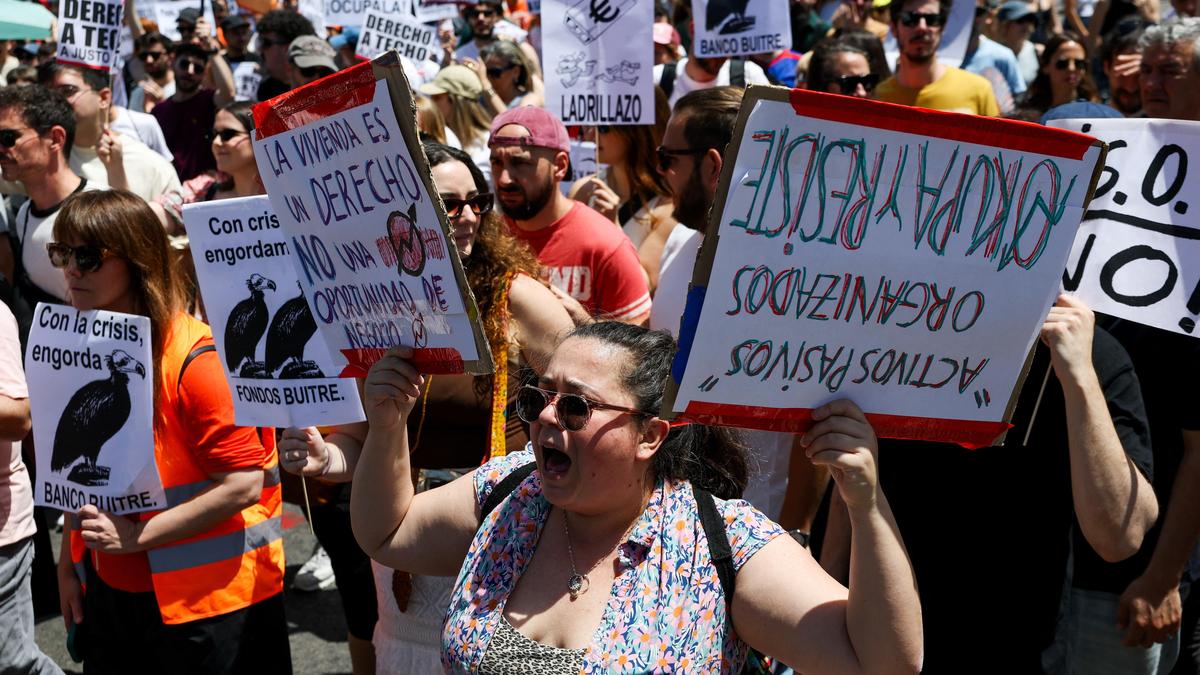
Tens of thousands of residents flooded the Gran Vía in Madrid this week, not for a festival or a football parade, but to declare a state of emergency over a housing market that has effectively decoupled from local wages. The protests represent a boiling point for a city where the average rent has surged nearly 15% in a single year, while salaries remain stubbornly stagnant. This is no longer a localized grievance about gentrification. It is a fundamental collapse of the social contract in one of Europe’s major capitals.
The math is brutal. In neighborhoods like Lavapiés or Malasaña, a standard two-bedroom apartment now commands prices that require two or three full-time minimum-wage salaries just to cover the monthly bank transfer to a landlord. For the younger generation, the "Spanish Dream" of property ownership has been replaced by a precarious cycle of room-sharing and "nesting" with parents well into their thirties.
The Short Term Rental Trap
While protesters often point the finger at greedy landlords, the systemic cause is a lethal cocktail of supply scarcity and the unchecked professionalization of the short-term rental market. Platforms like Airbnb and Booking.com have transformed residential buildings into decentralized hotels. In the Centro district, the density of tourist apartments has reached a level where long-term neighbors are becoming a minority.
When a property owner can make as much in four days of tourist turnover as they can in a full month of a traditional lease, the incentive to house a local family vanishes. This isn't just a matter of "market forces." It is a structural shift where housing has transitioned from a basic social necessity to a high-yield financial asset for international investment funds.
The city council has attempted various crackdowns, including a temporary freeze on new licenses for tourist flats. It hasn't worked. Enforcement is toothless, and the sheer volume of "invisible" listings—illegal apartments operating without a license—continues to cannibalize the supply of permanent homes.
The Golden Visa and the Wealth Gap
Spain’s "Golden Visa" program, which granted residency to non-EU investors who spent over €500,000 on real estate, was recently targeted for abolition by the central government. While the move was framed as a victory for the working class, industry analysts suggest the damage is already done. These visas fueled a decade of luxury developments that did nothing for the average Madrileño.
Developers spent years focusing on high-end penthouses for international buyers because the profit margins were vastly superior to building affordable or mid-range housing. This created a lopsided skyline: luxury units sitting empty for six months a year as "wealth silos," while just three blocks away, three generations of a local family cram into a 50-square-meter flat.
Why Price Caps Aren't the Silver Bullet
The Spanish government’s Housing Law (Ley de Vivienda) introduced the concept of "stressed zones" where rent increases can be capped. On paper, this sounds like the solution the protesters are demanding. In practice, it has triggered a series of unintended consequences that have made the situation worse for many.
Property owners, fearing they will lose control over their assets or be unable to evict non-paying tenants under new protections, are pulling their apartments off the long-term market entirely. They are either selling them to large-scale equity firms or shifting them into "seasonal rentals"—leases of less than 11 months that bypass the new rent control laws.
This creates a "ghost market" where nothing is available for a standard five-year lease. A young professional looking for a home today isn't just fighting high prices; they are fighting a total lack of availability. If you find a place, you are often asked for six months of rent upfront as a "guarantee," a demand that is technically illegal but widely practiced in a market where the landlord holds all the cards.
The Construction Deficit
We have to look at the numbers. To keep pace with demand, Madrid needs to be building significantly more social and affordable housing than it has over the last decade. The 2008 financial crisis decimated the Spanish construction industry, and it never truly recovered its previous capacity.
Madrid Housing Completion Rates
| Year | Housing Units Completed (Madrid Region) |
|---|---|
| 2006 | ~70,000 |
| 2013 | ~7,500 |
| 2023 | ~15,000 |
The table above illustrates the massive shortfall. Even as the city’s population grows and more people move to the capital for work, the physical inventory of homes isn't expanding. When you have ten thousand people moving to a city and only a thousand new doors opening, the result is basic arithmetic. Prices must go up.
The Public Land Paradox
The regional government and the city council often clash over how to use public land. While some advocate for the direct construction of public housing, others prefer the "concession" model—giving public land to private developers who then manage the housing at a slightly reduced rate for a set number of years.
Critics argue this is a giveaway to the private sector that fails to provide long-term stability. Once the 15 or 20-year concession ends, those apartments often revert to market rates, and the tenants are right back where they started: priced out of their own lives.
The Threat of a Rent Strike
The organizers of the recent protests have moved beyond simple marches. They are now openly discussing a "rent strike." The logic is simple: if everyone stops paying, the system breaks. It is a radical, high-risk strategy that could lead to mass evictions and legal chaos, but the fact that it is being seriously considered at the neighborhood assembly level shows the depth of the desperation.
"If the prices don't fall, we don't pay," has become the unofficial slogan. This isn't just talk from fringe activists; it is a sentiment shared by teachers, nurses, and service workers who find themselves spending 60% or 70% of their income on a roof.
Infrastructure and the Commuter Trap
One "solution" often proposed by the wealthy is for the working class to simply move further out. But Madrid’s periphery is also feeling the heat. Towns like Getafe, Alcorcón, and Vallecas—historically working-class strongholds—are seeing their own price spikes as the "expelled" residents of the center move outward.
This creates a domino effect. As the center becomes a playground for tourists and high-earners, the workers who keep the city running—the cleaners, the cooks, the bus drivers—are pushed into grueling two-hour commutes. This degrades the quality of life and places immense strain on the Cercanías train network, which has been plagued by delays and underinvestment.
The Financialization of Living Space
Large investment funds, often referred to as "vulture funds" in the Spanish press, now own thousands of units across the city. These entities operate with a different logic than the "mom-and-pop" landlord. They are looking for quarterly growth and portfolio appreciation. For them, a 10% vacancy rate is acceptable if it keeps the valuation of their other 90% high.
This institutionalization of the market makes it much harder to negotiate. You cannot talk to an algorithm about your child’s school or your sudden medical bill. You either pay the increase dictated by the head office in London or New York, or you leave.
Beyond the Protest
The anger on the streets of Madrid is a warning to every other major European city. Berlin tried rent caps and saw them struck down by courts. Lisbon is grappling with the same "digital nomad" influx that is pricing out the Portuguese.
For Madrid, the path forward requires more than just slogans. It requires a massive, state-led investment in housing stock that can never be sold into the private market. It requires the courage to shut down illegal tourist apartments with heavy fines that actually hurt. It requires a rethink of how we value land.
The people marching in the streets aren't asking for luxury. They are asking for the right to live in the city where they work, pay taxes, and raise their families. If the government cannot provide a path to that basic dignity, the current unrest is merely a rehearsal for a much larger social rupture.
Stop waiting for the market to fix a crisis that the market created.


