Most state legislatures treat symphony orchestras like expensive museum pieces that only matter to wealthy donors in major cities. Kentucky just blew up that assumption.
By awarding $3.2 million to the Louisville Orchestra to extend its statewide In Harmony Tour through 2028, the Kentucky General Assembly pushed its total investment in the program to $11.8 million. That figure makes the state legislature the largest independent donor in the orchestra's history. Think about that for a second. In an era when public arts budgets usually get gutted first during legislative sessions, Kentucky lawmakers doubled down on sending a full-sized classical ensemble into rural school gyms, county fairgrounds, and courthouse lawns.
And they didn't do it out of charity. They did it because the numbers prove people outside big metro areas actually want live symphonic music when you drop the $80 ticket price and take the tuxedo off the stage.
What the $3.2 Million Allocation Actually Buys
A lot of coverage around the Louisville Orchestra securing $3.2 million treats it like a standard arts grant. It isn't. State-level funding of this scale comes with strict expectations around geographic reach and community return, especially when you're working alongside the Kentucky Tourism, Arts, and Heritage Cabinet.
Since launching in November 2022 under Music Director Teddy Abrams, the In Harmony Tour has already reached more than 59,000 people across 55 Kentucky counties. Earlier benchmarks from the orchestra's February 2026 impact report showed just how granular that outreach gets:
- Over 235 total events staged across the Commonwealth, proving this isn't just a handful of summer vanity gigs.
- 45 free full-orchestra concerts across 29 zip codes, drawing more than 36,900 audience members.
- 190 smaller community engagement events spanning 67 unique zip codes, including 80 school education programs, 60 "Once Upon an Orchestra" musical storytimes in public libraries, 34 public pop-up performances, and 16 collaborative local shows.
That ratio matters. If an orchestra only shows up in a small town, plays Beethoven for ninety minutes, and hops back on the tour bus, the cultural impact evaporates by Tuesday. By pairing mainstage concerts with classroom visits, instrument demonstrations, and library readings, the musicians embed themselves in the town for days.
Private philanthropy hasn't sat on the sidelines either. Alongside the General Assembly's $11.8 million commitment, the tour pulls backing from Humana, the Brown-Forman Foundation, Robert W. Rounsavall III and Mary Rounsavall, the Dr. M. Lee Pearce Foundation, and anonymous donors. That blend of public tax dollars and corporate sponsorship insulates the tour from single-source budget shocks through 2028.
The Secret Behind Why Rural Audiences Actually Show Up
If you've ever worked in arts administration, you know the biggest mistake regional orchestras make when they try "community outreach." They treat rural audiences like beginners who need to be talked down to, or they play stiff, dated programs that feel completely disconnected from local life.
Teddy Abrams and the Louisville Orchestra took the opposite approach. They tailor the programming to the specific identity of the host county.
Look at the September 2026 leg of the tour, conducted by Gabriel Lefkowitz in Elizabethtown, Frenchburg, and Bardstown. Instead of sticking strictly to 19th-century European warhorses, the orchestra teamed up with Kentucky pianist and composer Kory Caudill. Their setlist mixed Leonard Bernstein's Overture to West Side Story and Arturo Márquez with a world premiere piece titled Together and a medley weaving How Great Thou Art, Song for Appalachia, and This Little Light of Mine.
That kind of programming respects the room. It tells a crowd sitting in lawn chairs at Freeman Lake Park or inside Menifee Central School that their musical heritage belongs on the exact same stage as Sibelius and Bernstein.
Breaking the Venue Barrier
Conventional concert halls intimidate people. That's just reality. Even when tickets are cheap, walking into a downtown performing arts center carries unwritten rules about what to wear, when to clap, and how to sit still.
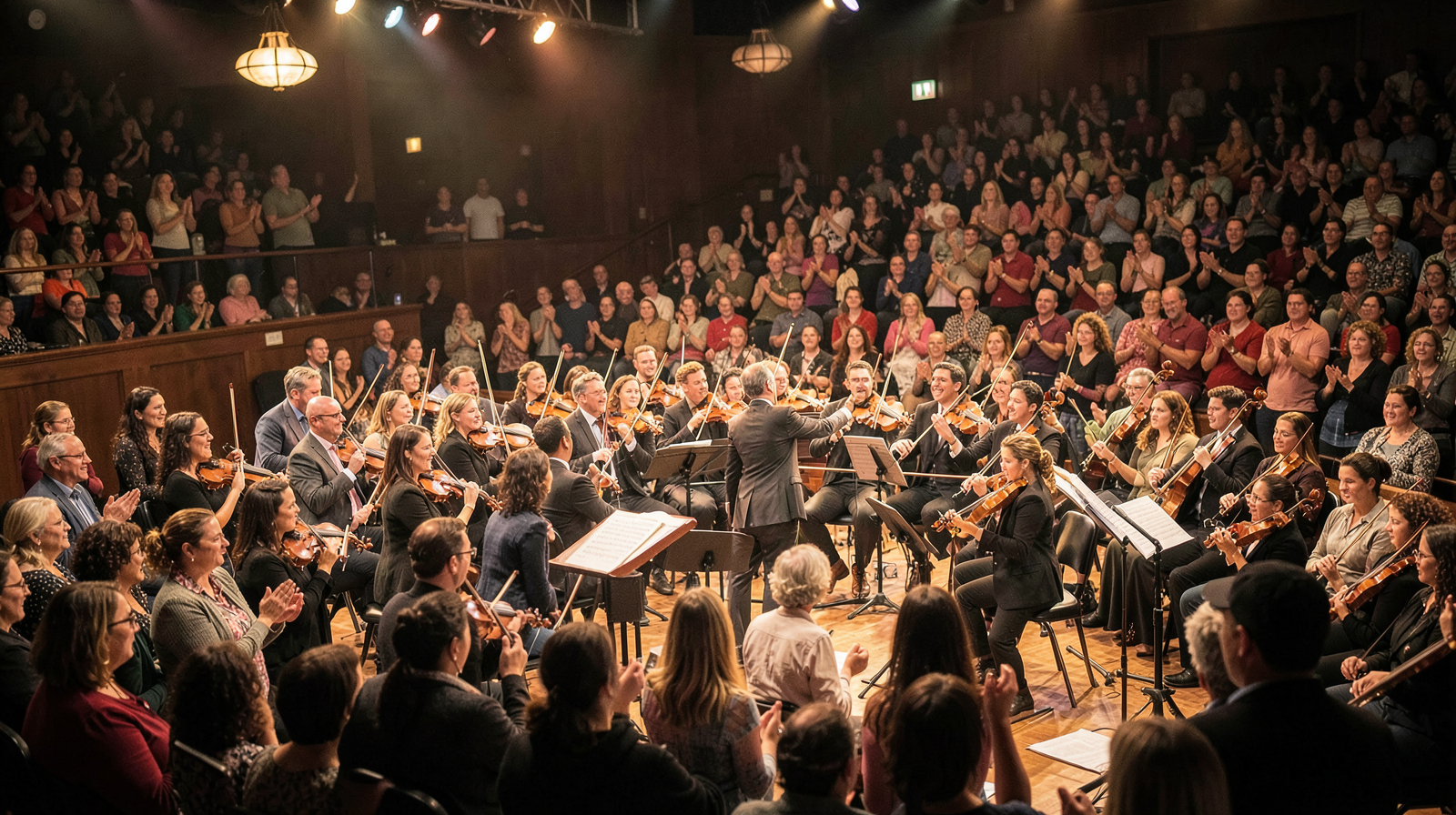
The In Harmony Tour strips all of that friction away by meeting residents on their own turf. Over the past four years, the orchestra has set up inside high school gymnasiums, county fairgrounds, public parks, and even Mammoth Cave. When you remove ticket prices and dress codes, first-time attendees show up in droves. And once people hear a 60-piece orchestra live in their own hometown, the stereotype that classical music is boring or elitist dies fast.
Upcoming In Harmony Tour Dates and What to Expect in 2027
With the fresh $3.2 million runway secured through 2028, the orchestra is already mapping out its next waves of free concerts. Following the summer and autumn 2026 runs across Glasgow, Elizabethtown, Shelby County, Frenchburg, and Bardstown, the tour shifts west for winter.
In February 2027, Music Director Teddy Abrams will lead three free 90-minute concerts across western Kentucky:
- Thursday, February 11, 2027: Trigg County High School Gymnasium in Cadiz (203 Main Street).
- Friday, February 12, 2027: Felix E. Martin Jr. Hall in Greenville (501 West Everly Brothers Boulevard).
- Saturday, February 13, 2027: Preston Arts Center in Henderson (2660 South Green Street).
All three February shows start at 7:30 p.m. Central Time, with doors opening an hour earlier at 6:30 p.m.
Even bigger news sits further down the 2027 calendar. World-renowned cellist Yo-Yo Ma—who previously joined the orchestra for unforgettable performances inside Mammoth Cave in 2023—is returning for a special In Harmony Tour engagement in 2027, alongside his April 16, 2027 Spring Gala appearance with the orchestra at Whitney Hall. Bringing one of the most recognizable classical musicians on earth into small Kentucky venues sends a clear signal: rural communities don't get the "B-team" version of the arts. They get the exact same headline talent as Louisville.
How Other States and Arts Groups Can Copy This Playbook
Honestly, most American orchestras are struggling with shrinking subscription bases and aging audiences. Watching the Louisville Orchestra pull $11.8 million out of a state legislature offers a pretty clear blueprint for surviving—and actually growing—in the late 2020s.
If you're an arts administrator, community organizer, or local official trying to figure out why your cultural programs can't gain traction, look at what Kentucky got right:
- Tie funding to statewide geography. Lawmakers represent districts, not just one zip code. When a state's flagship cultural institution proves it will serve 55+ counties instead of staying locked inside its home city, bipartisan legislative support suddenly becomes realistic.
- Make admission free, but require registration. Every In Harmony concert costs zero dollars to attend, yet the orchestra pushes advance RSVP sign-ups. That gives organizers accurate headcounts for school gyms and parks, allows instant weather alerts, and builds an email list of new local fans.
- Invest in local creative residencies. Through its Creators Corps—backed by the National Endowment for the Arts and private donors—the orchestra puts living composers directly into Kentucky communities to write music inspired by the people living there.
How to Attend or Bring the Tour to Your County
If you live in or near western Kentucky, don't wait until the week of the February 2027 shows to grab seats. Even though tickets are completely free, venues like Trigg County High School Gymnasium and Felix E. Martin Jr. Hall have strict fire-marshal capacities, and advance RSVPs fill up fast. Head straight to the Louisville Orchestra In Harmony Tour page to register for the Cadiz, Greenville, or Henderson dates and sign up for alerts on Yo-Yo Ma's 2027 tour stops.
If you're a school principal, library director, or county arts council member in one of Kentucky's remaining counties that hasn't hosted the orchestra yet, start pitching now. Reach out directly to the orchestra's tour management team through their community portal with specific local venues—whether that's a high school auditorium, a fairground stage, or a public library—and outline how your local schools can host daytime musician workshops alongside an evening concert. The funding is locked in through 2028, and the schedule is actively being built.
Watch this brief news report on Louisville Orchestra adds 6 stops to free 'In Harmony' tour for local broadcast coverage of how the $3.2 million state investment is expanding the concert schedule.