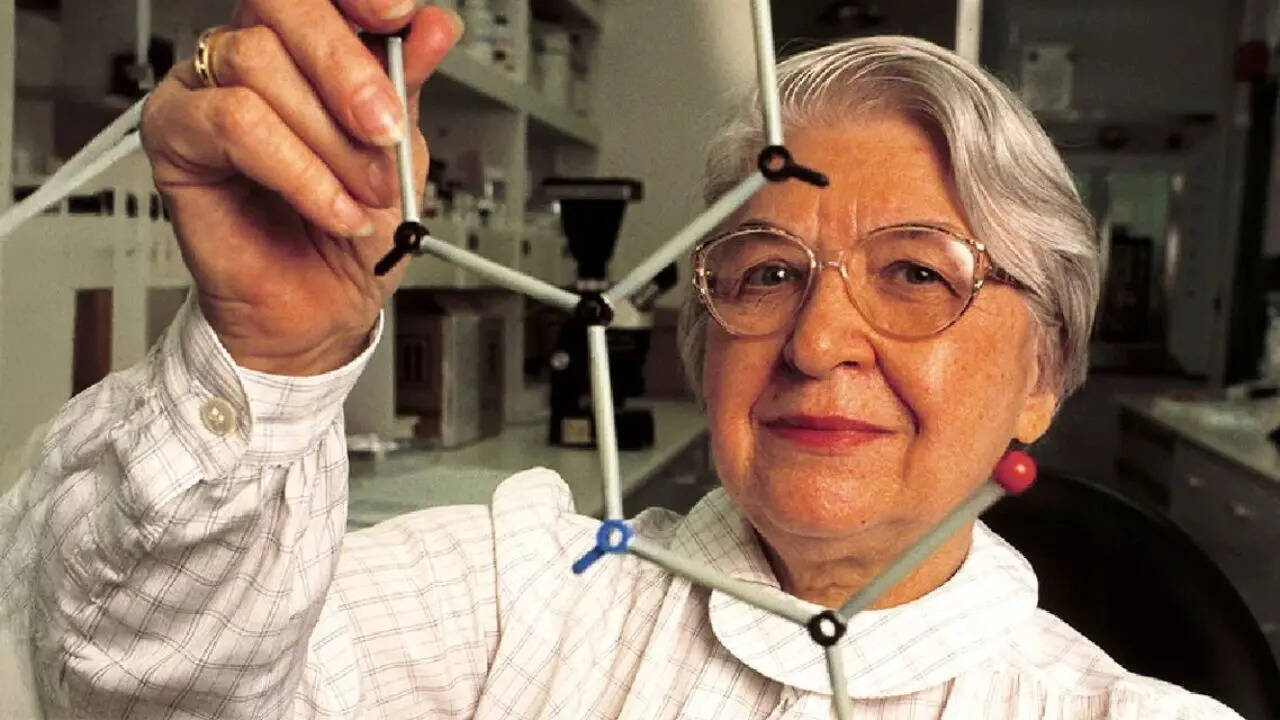
Stephanie Kwolek did not set out to save thousands of lives. She was just looking for a lighter tire.
It was 1965, a time when the American highway was dominated by heavy, gas-guzzling steel giants. The Cold War was simmering, the space race was sprinting, and at the DuPont labs in Wilmington, Delaware, the pressure was on to find a material that could make car tires lighter and more fuel-efficient. Anticipating a looming shortage of petroleum, the chemical giant wanted a synthetic fiber that was as strong as steel but weighed next to nothing.
Kwolek, a 42-year-old chemist with a sharp mind and a quiet, fierce determination, spent her days dissolving long-chain polymers into various solvents. Her goal was to spin these liquid mixtures into solid, ultra-strong fibers using a machine called a spinneret.
Most people in her position would have followed the rules. The rulebook at DuPont was clear: a good polymer solution for spinning should be thick, clear, and look somewhat like molasses.
What Kwolek got instead was a mess.
It was thin. It was watery. It looked like a cloudy, milky soup that had somehow gone bad. By all established standards of mid-century polymer chemistry, it was a failure. It belonged in the waste bin.
But Kwolek looked closer.
The Beauty in the Cloud
When she stirred the strange, translucent liquid, she noticed something odd. It didn't just swirl like water. It exhibited birefringence. When light hit the solution, it bent in a way that suggested the molecules weren't just floating around at random. They were lining up. They were organizing themselves into parallel formations, acting like tiny, liquid soldiers even before being spun into a fiber.
She decided she wanted to run this cloudy liquid through the laboratory’s spinning machine.
The man in charge of the spinneret refused. He told her the cloudy solution would clog the microscopic holes of the machine. He told her she was wasting time. He told her it was a safety hazard.
Consider what happens next: a less stubborn scientist might have nodded, apologized, and thrown the mixture down the drain. The corporate structure of the 1960s was not designed to accommodate a woman bucking the directives of the male technicians running the heavy machinery.
Kwolek did not back down. She spent days cajoling, pleading, and using her formidable intellect to convince the operator to run her cloudy soup just once. He finally relented.
They poured the milky liquid into the machine. It didn't clog. It spun smoothly, drawing out into a fine, silvery thread.
When Kwolek took the resulting fiber to the testing room to measure its tensile strength, she assumed the machine was broken. The numbers blinking back at her were astronomical. She calibrated the equipment and ran the test again. She ran it a third time.
The fiber was five times stronger than steel on an equal-weight basis. It resisted heat. It resisted corrosion. It was practically indestructible.
Kwolek had just discovered liquid crystalline polymers, the foundation of what the world would soon know as Kevlar.
The Anatomy of an Impact
To understand why Kwolek’s fiber behaves the way it does, you have to look past the macroscopic world of vests and helmets and zoom into the atomic scale.
Most synthetic polymers, like the nylon used in stockings or the polyethylene used in grocery bags, are structurally chaotic. Imagine a giant bowl of cooked spaghetti. The strands are tangled, looping over and around one another in a messy, disorganized heap. When you pull on that bowl of spaghetti, the strands slide past each other easily. The material stretches, deforms, and eventually breaks under relatively low stress.
Kwolek’s cloudy solution changed the geometry entirely.
Because of the specific chemical structure she synthesized—poly-paraphenylene terephthalamide—the molecules didn't tangle. They stayed straight and rigid, like uncooked sticks of spaghetti. When spun through the tiny holes of the spinneret, these rigid molecular chains aligned perfectly along the axis of the fiber.
But alignment is only half the secret. The real magic happens between the rows. As these straight chains line up side by side, they form incredibly strong hydrogen bonds with their neighbors. It is a molecular lattice. When an external force hits this structure, the energy cannot easily break a single strand because the force is instantly transferred across the vast, interconnected web of hydrogen bonds.
It is the physical embodiment of the old fable about the single stick that breaks easily, while a bundle of sticks remains unbroken. Except in this case, the bundle is microscopic, and it can stop a bullet traveling at twelve hundred feet per second.
The Invisible Stakes on the Asphalt
The corporate executives at DuPont knew they had a hit on their hands for industrial applications, but they didn't immediately see the human canvas this technology would repaint. They saw hoses, racing sails, and radial tires.
The pivot from industrial utility to lifesaver happened because of a completely different kind of friction.
Let us step away from the clean labs of Delaware and onto a rain-slicked street in Detroit, circa 1971. A police officer approaches a stopped vehicle. His heart rate is slightly elevated, a standard physiological response to the unknown variables of a midnight traffic stop. His uniform is made of wool and polyester. It offers protection against the chill night air, but absolutely nothing against the cold piece of lead that suddenly erupts from the driver’s side window.
Before the mid-1970s, soft body armor for law enforcement was a miserable trade-off. Officers could wear heavy, rigid vests lined with steel or ceramic plates. They were hot, bulky, and restricted movement so severely that most officers chose to leave them in the trunk of the cruiser. They chose comfort and agility over a theoretical layer of protection that made them feel like medieval knights trying to navigate a modern urban landscape.
The National Institute of Justice began looking for a solution to this exact dilemma. They needed something wearable. Something that could be tailored into a standard vest, hidden beneath a uniform shirt, or worn comfortably for a twelve-hour shift in the sweltering heat of August.
When they tested Kwolek’s fiber, they realized the paradigm had shifted.
When a bullet strikes a vest woven from this material, it doesn't encounter a hard wall that shatters the projectile. Instead, it encounters an incredibly dense, multi-layered net. The bullet pushes against the fibers, but the fibers refuse to stretch. The kinetic energy of the bullet is forced to disperse laterally across the entire surface area of the vest.
The bullet mushrooms, loses its velocity instantly, and drops to the ground.
The officer still gets hurt. Let us not romanticize the physics. Being hit by a bullet while wearing a ballistic vest is often compared to being struck in the chest with a baseball bat swung by a professional athlete. It cracks ribs. It leaves deep, purple bruises that take weeks to heal. It can cause internal bleeding.
But it keeps the bullet on the outside of the skin. It keeps the organs intact. It lets the officer go home to their family.
The Human Ledger
It is easy to get lost in the metrics of materials science. We talk about denier, tensile modulus, and gigapascals of strength. But the true measure of Stephanie Kwolek’s cloudy, discarded solution is written in a very different ledger.
It is written in the archives of the International Association of Chiefs of Police/DuPont Kevlar Survivors Club. This is not a hypothetical group. It is an organization that documents every single documented instance where body armor saved an officer from death or serious injury.
The club’s roster passed three thousand members years ago.
Think about that number. Three thousand individuals who walked out of an ambush, a routine traffic stop gone wrong, or a domestic dispute because of a chemical reaction discovered by a woman who refused to throw away a messy experiment. Three thousand families that did not have to plan a funeral.
The material quickly expanded beyond law enforcement. It found its way into the helmets of soldiers in the sandbox of Iraq and the mountains of Afghanistan. It became the gloves that protect surgeons from accidental scalpel slips, the boots that protect lumberjacks from chainsaw blades, and the brake pads that stop roaring commercial airplanes on short runways. It lines the hulls of spacecraft and the tethers of deep-sea oil rigs.
Yet, for decades, Kwolek remained a relatively obscure figure outside the scientific community. She never received a massive windfall of royalties from her invention. The patent belonged to DuPont. She signed the rights away for a single dollar, a standard practice for corporate researchers at the time.
She didn't complain about the arrangement. She was content with the work itself, staying at DuPont for forty years, mentoring younger scientists, and advocating for women in STEM long before it became a corporate talking point. She received the National Medal of Technology in 1996 and was inducted into the National Inventors Hall of Fame, only the fourth woman to be so honored.
The Lasting Thread
When Stephanie Kwolek passed away in 2014 at the age of 90, the world she left behind was radically different from the one she entered in 1923. Her invention had become a generic trademark, a shorthand for toughness, durability, and ultimate protection.
We live in a culture obsessed with the flash of sudden genius, the lone inventor struck by a bolt of lightning out of nowhere. But the story of modern materials science is rarely a story of lightning. It is a story of paying attention when things go wrong. It is the story of looking at a failure—a cloudy, watery, disappointing failure—and having the insight to see that the rules of the past were simply unequipped to explain the future.
Somewhere right now, a police officer is fastening the hook-and-loop straps of a ballistic vest before stepping out into the dark. They don't think about the chemical structure of poly-paraphenylene terephthalamide. They don't think about birefringence or the alignment of liquid crystalline polymer chains in a laboratory in 1965.
They just pull the uniform shirt over the vest, check their badge in the mirror, and step out the door, protected by an invisible web of stubborn grace.