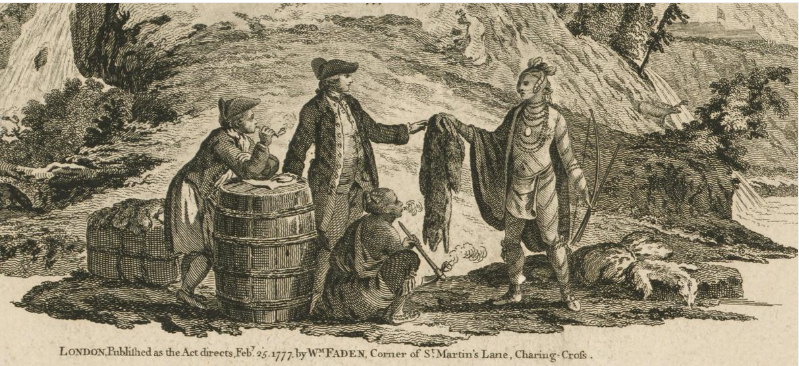
Canada was not built on beaver pelts alone. While history books often paint a quaint picture of the fur trade as a simple exchange of pelts for blankets, the cold reality of the ledger tells a different story. Rum was the true currency of the frontier. It was the lubricant for a brutal form of early capitalism that tied Indigenous labor to European markets through the intentional creation of dependency. This was not a side effect of trade; it was the engine of the economy.
The Myth of the Fair Exchange
In the early days of the Hudson’s Bay Company (HBC) and its rival, the North West Company, the goal was maximum extraction at minimum cost. Fur prices were volatile in London, and transporting heavy goods across the Canadian Shield was a logistical nightmare. Rum solved both problems. It was cheap to produce in the West Indies, easy to transport in concentrated forms, and, most importantly, it created its own demand. Don't miss our previous post on this related article.
Unlike a metal kettle or a wool blanket, alcohol is consumed immediately. Once the "high" wore off, the trader was still there, and the hunter needed more. By shifting the trade from durable goods to addictive ones, colonial corporations ensured a revolving door of labor. This transformed the vast wilderness into a closed-loop system of debt and delivery.
How Alcohol Bypassed Traditional Economics
Standard economic theory suggests that as supply increases or demand wanes, prices adjust. But the rum trade functioned outside these norms. The merchants discovered that alcohol could override the traditional Indigenous "target-production" model. In many Northern cultures, hunters worked until they had enough supplies to sustain their community, then stopped. There was no cultural drive to accumulate excess wealth for the sake of it. To read more about the history of this, Reuters Business provides an excellent summary.
Rum broke that cycle. By introducing a substance that triggered a physiological craving, the companies forced hunters to bypass their traditional conservation limits. They stayed on the trap lines longer. They took more animals than the ecosystem could naturally replenish. The "alcoholic capitalism" of the 18th and 19th centuries was essentially the first instance of a predatory subscription model, where the user paid with the natural resources of a continent.
The Corporate Arms Race for Inebriation
The competition between the HBC and the North West Company in the late 1700s triggered what historians sometimes call the "rum wars." Because the two companies were fighting for the same pelts, they stopped competing on the quality of their knives or the warmth of their cloth. They competed on the strength and quantity of their spirits.
The North West Company, based in Montreal, lacked the HBC’s legal monopoly and coastal access. To compensate, they pushed further into the interior, using high-proof "Highland" whiskey and Caribbean rum as their primary recruiting tools. The HBC, initially hesitant due to the "sober" directives of its London directors, eventually folded under the pressure. They realized that if they didn’t provide the alcohol, they wouldn't get the fur.
This led to a massive spike in imports. Records from the 1790s show that tens of thousands of gallons of spirits were being paddled into the interior every year. It wasn't just about selling a product; it was about territorial control. A post that ran out of rum was a post that went bankrupt.
The Social Cost of Early Infrastructure
The wealth generated from this trade didn't just stay in the pockets of fur barons. It flowed into the foundations of Canadian banking and transport. The early capital used to fund the first canals and railways often had its roots in the high-margin profits of the liquor-for-fur exchange.
However, the human cost was staggering. The introduction of high-proof spirits into communities with no previous exposure or social frameworks for its management led to the rapid breakdown of governance structures. Violence increased. Seasonal migrations were missed because hunters were waiting at the posts for the next shipment. The very people who made the Canadian economy possible were being systematically dismantled by the medium of exchange.
The Transition to State Control
As the fur trade declined and the era of settlement began, the role of alcohol shifted from a trade tool to a revenue stream for the burgeoning Canadian state. The government moved to regulate what it once encouraged, but the motive remained financial. Excise taxes on spirits became a primary source of "sin tax" revenue that helped balance the books of a young, cash-strapped nation.
Even the eventual prohibition movements were less about public health and more about labor productivity. Factory owners in the growing cities of Ontario and Quebec needed a sober workforce that could show up on time and operate heavy machinery. The wild, rum-soaked capitalism of the frontier was no longer compatible with the disciplined industrial capitalism of the Victorian era.
The Legacy of the Bartered Barrel
We often look at modern issues of substance abuse in isolated communities as a contemporary failing. This ignores the structural history of the country. For nearly two centuries, the dominant economic players in Canada actively incentivized the use of alcohol to ensure the flow of capital. It was a business strategy executed with cold, calculated precision.
The grand estates of Montreal’s Golden Square Mile and the historic boardrooms of London were built on a foundation of liquid debt. When we examine the "growth" of the early Canadian economy, we must account for the fact that this growth was heavily subsidized by a manufactured crisis of addiction.
Recognizing this isn't just an exercise in historical guilt. It is a necessary step in understanding how market forces can be weaponized against a population. The rum trade proved that if you control the substance of a man’s desire, you control his labor, his land, and his future.
The barrels are empty now, but the ledger remains.