The dirt along the Rio Grande doesn’t belong to Washington. Ask anyone who has spent forty summers pulling mesquite roots out of the South Texas brush, and they will tell you the land owns them, not the other way around.
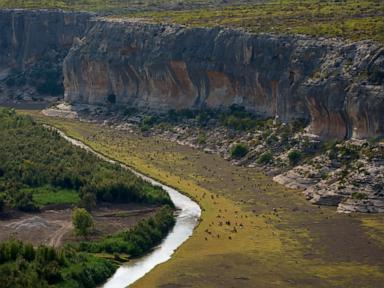
Walk through a grapefruit orchard in Hidalgo County just before dawn, and you can smell the damp earth waking up before the heat arrives. You hear the low, persistent murmur of the river—a brown, winding ribbon that has fed cattle, watered crops, and marked the southern edge of American soil since 1848. For generations, the people living along this water have voted conservatively, flown the American flag from their porch rafters, and fiercely guarded the Fifth Amendment right to hold onto what they built with their own blistered hands.
Then came the certified letters.
Stiff white envelopes bearing the seal of the Department of Homeland Security, arriving in rural mailboxes from Brownsville to Laredo. Inside was a polite, terrifying legal notice: the federal government wanted to survey their acreage, slice their ranches in half, and erect thirty-foot steel bollards right through their backyards.
We often view the debate over the southern border through the lens of cable news shouting matches—a binary clash between national security and open-border idealism. That framing misses the quiet, gritty reality unfolding in the brush country. Out here, the loudest opposition to the border wall isn't coming from progressive activists in distant cities. It is coming from lifelong ranchers, citrus farmers, and conservative property owners who suddenly find themselves staring down the barrel of federal eminent domain.
The Anatomy of a Land Grab
To understand why a fifth-generation Texas rancher would hire a constitutional lawyer to fight a Republican administration, you have to understand how the wall actually gets built.
In California, Arizona, and New Mexico, vast stretches of the border consist of federal land—national parks, military ranges, and public reserves where Washington already holds the deed. Texas is a different beast entirely. When Texas entered the Union in 1845, it retained ownership of its public lands, selling them off over the decades to private citizens. Today, roughly ninety-five percent of the Texas border is privately owned.
Every single mile of new barrier in the Lone Star State requires the federal government to take property from a taxpaying citizen.
Consider a hypothetical scenario based on dozens of real cases filed in federal courtrooms across the Southern District of Texas. Imagine a woman—let’s call her Elena—whose great-grandfather cleared three hundred acres of riverfront scrub in Starr County in 1912. Her family has paid taxes on every square inch for over a century. Because the Rio Grande twists and loops like a dropped rope, engineers cannot build a straight steel wall directly on the riverbank; the soil is too soft, and seasonal flooding would wash the concrete footings away.
Instead, the government plans to build the wall a mile north of the river, running straight through Elena’s pasture.
If the wall goes up, eighty percent of her land ends up on the south side of the steel fence—technically still hers, practically unreachable. Her cattle can no longer reach the river to drink. Her tractors can only cross through a heavy automated gate controlled by Border Patrol agents miles away, assuming the gate isn't locked down during a security alert. The market value of her trapped acreage plummets overnight, yet the government’s initial offer to buy the narrow strip of dirt beneath the wall ignores the devastation inflicted on the rest of the ranch.
This isn't a policy debate for Elena. It is an amputation.
Surveyors in the Brush
The fight usually begins long before a single bulldozer rumbles down a county road. It starts with a request for a "right of entry."
Before the government can condemn land, engineers must walk the property to test the soil, map the elevation, and check for environmental hazards. When landowners refuse to sign the paperwork granting permission, the Department of Justice goes to federal court to force them to open their gates.
I have spoken with landowners across the Rio Grande Valley who describe the psychological toll of those early months. You wake up to find strangers in high-visibility vests hammering wooden stakes into the pasture where your grandfather is buried. You spend your evenings at the kitchen table—not talking about crop yields or cattle prices, but trying to decipher dense legal filings written in the cold, bloodless language of federal condemnation law.
"They tell you it’s for your protection," one veteran rancher in Zapata County told me, leaning against the rusted bed of his pickup truck while the afternoon sun baked the caliche dust white. "You look at the plans, and you realize they’re locking you out of your own water, cutting your herd off from shade, and calling it security. In Texas, we have a word for people who take your land against your will, and it isn't 'patriot.'"
The confusion is often deliberate, or at least born of a massive bureaucratic machine moving too fast to care about collateral damage. Under the Real ID Act of 2005, the Secretary of Homeland Security holds sweeping authority to waive dozens of federal laws—including the Endangered Species Act, the Clean Water Act, and the National Historic Preservation Act—to expedite border barrier construction.
Think of the wall’s legal authority like a snowplow roaring down a narrow residential street. The plow doesn't stop to ask if your mailbox is cemented into the curb; it simply has a mandate to clear the lane, leaving homeowners to dig their property out of the drift afterward.
The Unequal Fight in Federal Court
When a landowner refuses the government's buyout offer, the case enters the grinding machinery of eminent domain under the Declaration of Taking Act.
Here is the catch that shocks most Americans when they first hear it: in a "quick-take" condemnation proceeding, the government doesn't have to win the argument before taking your dirt. Once the Department of Justice files the paperwork and deposits its own estimated value of the land into a court registry, title to the property transfers to the United States immediately.
The landowner is left fighting a rear-guard action. You cannot easily stop the taking itself unless you can prove the government acted in bad faith or outside its statutory authority—a near-impossible standard to meet. Instead, the battle shifts to "just compensation," the constitutional guarantee that if the government takes your property for public use, it must pay you what it is actually worth.
That sounds fair on paper. In reality, it is a war of attrition designed to exhaust ordinary families.
The federal government commands an army of salaried Justice Department attorneys, endless expert witnesses, and deep pockets funded by taxpayers. Across the aisle sits a farmer or a small-business owner who has to pay a private eminent domain attorney hundreds of dollars an hour just to argue that a severed cattle ranch is worth more than the government’s lowball appraisal.
Consider what happens next when a family decides not to cave.
For years, the litigation drags on. Appraisal reports clash over how to value "severance damages"—the loss of value to the remaining land left stranded on the wrong side of the wall. Meanwhile, the government’s initial cash deposit often sits locked in the court system, or if the landowner withdraws it to pay legal fees, they risk having to pay money back if a jury later sides with the government’s lower valuation. Many families, terrified of going bankrupt fighting Uncle Sam, eventually sign the settlement papers just to make the stress stop.
How the Resistance Organized
Yet something unexpected happened when the latest wave of border wall expansion collided with South Texas stubbornness. Instead of folding quietly one by one, landowners began talking to each other across county lines.
They realized that isolation was the government’s sharpest weapon. When the Army Corps of Engineers approached families individually, officials could claim that everyone else down the road had already signed away their rights. Once neighbors started comparing notes at town halls, church basements, and local diners, that illusion shattered.
A remarkable coalition emerged—one that scrambles every conventional political label in America.
On one side stood non-profit legal defense groups like the Texas Civil Rights Project and the Institute for Justice, organizations that rarely agree on anything else. Civil rights attorneys who spent years advocating for migrants suddenly found themselves sitting in living rooms alongside libertarian property-rights lawyers and lifelong conservative ranchers. Together, they formed an unlikely shield, offering pro bono representation to families who could never afford a five-year federal court battle.
Their strategy shifted from passive negotiation to aggressive legal trench warfare:
- Challenging the Right of Entry: Rather than signing blanket permission slips allowing surveyors to roam freely, attorneys forced the government to justify every single entry in court, narrowing the scope and duration of inspections to protect crops and livestock.
- Exposing Appraisal Flaws: Legal teams brought in independent agricultural economists and water-rights specialists to prove that cutting off river access destroys the fundamental viability of a South Texas ranch, driving up the price tag of condemnation to levels that made federal planners flinch.
- Delaying Through Statutory Scrutiny: Lawyers combed through appropriations bills line by line, challenging whether funds allocated by Congress for specific border sectors could legally be diverted to condemn private land miles away from existing fencing.
In Washington, time is the enemy of any administration. Every month a condemnation suit stays tangled in discovery motions is a month closer to an election cycle, a budget battle, or a shift in executive priorities. By refusing to sign on the dotted line, Texas landowners discovered they didn't always need to beat the federal government outright; they just needed to outlast the political clock.
The Invisible Scars Left Behind
Even when a landowner wins a higher payout, or when construction stalls due to shifting political winds, the land itself rarely returns to what it was.
Walk along the levee roads near Mission or McAllen today, and you can see the physical residue of a half-built policy. Massive stacks of rusted steel bollards lie piled in staging yards like giant pick-up sticks. Survey stakes with faded pink ribbons still poke out of the prickly pear cactus. In spots where the concrete wall already stands, the quiet ecology of the river valley has been permanently altered.
The Rio Grande isn't just a political boundary; it is a wildlife corridor and a floodplain. Local residents know that when a hurricane stalls over northern Mexico, the river swells fast and wide. A solid concrete barrier running parallel to the water acts like a dam, trapping floodwaters on the south side and pushing torrents back into Mexican colonias—or, if the wall breaches, unleashing a sudden surge onto American farms.
Then there is the spiritual cost, harder to measure in an appraisal report but heavier than any steel beam.
For families along the border, the river has always been the front porch of their community, not a moat. Generations grew up fishing its banks, baptizing children in its eddies, and watching the same indigo buntings and green jays cross the water every spring without a passport. Putting a thirty-foot wall between a family and the river turns their ancestral home into a dead-end alley. It sends an unmistakable message from a distant capital: your history here is expendable, and your property rights are conditional.
I remember standing near the historic La Lomita Chapel outside Mission, a tiny adobe mission built by Oblate priests in 1865 that briefly found itself directly in the path of proposed border wall construction. Looking out from the chapel steps toward the river, you realize how fragile local heritage becomes when reduced to a line drawn on a map in Washington by people who have never smelled orange blossoms in February or felt the grit of a South Texas dust storm between their teeth.
The Quiet Lesson in the Brush
We like to believe that constitutional rights protect themselves—that the words ink-stamped onto parchment two centuries ago act like an automatic force field around our homes.
The reality in South Texas tells a harder, more humbling truth. Rights only survive when ordinary people are willing to endure the exhaustion, expense, and loneliness of defending them when it becomes inconvenient for those in power.
When the executive orders changed and federal bulldozers temporarily pulled back from several disputed parcels along the Rio Grande, there were no parades in Washington. No cable news panels paused to thank the stubborn farmers of Hidalgo and Starr counties for holding the line on the Fifth Amendment. Most of them simply went back to mending fences, checking irrigation pumps, and praying for rain.
Out in the citrus groves, the mornings are quiet again, save for the wind moving through the leaves and the steady, indifferent current of the river rolling toward the Gulf. Just beneath the dust, though, the survey stakes are still buried—a reminder that the fight over who truly owns the border isn't settled by treaties or walls, but by whoever refuses to walk away when the certified letters arrive.