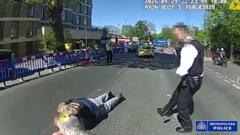
Rain-slicked asphalt reflects the flashing blue neon of a London night. A crowd gathers, phones raised like miniature shields, recording a chaotic arrest. On the other side of the line, a Metropolitan Police officer feels the weight of a tiny, plastic cube pinned to their chest. It blinks a steady, unblinking red.
For years, that little camera was a silent witness, its memory cards locked away in secure digital vaults, whispered about in courtrooms but hidden from the public square.
That is about to change.
The Metropolitan Police Service is shifting its strategy, preparing to push vastly more body-worn video footage directly onto the internet. It is a massive departure from a policy of digital hoarding toward a policy of radical transparency. But beneath the bureaucratic announcements lies a messy, deeply human struggle over who gets to narrate the truth of our streets.
The Fragmented Truth
Consider a hypothetical, yet entirely typical, scenario on a Brixton side street. An officer tackles a suspect. To a passerby filming from ten yards away, it looks like unprovoked brutality. The ten-second clip hits social media. By midnight, it has amassed millions of views, sparked local protests, and shattered a community’s fragile trust in the law.
But the officer’s body camera tells a different story. It shows the preceding five minutes: the de-escalation attempts, the sudden flash of a blade, the split-second decision to protect a bystander.
Until now, the Met kept that second video hidden until formal investigations concluded—a process that often takes months or even years. By then, the public consciousness has already hardened around the initial, fragmented clip. The truth arrives too late to repair the damage.
The decision to release more footage online is an admission of a harsh reality: in the modern media ecosystem, silence is interpreted as guilt. If the police do not fill the information vacuum, someone else will.
The Digital Erasure of Nuance
Living in a major metropolis means accepting that you are always on camera. CCTV tracks your commute. Shopfront security records your coffee run. Dashcams log your driving. Yet, despite this saturation of surveillance, we have never felt more disconnected from the objective truth of what happens during a police encounter.
Human memory is a notoriously fragile thing. Under high stress, adrenaline narrows an officer's peripheral vision and distorts their perception of time. A suspect, fueled by fear or substance, experiences a completely different reality.
When these two volatile forces collide, the bodycam is supposed to be the objective referee.
Surveillance Saturation vs. Objective Truth
[CCTV / Dashcams / Phones] ----> Record the Event (Subjective Angles)
[Body-Worn Video]            ----> Records the Interaction (The Referee)
But context is fragile. Uploading a video to YouTube or a police portal does not instantly guarantee clarity. A camera mounted on a vest does not see what the officer sees; it sees where the officer's torso is pointing. It misses the subtle hand gesture to the left, the sudden movement in the shadows, or the smell of intoxicants in the air.
By relying on video to solve the crisis of trust, we risk trading one form of bias for another. We risk believing that because we watched a clip, we know the whole story.
The Toll of Exposure
There is a human cost to this digital pivot that rarely makes it into policy documents. Imagine being a victim of domestic abuse on the worst day of your life. The police arrive at your home. You are crying, vulnerable, perhaps injured. The officer’s camera is running.
Under the new drive for openness, how secure is that moment?
The Met promises rigorous blurring, redaction, and strict compliance with privacy laws before any footage is shared with the public. They assure us that the goal is to highlight instances of public interest, particularly when policing public order, protests, or highly disputed arrests.
Yet, the thought of one’s private trauma becoming public digital collateral is terrifying. The line between public accountability and public voyeurism is razor-thin. For policing to work, communities must trust that calling for help will not result in their worst moments being uploaded to the internet for viral consumption.
The Machinery of Accountability
Statistically, the Metropolitan Police handle thousands of interactions daily. The sheer volume of video data generated is staggering. To process, redact, and clear this footage for public consumption requires an immense logistical operation. It demands shifting resources away from the streets and into digital editing suites.
The logic behind the investment is simple: accountability reduces friction.
When people know they are being recorded, behavior changes. Officers are less likely to overstep; citizens are less likely to escalate. Studies across global policing jurisdictions consistently show that the introduction of body-worn cameras correlates with a drop in complaints against police and a reduction in the use of force.
But hiding the footage defeated the purpose. It was like buying a high-tech home security system but never looking at the feed when the alarm went off. By opening the vaults, the Met hopes to buy back the public currency they have lost over a turbulent decade defined by high-profile scandals and eroding systemic confidence.
The View from the Concrete
Walk down any high street and talk to the people who live under the gaze of these lenses. The reaction is rarely uniform.
An older shopkeeper might welcome the transparency, eager for anything that validates the difficulty of maintaining order. A young man from an over-policed demographic might view the announcement with profound skepticism, wondering if the police will only release footage that vindicates their own actions while keeping the damning videos buried under legal exemptions.
This skepticism is the greatest hurdle the Met faces. Selective transparency is not transparency at all; it is public relations.
If the public senses that the police are curation-happy—only uploading the heroic saves and the justified uses of force while hiding the mistakes, the bumbles, and the abuses—the entire initiative will backfire. True accountability means showing the failures too. It means broadcasting the moments where tactics broke down, where training failed, and where the human beings behind the badge fell short of the standard expected of them.
The Unblinking Eye
We are entering an era where the badge and the camera are inseparable. The blue uniform is no longer just a symbol of state authority; it is a walking broadcast platform.
As the Metropolitan Police begin uploading more of their daily reality to the digital world, the ultimate success of the project will not be measured in view counts, likes, or positive press cycles. It will be measured in the quiet restoration of faith in a simple idea: that when the state uses force in the name of the people, it is willing to let those same people watch exactly how they did it.
The red light on the officer's chest blinks on. The camera rolls. The city watches, waiting to see if it can finally believe what it sees.