The floor is tacky with the ghost of a thousand spilled sodas. A cooling vent hums somewhere above Row L, a low-frequency vibration that you only notice during the quietest beats of a trailer. You are sitting in a room with eighty-four strangers, all of you facing the same direction, eyes fixed on a silver-threaded curtain that is about to pull back.
For three years, we were told this ritual was dead. We were told the couch had won. The "content" was supposed to be piped directly into our veins while we folded laundry or scrolled through our phones. But then something happened. We realized that watching a skyscraper collapse on a six-inch screen while a Slack notification pops up isn't an experience. It’s a distraction.
This summer, the cinema isn't just a business. It is a battlefield where the human need for awe is fighting back against the algorithm.
The Architect of Gravity
Christopher Nolan doesn’t care about your data plan. He doesn’t care if you have a high-definition television in your living room. He cares about the way your chest rattles when a 70mm projector throws the weight of history against a wall. With Oppenheimer, Nolan has stepped away from the high-concept puzzles of dreams and time-inversion to look at the man who gave us the power to end ourselves.
Consider the technical audacity. Nolan chose to recreate the Trinity Test—the first nuclear explosion—without a single frame of computer-generated imagery. This isn't just a flex of directorial ego. It is a commitment to the tangible. When you see that light bloom across the screen, you aren't looking at a math equation solved by a server farm in Oregon. You are looking at chemicals, light, and fire.
The stakes are invisible but heavy. We live in an era where we can no longer trust our eyes; deepfakes and AI-generated realities have made us cynical. By grounding a film about the birth of the atomic age in practical, physical effects, Nolan is making a plea for the "real." He is betting that the audience can tell the difference between a pixel and a spark. The film rests on the shoulders of Cillian Murphy, whose face has become a landscape of its own—sunken, haunted, and carrying the terrifying realization that he has become death, the destroyer of worlds.
The Weight of the Mask
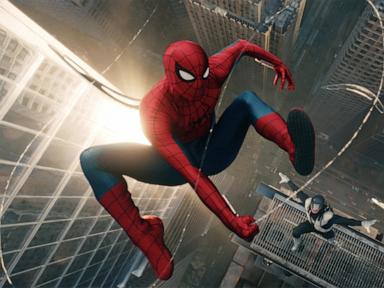
While Nolan builds a monument to the physical world, another corner of the summer slate is busy reinventing the digital one. Spider-Man: Across the Spider-Verse shouldn't work. On paper, it’s a chaotic explosion of disparate art styles, a sensory overload that threatens to break the viewer’s focus.
But beneath the neon-soaked visuals of Miles Morales swinging through a multi-dimensional New York lies a story about the agonizing loneliness of being "chosen."
We often treat superhero movies like fast food—predictable, salty, and ultimately hollow. This film, however, treats its medium like high art. It uses different animation styles not just because they look cool, but to represent the emotional frequency of different universes. When Gwen Stacy’s world bleeds into watercolors that change hue based on her mood, the film is doing something the "real" world can’t. It’s making internal trauma visible.
The human element here is the burden of expectations. Miles isn't just fighting a villain; he is fighting the narrative itself. He is a kid being told by an entire universe of "experts" that his story must end in tragedy because that’s just how the script is written. It is a profound metaphor for a generation of young people who feel trapped by the grim projections of the future. They are told the world is ending, the climate is failing, and the "canon" of their lives is already set. Miles Morales looks at that inevitability and decides to write his own ending.
The Plastic Mirror
Then there is the pink elephant in the room.
Greta Gerwig’s Barbie is perhaps the most subversive gamble of the decade. It takes a brand that represents the pinnacle of artificiality—a literal plastic doll—and uses it to examine the messy, painful, and beautiful complexity of being a woman.
There is a specific kind of magic in taking a corporate icon and breathing a soul into it. When Margot Robbie’s Barbie begins to think about death, the movie stops being a toy commercial and becomes a philosophical inquiry. It asks: What does it mean to be a "perfect" object in an imperfect world?
The brilliance lies in the contrast. We see Ryan Gosling’s Ken, a character defined entirely by the gaze of another, struggling to find a purpose when he isn't being looked at. It’s a comedy, yes. It’s bright and loud and saturated in a shade of pink that reportedly caused a global shortage of paint. But at its heart, it’s a story about the moment the mask slips. It’s about the terrifying day you realize you aren't a toy, or a role, or a brand, but a person with the terrifying agency to choose who you want to be.
The Toy Box of Memory
Nostalgia is a dangerous drug. It can make us settle for mediocrity just because it reminds us of a time when our knees didn't hurt. Pixar has lived in this tension for years, and with the return to the world of Toy Story, the stakes have shifted from "Will they get home?" to "How do we say goodbye?"
The invisible stake in our obsession with these characters is our own aging. We watched the first Toy Story as children, or as parents of young children. Now, those children have children. When Woody or Buzz Lightyear face a crisis of purpose, they aren't just toys on a screen. They are proxies for our own obsolescence.
The miracle of this medium is its ability to make us weep for a plastic cowboy. We do this because the filmmakers understand a fundamental truth: we don't care about the shiny textures or the celebrity voices. We care about the fear of being left behind in a cardboard box while the world moves into a new room.
The Silence of the Crowd
There is a moment that happens only in a movie theater. It’s not during the explosions. It’s not during the punchlines.
It’s the silence.
It is that specific, heavy quiet that falls over a room when eight-four strangers all realize something at the exact same time. It’s the collective intake of breath when Oppenheimer watches the world change forever. It’s the sniffle in the dark when a toy says a final farewell.
You cannot replicate this on a smartphone. You cannot get this from an algorithm that suggests what you might like based on your previous browsing history. The algorithm wants to keep you in a loop of the familiar. The cinema wants to shock you with the new.
We are living through a period of profound isolation. We work from home, we order food through apps, and we consume "content" in silos. The summer movie season is the one remaining cultural bridge where we are required to be physically present with one another. We have to navigate the armrest disputes and the person who won’t stop whispering, but in exchange, we get to be part of a temporary tribe.
The business analysts will talk about "box office recovery" and "intellectual property leverage." They will look at the numbers and the opening weekends and the international markets. But they are missing the point.
The point is the light.
We are a species that has always gathered around fires to tell stories. The fire has just evolved into a laser projector. We still need the stories to tell us who we are, to warn us about the bombs we build, to show us the colors of our own sadness, and to remind us that even if we are made of plastic, we can still feel the sun on our skin.
The lights dim. The hum of the cooling vent fades into the background. The tacky floor doesn't matter anymore. The curtain pulls back, and for the next two hours, the rest of the world ceases to exist.
You are not a consumer. You are not a data point. You are an observer of the human soul, sitting in the dark, waiting for the spark.