The coffee in Stuttgart is always hot, but Stefan’s office feels like a walk-in freezer.
For thirty years, Stefan has watched the redbrick clock tower from his desk at a mid-sized mechanical engineering firm in Baden-Württemberg. His father worked here, welding chassis components for industrial presses that shipped to Detroit, São Paulo, and Tokyo. The air always smelled faintly of machine oil and ozone, the scent of absolute certainty. When Stefan started, Germany did not merely participate in the global economy; it wrote the rulebook on how to build things that refused to break.
Now, Stefan stares at a spreadsheet that refuses to balance.
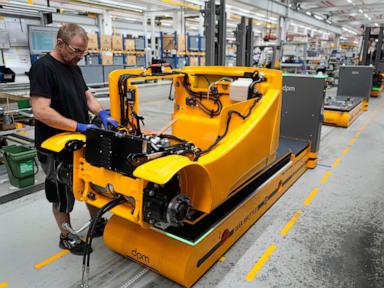
Halfway across the planet, in a sprawling industrial park outside Shenzhen, a factory floor hums with a different kind of energy. The lights do not flicker. The robotic arms move with a terrifying, liquid grace, assembling high-precision industrial automation tools at a fraction of the cost Stefan must charge just to cover his German labor and energy overhead. For decades, Western executives comforted themselves with a convenient myth: Chinese manufacturers could copy, but they could not innovate. They could build cheap toys and simple textiles, but they could never master the soul of heavy machinery.
That myth just died.
Consider what happens when the student not only catches up to the master, but redesigns the entire gymnasium. Chinese firms are no longer content with being the world's workbench. Armed with mountains of venture capital, state-backed research initiatives, and an appetite for speed that leaves Munich boardrooms gasping for air, they have mastered the art of high-end manufacturing. They are building better electric vehicles, smarter industrial robots, and cleaner renewable energy grids—often faster, and almost always cheaper, than the legacy giants of Europe.
The pressure is not coming from some distant horizon. It is sitting on Stefan’s desk, wrapped in an email from a lifelong client in Munich who just defected to a Shenzhen-based supplier.
To understand why this stings so deeply, you have to understand the German Mittelstand. These are the thousands of family-owned, specialized companies that form the spine of Europe's largest economy. They are hidden champions, producing specialized screws, optical lenses, and hydraulic valves that the rest of the world relies on. They are notoriously conservative, deeply proud, and built for the long haul.
Or at least, they were.
Long-term thinking is a luxury when the short-term math stops working. Energy prices across Europe spiked permanently following geopolitical shocks, turning what used to be a predictable overhead cost into a monthly heart attack. At the same time, China’s domestic market slowed down, leaving its industrial juggernauts with massive overcapacity. Desperate to find buyers, these companies turned their export engines toward Europe, offering sophisticated machinery backed by lightning-fast software updates and service models that make traditional German engineering look like a museum exhibit.
It is a culture clash disguised as a trade deficit.
German engineering has always prioritized depth over speed. A German engineer will spend three years perfecting a titanium gear, ensuring it can withstand a nuclear winter, because that is what the brand stands for. But a Chinese competitor might iterate that same gear three times in six months, releasing software patches to fix minor flaws on the fly, while undercutting the price by forty percent.
Stefan tried to explain this to his board last Tuesday. He used a metaphor, standing by the window as rain streaked the glass. We are building cathedral clocks in an age of disposable smartphones.
The board did not like the metaphor. They liked the profit margins of 2014 even less.
The danger for German firms is not that they will suddenly forget how to build great things. The danger is that they will become irrelevant while building them. Perfection is a terrible shield against velocity. When a customer can buy an autonomous logistics robot that arrives in weeks, integrates seamlessly with cloud software, and costs half as much as the domestic equivalent, loyalty to the hometown brand evaporates. Patriotism does not survive a balance sheet audit.
Yet, to write off German industry would be to misunderstand the stubbornness of steel.
In a workshop down the road from Stefan’s office, a younger engineer named Lena is trying a different experiment. She is not fighting the price war. She knows she cannot win a race to the bottom against factories subsidized by municipal governments in Guangdong. Instead, she is leaning into the one thing German manufacturing still owns: radical customization and deep domain expertise.
Lena’s company builds bespoke milling machines for aerospace labs. They do not sell hardware; they sell solutions to problems that do not have textbooks yet. When a research team in Zurich needs a milling tolerance measured in fractions of a micron, they do not call Shenzhen. They call Lena.
This is the pivot point. The era of resting on a century-old reputation is over. The comfortable decades of exporting standard industrial goods to a developing world that desperately needed them are gone, replaced by a ruthless, multipolar marketplace where the challenger has learned every trick in the book and invented a few new ones along the way.
The furnaces in Stuttgart are still burning. But the heat inside them has changed. It is no longer the warmth of unchallenged dominance. It is the white-hot clarity of survival.
Stefan closes his laptop. Outside, the redbrick clock tower marks the turn of another hour, indifferent to the shifting tectonic plates of global commerce. He picks up his pen, looks back at the spreadsheet, and finally begins to delete the assumptions of the past.