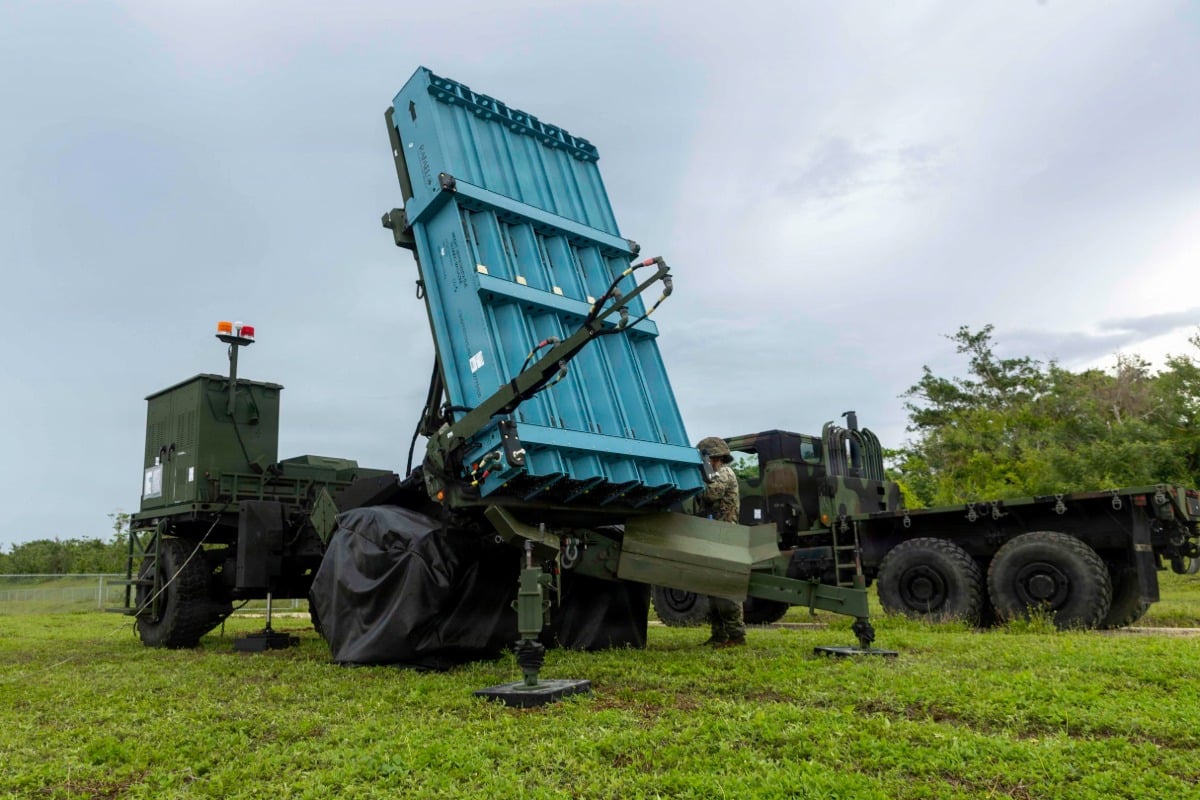
The United States Marine Corps is sending its new, Iron Dome-based air defense system to Guam. It is a direct response to China’s massive missile arsenal. The deployment, centered around the Marine Corps’ Marine Air-Defense Integrated System and its Medium-Range Intercept Capability, aims to plug a critical gap in Western Pacific deterrence. By pairing American radar with Israeli interceptor technology, the Marines hope to protect vital logistics hubs from a sudden, overwhelming strike.
But this is not a simple plug-and-play victory for American forces. It is a stopgap measure that exposes deeper, systemic vulnerabilities in how the Pentagon plans to fight a near-peer conflict in the Pacific.
The Indo Pacific Chokepoint
Guam is the linchpin of American military strategy in the second island chain. If conflict erupts over Taiwan or the South China Sea, Guam serves as the primary unsinkable aircraft carrier, logistics node, and submarine base for the U.S. military. Beijing knows this. Consequently, the People’s Liberation Army has spent two decades building weapons specifically designed to turn the island into a smoking ruin within the first hours of a war.
The threat is multifaceted. China possesses the DF-26, a intermediate-range ballistic missile dubbed the "Guam Killer" by defense analysts. They also wield air-launched land-attack cruise missiles carried by H-6K bombers, alongside a rapidly maturing fleet of hypersonic glide vehicles designed to evade traditional radar networks.
Against this onslaught, the current defenses on the island are dangerously thin. The U.S. Army operates a single Terminal High Altitude Area Defense battery on Guam. While THAAD is exceptional at knocking down high-altitude ballistic missiles in their terminal phase, it is entirely blind to low-altitude cruise missiles hugging the waves. It can also be easily overwhelmed by sheer numbers.
The Marine Corps is stepping into this vacuum. Their new system utilizes the Tamir interceptor, the battle-proven backbone of Israel's Iron Dome, married to the American AN/TPS-80 Ground/Air Task-Oriented Radar and a U.S.-made command and control architecture. On paper, it gives the Marines a mobile, rapidly deployable shield against the exact cruise missiles currently targeting Guam's airfields and ports.
Logistics of an Island Under Siege
Moving a missile system to a remote island is one thing. Sustaining it during a high-intensity shooting war is another matter entirely.
The Tamir interceptor was designed for a very specific geography. It was built to protect a compact, contiguous nation with short internal supply lines against low-tech, unguided rockets launched from just across a border. Israel can replenish its Iron Dome batteries via highways within hours.
Guam enjoys no such luxury. It sits roughly 6,000 miles from the American mainland and 1,500 miles from Japan. In a conflict scenario, the waters and skies surrounding the island will be heavily contested. Every single replacement missile, spare radar component, and gallon of fuel will have to traverse thousands of miles of ocean under threat from Chinese attack submarines and long-range bombers.
Consider the consumption rates. During periods of heavy bombardment, an Iron Dome battery can burn through dozens of interceptors in a single afternoon. If a Chinese saturation attack fires 100 cruise missiles at Guam’s Andersen Air Force Base, the Marine system will exhaust its ready-to-fire inventory in minutes. Air-lifting heavy, explosive missile canisters across the Pacific while under fire is a logistical nightmare that the Pentagon has talked about shifting away from, but has yet to fully solve.
Furthermore, the Tamir interceptor relies on a complex international supply chain. While parts of the system are manufactured in the United States through a joint venture between Raytheon and Rafael, production capacity is not infinite. The U.S. military is already facing severe munitions shortages across almost every theater, driven by commitments to allies in Europe and the Middle East. Forcing a new, foreign-derived missile system into the Pacific logistics pipeline strains a system that is already near its breaking point.
The Friction of Integration
The military loves to talk about joint operations. The reality on the ground is often defined by bureaucratic turf wars and incompatible hardware.
The defense of Guam is currently a patchwork of competing service priorities. The Army is responsible for the land-based THAAD battery and is working on its own Integrated Air and Missile Defense system. The Navy guards the surrounding waters with Aegis-equipped destroyers. Now, the Marine Corps is inserting its own independent capability into the mix.
Making these systems talk to one another in real-time is an immense technical hurdle. A Marine radar must be able to hand off a target tracking profile to an Army command post, which might then order a Navy ship to fire, or vice versa. If these systems cannot share data at the speed of relevance, the result is catastrophic failure. Batteries will either fire at the same incoming target—wasting precious ammunition—or assume another unit has the target covered, allowing a hostile missile to slip through the net.
Historical precedents in air defense integration are troubling. During the opening phases of the 2003 invasion of Iraq, communication breakdowns between different service branches and allied air defense networks contributed to multiple tragic friendly-fire incidents involving Patriot missile batteries. While data link technology has advanced significantly since then, the complexity of managing a multi-tiered, multi-service defense over a vast maritime domain like Guam is unprecedented.
The Marines are using the Common Aviation Command and Control System to bridge this gap. It is a capable platform, but it is fundamentally a Marine Corps tool. Forcing it to sync perfectly with the Army’s Integrated Battle Command System and the Navy’s Cooperative Engagement Capability under combat conditions remains an unproven experiment.
Air Defense Intercept Profiles
| System | Target Profile | Operational Range | Service Branch |
|---|---|---|---|
| THAAD | High-Altitude Ballistic Missiles | Long Range (Exo-atmospheric) | U.S. Army |
| Aegis (SM-3/SM-6) | Ballistic & Cruise Missiles | Fleet Wide / Multi-tier | U.S. Navy |
| Marine MRIC (Iron Dome) | Low-Altitude Cruise Missiles / UAVs | Short to Medium Range | U.S. Marine Corps |
The Mobility Illusion
The core tenet of the Marine Corps' new operational concept, Expeditionary Advanced Base Operations, is mobility. The Marines want to avoid becoming static targets. The idea is to land on an island, fire at the enemy, and pack up and move before the counter-strike arrives.
This philosophy works well for small scouting teams or light anti-ship missile launchers. It does not scale easily to comprehensive air defense.
An Iron Dome-based battery is a heavy, footprint-heavy apparatus. The AN/TPS-80 radar requires significant power generation and cooling infrastructure. The missile launchers themselves are bulky, truck-mounted units. While they are technically mobile, moving them across an island like Guam—which is only 30 miles long and 4 to 12 miles wide—presents a geometric problem.
There are only so many roads on Guam. There are only so many cleared sites where a radar can achieve a clear line of sight to the horizon without being blocked by jungle terrain or ridges. Chinese satellite reconnaissance and electronic intelligence aircraft will be mapping these potential deployment sites constantly.
Once a Marine battery turns on its radar to scan for incoming threats, it lights up like a flare in a dark room. The electronic emissions can be detected from hundreds of miles away by Chinese signals intelligence satellites. The moment those coordinates are logged, a volley of ballistic or cruise missiles will be en route to that position. The Marines will have a very narrow window to turn off the radar, pack up the trucks, and drive down a predictable road network before the impact zone is pulverized. Mobility on a small island is largely an illusion when facing an adversary with persistent overhead surveillance.
The Cost Curve Dilemma
Waging war through air defense is an economic losing proposition. This reality is magnified in the Western Pacific.
A single Tamir interceptor costs an estimated $40,000 to $100,000. Compared to an American Patriot missile, which costs several million dollars, the Israeli-designed interceptor is incredibly cheap. This cost-efficiency is why the system works so well against crude, homemade rockets fired out of Gaza.
However, the Chinese cruise missiles targeting Guam are not cheap rockets. They are sophisticated, high-speed, maneuverable military assets. More importantly, China can manufacture them at a scale and a price point that the American industrial base cannot match.
If Beijing launches a swarm of low-cost, long-range attack drones alongside their cruise missiles, they can force the Marine batteries on Guam to burn through their entire stockpile of Tamir interceptors just to clear the skies of cheap decoys. Once the defensive shield is empty, the high-end Chinese ballistic missiles will follow to strike the defenseless infrastructure.
The Pentagon is caught on the wrong side of the cost-imbalance curve. Defending a fixed point on earth requires constant vigilance and a continuous expenditure of resources. The attacker only needs to get lucky once. By relying on a kinetic interceptor system like Iron Dome, the U.S. military is choosing to play a war of attrition that favors the country with the world's largest manufacturing sector.
Beyond the Stopgap
The deployment of this Marine system to Guam is an admission of fear. It shows that the Pentagon realizes its premier Pacific base is dangerously exposed and that the long-promised, comprehensive defense architecture for the island is years away from being fully realized.
Relying on a system designed for the Middle East to solve the tyranny of distance in the Pacific is a gamble born of necessity, not strategic brilliance. It buys time, but time is a wasting asset.
True security for Guam will not come from packing a tiny island with more missile batteries that can be bypassed or overwhelmed. It will require a fundamental shift toward distributed lethality—moving American forces off centralized hubs like Guam and scattering them across a vast network of smaller, austere airfields and ports throughout the Pacific. Until the military can move away from relying on single points of failure, throwing a handful of Israeli interceptors at a superpower adversary is merely rearranging the deck chairs on a very exposed ship.