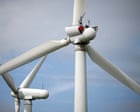
Stand on a ridge in the Scottish Borders when the wind comes tearing off the Atlantic, and you will hear it long before you see them. It is not a whistle or a roar. It is a deep, rhythmic thrumming, the sound of massive carbon-fiber blades slicing through empty air, turning a wild, invisible force into steady current for homes a hundred miles away.
We look at those white towers and see progress. We see steel and engineering rising to meet a warming planet.
Look higher.
Miles above that spinning blade, traveling at the speed of light, an electronic pulse is sweeping across the horizon. It is a rotating beam from a military radar installation, scanning the night for an aircraft that might not be broadcasting its position. To that radar, a three-bladed turbine three hundred feet tall is not a green energy generator. It is a phantom bomber. It is a cluster of solid metal returning an echo so dense, so chaotic, that it can blind the eye of the state.
This is the quiet friction of the modern age. We are trying to build the future on top of the infrastructure of the past, and sometimes, the gears simply grind.
Over the past twelve months, the Ministry of Defence stood up and said no four times. Four different wind farm developments, pitched by companies eager to harvest the gales sweeping across the British countryside, ran straight into a wall of national security objections.
Radar interference.
The phrase sounds bureaucratic, dry enough to print on government letterhead and file away in a drawer marked tomorrow. But unpack it. Behind those four rejections lies a collision between two absolute necessities: our desperate scramble to decarbonize the electrical grid, and the unyielding mandate to keep the national airspace safe and sovereign.
Imagine sitting in a darkened operations room, staring at a green glowing sweep on a circular display. Your job is to track every object moving through the sky above the British Isles. Suddenly, a new wind farm goes live twenty miles away. The massive, rotating blades act like giant mirrors for radio waves. They scatter the radar signal in a thousand unpredictable directions. The screen fills with clutter—ghost returns, false targets, shimmering rings of electronic snow that obscure the actual skies.
In that moment, an air defense operator faces a terrifying question. Is that flash on the screen a flock of migrating geese, a wind turbine blade spinning in a thermal updraft, or an unidentified aircraft slipping through a blind spot?
You cannot guess. Security does not tolerate ambiguity.
This is why developers and defense officials find themselves locked in an increasingly tense dance. On one side are the energy firms, backed by investors and climate timetables, looking at vast tracts of windy moorland as untapped treasure. On the other side sits the military, tasked with defending a crowded island where every square mile of airspace is scrutinized, monitored, and fiercely guarded.
The tension is real. It is felt in boardrooms where millions of pounds in capital expenditure hang in the balance, and it is felt in radar stations where technicians try to write software filters sophisticated enough to tell the difference between a spinning turbine and a streak of aluminum.
Technology, of course, is supposed to save us from these dilemmas. Engineers have spent years developing advanced signal processing, radar-absorbing coatings, and software algorithms designed to teach defense systems how to ignore wind farms. Sometimes it works. A turbine can be modified, relocated, or programmed to feather its blades during specific operational windows.
But sometimes, the physics of the site simply refuse to cooperate. The terrain is too complex, the radar line-of-sight too direct, the strategic importance of the airspace too high. When that happens, the project stops. The application is withdrawn, the permits are denied, and the wind stays uncaptured.
We do not often talk about these invisible boundaries. We prefer our green transitions to be simple stories of good intentions meeting clever engineering. We like to imagine a world where every hill can be crowned with clean energy without friction or compromise.
Reality is messier.
Every time we reach for the sky to pull power from the wind, we share that same sky with history, with defense, with the quiet machinery that watches over borders while the rest of us sleep. The four rejections of the past year are not just bureaucratic speed bumps. They are reminders that space on this crowded island is finite, and every acre must serve multiple, competing masters.
The wind will keep blowing across the hills, indifferent to the radars sweeping the clouds above it. And somewhere in a room filled with hums and glowing screens, someone will keep watching the glass, waiting for the clutter to clear.


