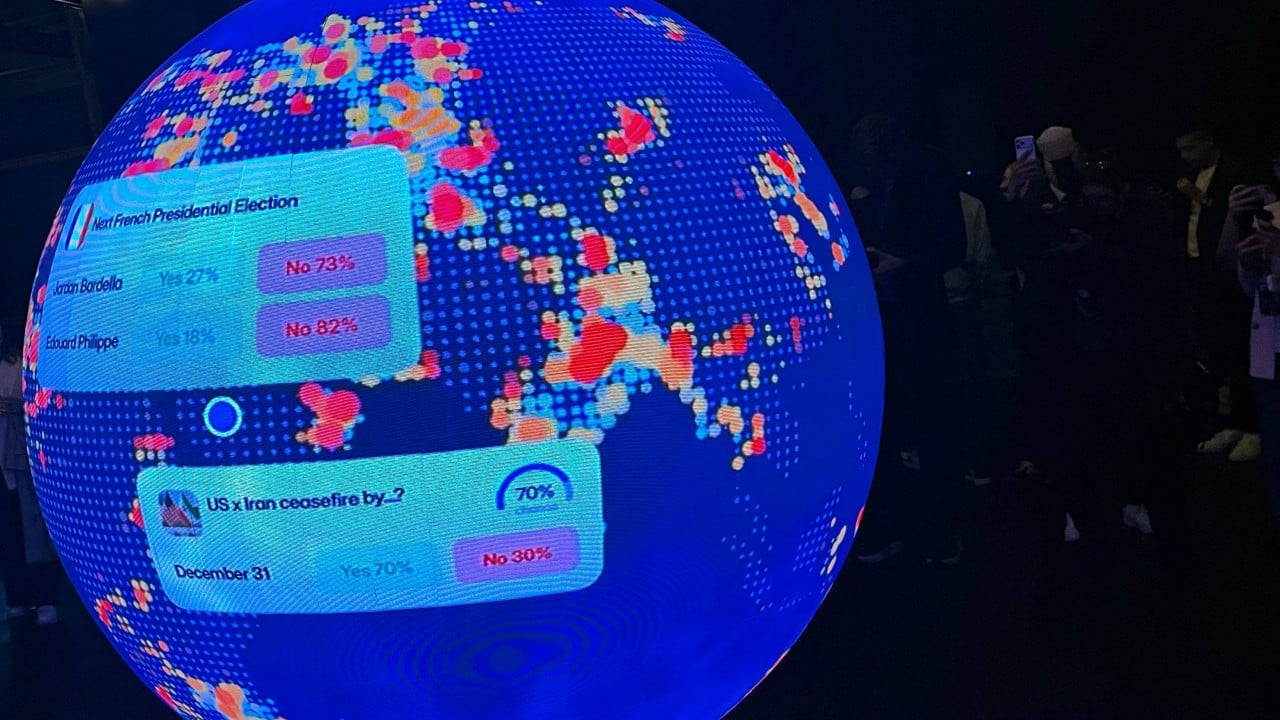
Governments are terrified of being proven wrong in real-time. While officials in Hong Kong and other financial hubs publicly frame their skepticism of prediction markets as a concern for "investor protection" or "market stability," the reality is much more visceral. These platforms do not just facilitate gambling; they aggregate private information into a single, public number that often contradicts official state narratives. When a government says a policy is working, but a billion-dollar liquidity pool says there is an 80% chance of failure, the state loses its monopoly on truth. This is why regulators are moving to aggressive containment strategies.
The collapse of the official narrative
Prediction markets operate on a simple, brutal principle: money talks. Unlike polls, which measure what people are willing to say to a stranger, or expert panels, which are often clouded by careerism, these markets force participants to back their convictions with capital. This creates a high-stakes environment where the "price" of an event—whether it is an election outcome, a central bank rate hike, or a military conflict—becomes a public benchmark of probability.
For a state that relies on managing public perception, this benchmark is a liability. If a government spends months promoting a specific economic outcome, and a decentralized market consistently bets against it, the state's credibility erodes every time the market ticks. We saw this during recent global health crises and geopolitical shifts. The markets were often weeks ahead of the official press briefings. This lead time creates a window of "truth" that governments cannot control, and that is a direct threat to the traditional top-down flow of information.
Why the gambling label is a convenient distraction
Regulators frequently hide behind the "anti-gambling" banner to shut down these platforms. By classifying prediction markets as mere betting shops, they can apply restrictive laws designed for casinos. However, this ignores the fundamental difference between a game of chance and a price discovery mechanism.
In a casino, the house sets the odds to ensure a profit, and the outcome is often tied to a random event like a spinning wheel. In a prediction market, the participants set the price based on information. It is much closer to a futures market than a poker table. Yet, by keeping them stuck in the "gambling" category, regulators prevent these platforms from achieving the scale and legitimacy required to become part of the formal financial infrastructure. This isn't about protecting Grandma’s retirement fund from a bad bet; it’s about preventing a parallel information economy from taking root.
The Hong Kong paradox
Hong Kong serves as a perfect case study for this tension. As a city that prides itself on being a global financial center, it should, in theory, embrace any tool that increases market efficiency. But the proximity to mainland Chinese regulatory philosophy creates a hard ceiling. Beijing prizes "social harmony" and "predictability." A decentralized market that fluctuates wildly based on rumors of policy shifts or leadership changes is the antithesis of that controlled environment.
When Hong Kong regulators signal wariness, they are signaling a preference for managed markets over free ones. They recognize that if they allow a truly open prediction market, they are essentially allowing a 24/7 referendum on their own performance. No bureaucracy, no matter how sophisticated, wants to be graded in real-time by a global pool of anonymous traders.
The threat to central bank supremacy
Central banks are perhaps the most vulnerable institutions in this new world. For decades, the Federal Reserve and its global counterparts have relied on "forward guidance"—the practice of telling the markets what they intend to do to influence current economic behavior. It is a psychological game as much as an economic one.
Prediction markets break this spell. If the Fed signals "higher for longer" on interest rates, but the prediction markets show a massive spike in the probability of a rate cut within three months, the Fed's guidance loses its teeth. The market's collective intelligence begins to outweigh the central bank's communication strategy.
- Information Asymmetry: Historically, governments held the best data. Now, decentralized networks of individuals—from supply chain managers to junior staffers—can trade on "micro-intelligence" that hasn't reached the state's ivory towers yet.
- Reflexivity: When a market predicts a certain outcome, it can actually influence that outcome. If a market predicts a currency devaluation, it can trigger the very capital flight that makes the devaluation inevitable. Governments call this "destabilizing." Traders call it "efficiency."
The algorithmic resistance
As regulators tighten the screws on centralized platforms like Kalshi or Polymarket, the technology is simply migrating to the blockchain. This is the "how" that keeps regulators awake at night. You can sue a CEO. You can seize a domain name. But you cannot easily shut down a smart contract running on a decentralized network.
These "on-chain" markets operate without a middleman. There is no central office to raid and no board of directors to subpoena. This creates a regulatory vacuum that the state cannot fill. Governments are used to having a "choke point"—a bank, a broker, or an exchange—where they can exert pressure. Without that choke point, the state is forced to consider much more Draconian measures, such as banning the underlying technology or criminalizing the act of participating in the market itself.
A hypothetical example of the intelligence gap
Imagine a situation where a government is negotiating a major trade deal. Officially, the talks are "progressing well." However, a mid-level logistics officer at a port, who sees the actual volume of goods being prepped for shipment, knows the deal is falling apart. In the old world, that information stays local or is leaked to a journalist. In the new world, that officer buys "No" shares on a prediction market. The price of the trade deal's success drops. Suddenly, the entire world knows the deal is in trouble, and the government's leverage at the negotiating table evaporates.
The optics of "protecting the public"
The standard argument from bodies like the CFTC in the United States or the SFC in Hong Kong is that these markets are "contrary to the public interest." They argue that people shouldn't be allowed to profit from "tragedies" or "political instability." This is a moralistic mask for a political problem.
We already allow people to profit from tragedies. Insurance companies do it. Oil speculators do it during wars. Short-sellers do it during corporate collapses. The only difference with prediction markets is that they make the process transparent and accessible to everyone, not just the institutional elite. By framing the issue as a moral one, governments avoid having to explain why they are afraid of the information these markets produce.
The struggle for the soul of the internet
This isn't just a niche financial debate; it is a battle over the future of the internet as a tool for collective intelligence. If governments succeed in pushing prediction markets into the shadows, they preserve the status quo where information is filtered through official channels. If they fail, we enter an era of radical transparency where the "official line" is just one data point among many.
The wariness we see in Hong Kong, Washington, and Brussels is the sound of an old guard realizing that "the truth" is no longer something they can mandate. It is something that is discovered, second by second, in a global ledger of bets. The states that survive this transition will be those that learn to use this data, rather than those that try to outlaw it. But for now, the instinct remains the same: if you can't control the message, kill the messenger.
Stop looking at these platforms as casinos and start looking at them as the world’s first honest news feeds.