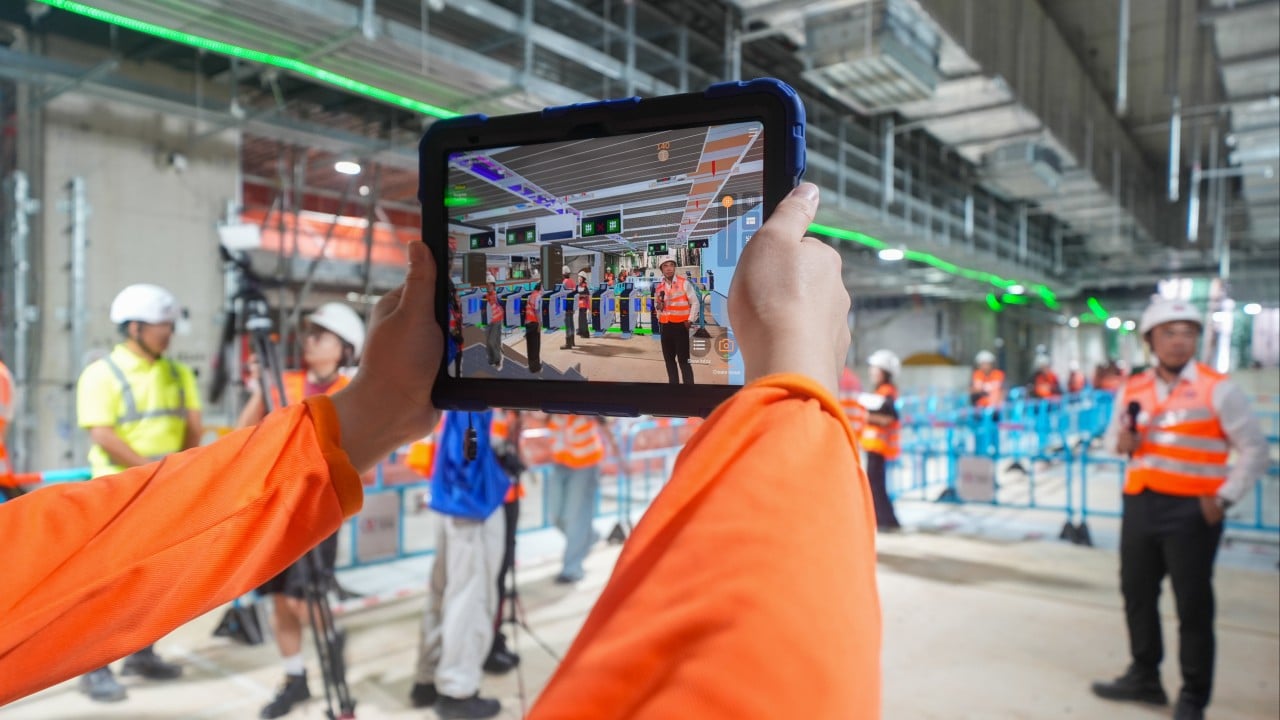
The Northern Link (NOL) is no longer just a line on a planning map. In the muddy construction sites of the New Territories, the MTR Corporation is currently executing a high-stakes pivot from traditional civil engineering to a digitized, software-driven workflow. By deploying Mixed Reality (MR) and Augmented Reality (AR) headsets, the rail giant is attempting to solve a chronic industry headache: the massive gap between a brilliant 3D design and the messy reality of a physical construction site.
This isn't about giving engineers fancy gadgets to play with. It is a calculated move to compress a timeline that would otherwise be bloated by human error and the constant need for rework.
The Death of the Paper Blueprint
For decades, the transition from a design office to a construction site involved a dangerous game of telephone. Architects created complex drawings, which were then printed onto flat sheets of paper for site workers to interpret. When a worker tries to translate a 2D line into a 3D pipe installation in a cramped underground tunnel, mistakes happen. A pipe is placed three inches to the left, hitting a structural beam that "wasn't supposed to be there." Work stops. Lawyers are called. Costs skyrocket.
The MTR is bypassing this entire cycle by using Building Information Modeling (BIM) combined with MR headsets. Instead of looking at a clipboard, an engineer on the Northern Link project puts on a visor and sees the "digital twin" of the station overlaid directly onto the raw concrete and rebar. They can see exactly where every bolt, cable tray, and ventilation duct is meant to go before a single hole is drilled.
Accuracy at Scale
The technical term for this is "spatial alignment." On the Kwu Tung Station project, the first phase of the Northern Link, the MTR is using these tools to verify installations in real-time. If the digital model shows a water main running through a specific corridor, the worker sees a holographic ghost of that pipe in their actual field of vision.
The immediate benefit is a reduction in "clash detection" delays. In traditional builds, you often don't realize two systems—say, electrical conduits and fire sprinklers—occupy the same physical space until the hardware arrives on site. By then, fixing it requires demolition or expensive custom fabrication. With the AR interface, these clashes are identified while the station is still a shell.
Efficiency here is measured in weeks saved. When you are building a rail link designed to connect the existing East Rail Line and Tuen Ma Line, every week of delay represents millions of dollars in lost economic productivity and increased overhead.
The Hardware Behind the Hype
The MTR isn't just buying off-the-shelf gaming gear. They are integrating industrial-grade headsets that can handle the dust, heat, and vibration of a Hong Kong construction site. These devices utilize LiDAR (Light Detection and Ranging) to constantly scan the surrounding environment, ensuring the holographic overlay stays pinned to the exact millimeter even as the user moves around.
This creates a continuous feedback loop. When a technician finishes an installation, they can take a "digital snapshot" through the headset. This data is uploaded back to the central BIM database, providing an as-built record that is 100% accurate. For the MTR, this is invaluable for future maintenance. Twenty years from now, when a pump needs replacing, the maintenance crew won't have to guess what is behind a wall. They will have a digital X-ray vision provided by the records created today.
Why This Matters for the Northern Link
The Northern Link is a unique beast. It serves as a critical artery for the Northern Metropolis, a massive urban development plan intended to house up to 2.5 million people. The project involves tunneling through varied geological strata and integrating with existing, operating rail lines. The margin for error is non-existent.
In the past, the MTR relied on "manual checking," a process where surveyors would use total stations and tape measures to verify coordinates. It was slow and prone to fatigue. By automating the verification process through MR, the MTR is shifting the burden of accuracy from the individual's eyesight to a calibrated laser system.
The Human Element and Resistance
Introducing this level of technology into a traditional industry isn't without friction. The construction sector is notoriously conservative. Foremen who have spent thirty years reading paper plans are often skeptical of "video games" on the job site.
To counter this, the MTR has had to treat the technology rollout as a cultural shift rather than just a technical one. The headsets are being framed as a safety tool. If a worker can "see" high-voltage lines or pressurized pipes hidden behind a partition before they start cutting, the site becomes demonstrably safer. Data-driven safety is a much easier sell to a skeptical veteran than "improved workflow efficiency."
The Cost of the Digital Frontier
While the MTR highlights the speed and accuracy, they are quieter about the upfront investment. High-fidelity BIM models and a fleet of MR headsets require significant capital. There is also the "data debt" to consider—the massive amount of processing power and storage required to maintain live 3D models of an entire subway station.
However, the industry math is shifting. The cost of a single major "clash" on a rail project—where a tunnel boring machine hits an unmapped utility or a structural error requires a month of redesign—dwarfs the cost of a hundred AR headsets. The MTR is effectively buying insurance against human error.
A New Standard for Transit Construction
The Northern Link is serving as a laboratory for the future of infrastructure. We are seeing a move away from "build and then measure" toward "simulate and then execute." The holographic scaffold used at Kwu Tung Station will likely become the mandatory standard for all future Hong Kong public works.
This isn't merely about building a station faster; it is about building a station that is a perfect mirror of its digital blueprint. In an era where public budgets are under intense scrutiny and the demand for rapid housing is at an all-time high, the MTR's bet on augmented reality is a necessity disguised as an innovation.
The next time you see an engineer on a construction site wearing a futuristic visor, understand they aren't looking at the world we live in. They are looking at the world that is about to exist, ensuring the two align perfectly before the concrete sets.
Stop looking for the blueprints on the table; they are already floating in the air.